
Your clients don't care about your reach; they care about their revenue. If you're spending 15 hours every week manually stitching together spreadsheets from ten different platforms, you're losing the battle for relevance. Mastering social media analytics for agencies in 2026 requires moving past vanity metrics and into the era of the automated command center.
It's exhausting to defend your strategy when a client questions the ROI of their social spend. You deserve a workflow that reflects your expertise. We'll show you how to transform fragmented data into a streamlined, AI-powered reporting engine that proves your agency's worth instantly. This guide covers the transition to automated, white-label dashboards and precise business growth attribution. We'll also dive into using strategic insights to inform next month's content, moving your team from reactive reporting to proactive leadership.
Key Takeaways
- Consolidate fragmented platform data into a unified system to move from manual reporting to strategic execution.
- Leverage AI-driven prescriptive insights to identify high-performing content patterns that manual analysis often misses.
- Implement a tiered KPI framework that connects awareness and engagement directly to client revenue and business growth.
- Scale your operations by automating social media analytics for agencies, reclaiming billable hours through streamlined data ingestion.
- Bridge the gap between data and creation by using performance insights to instantly inform AI-powered content drafting.
What is Social Media Analytics for Agencies?
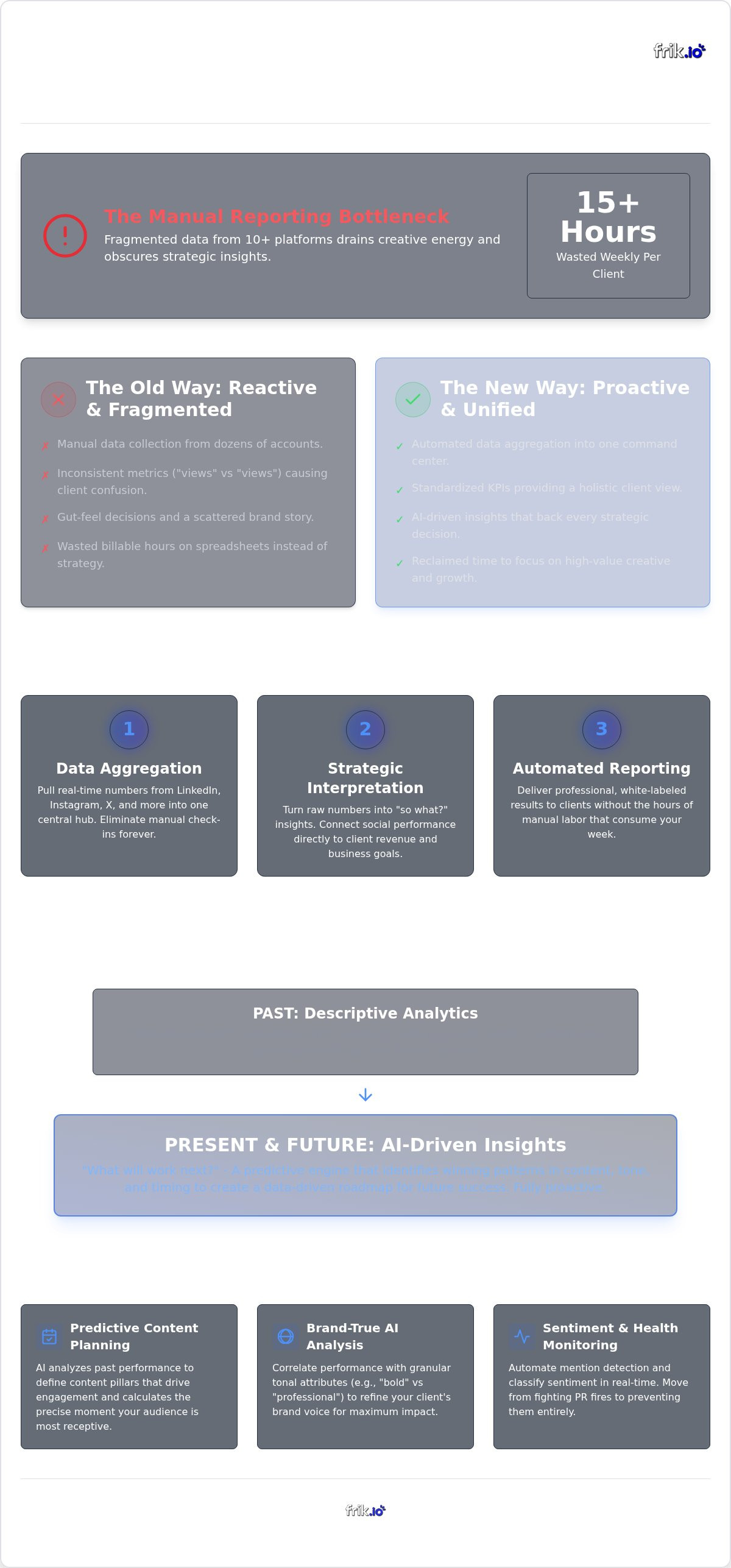
Analytics isn't just a collection of likes and comments. It's a unified system for tracking, interpreting, and reporting cross-platform performance. For individual creators, native platform insights might suffice. However, professional social media analytics for agencies requires a consolidated view that transforms raw data into actionable business intelligence. You're moving beyond "what happened" to "why it matters for the bottom line."
Consolidating data into a single workspace allows you to see the health of every client account at a glance. Agencies manage complex portfolios that demand a "Command Center" approach. You can't scale an agency by manually checking ten different apps every morning. High-performing teams focus on business metrics like conversion rates and audience sentiment. They leave vanity metrics like "likes" to the amateurs. Transitioning from fragmented numbers to a unified system is the only way to prove your strategic value.
The Three Pillars of Agency Analytics
Reliable analytics rests on three core functions that move your workflow from chaos to precision:
- Data Aggregation: Pulling real-time numbers from LinkedIn, Instagram, X, and other platforms into one central hub.
- Strategic Interpretation: Turning raw numbers into "so-what" insights that prove your strategy is actually working.
- Automated Reporting: Delivering professional, white-labeled results to your clients without the manual labor that usually consumes your Friday afternoons.
Why Native Insights are Failing Modern Agencies
Native tools aren't built for scale; they're built for individual users. Logging into 20 different accounts to grab manual screenshots is a massive time-sink that drains your team's creative energy. These platforms also use inconsistent metric definitions. A "view" on TikTok isn't the same as a "view" on LinkedIn, which creates confusion during client presentations.
This fragmentation prevents you from showing a holistic brand story across a client's entire digital footprint. When your data is scattered, your strategy looks scattered. Modern social media analytics for agencies eliminates this friction by standardizing definitions and centralizing every data point. You gain the clarity needed to make data-backed decisions instead of relying on gut feelings. Moving to an agency-grade system ensures your reporting is as sophisticated as the content you create.
The Evolution of Data: Moving to AI-Driven Insights
Data used to be a rearview mirror. You looked at last month's numbers and guessed what to do next. That's descriptive analytics. In 2026, social media analytics for agencies has evolved into a predictive engine. AI doesn't just count clicks. It recognizes patterns in visual composition, hook length, and tonal shifts that escape the human eye. This shift empowers agencies to move from reporting the past to predicting the future. You're no longer just showing what happened; you're proving what will work next.
Efficiency comes from understanding which version of a brand's personality actually converts. Brand-True AI correlates specific performance data with granular tonal attributes. If a "bold" tone performs significantly better than a "professional" one on LinkedIn, the system doesn't just report it. It learns. This level of insight ensures your creative output is always backed by hard evidence. It removes the creative guesswork that often leads to wasted ad spend and stagnant organic growth.
Protecting brand health is a constant requirement. Sentiment analysis provides a foundational layer for this protection by categorizing thousands of mentions into positive, neutral, or negative buckets. It's the difference between catching a PR spark and fighting a full-blown wildfire. Agencies that leverage these insights position themselves as proactive protectors of their clients' reputations.
Predictive Content Planning
Your data is a training manual. By feeding past performance into an AI workspace, you define which content pillars drive engagement for each specific client. Prescriptive analytics is a data-driven roadmap for future content strategy. AI-driven tools even calculate the precise moment your audience is most receptive. This removes the guesswork from scheduling and maximizes reach without increasing the workload. You can start building your AI-powered command center today to turn these predictions into reality.
Sentiment and Brand Health Monitoring
Manual monitoring is impossible at scale. Automating mention detection allows your team to focus on high-level strategy rather than scrolling through endless notifications. Real-time alerts act as your first line of defense in PR crisis management. This data also feeds back into your AI brand voice. You can refine the client's tone based on how the audience actually responds. It creates a feedback loop where data directly improves the quality and authenticity of every post.
Critical KPIs: The Agency ROI Framework
Metrics shouldn't just look good; they should drive decisions. Professional social media analytics for agencies requires a hierarchy that separates noise from signal. Awareness metrics like reach and impressions sit at the base. Engagement metrics like shares and saves form the middle. At the top, you have conversion metrics that directly impact the client's bank account. This structure ensures your team stays focused on what actually moves the needle.
Competitive benchmarking is another essential layer. Calculating "Social Share of Voice" (SSoV) allows you to quantify how much of the digital conversation your client owns compared to their rivals. It's a powerful way to justify budget increases. When a competitor dominates a specific niche, SSoV data provides the evidence needed to pivot your strategy. It turns a "feeling" of being behind into a clear, data-backed objective.
Linking social activity to website goals remains the ultimate attribution challenge. You must track the journey from a LinkedIn post to a CRM lead. Use UTM parameters and conversion pixels to close the gap. Even when results are negative, they aren't failures. They're optimization opportunities. High bounce rates on a specific landing page tell you exactly where the friction is. Presenting these insights as a roadmap for improvement builds more trust than hiding the numbers.
Vanity Metrics vs. Value Metrics
Follower count is a secondary signal. It's often inflated and doesn't guarantee reach. Instead, focus on "Engagement Rate per Impression." This metric tells you how effectively your content resonates with the people who actually see it. It's a much more accurate predictor of brand health. For agencies focused on growth, "Conversion Rate" and "Customer Acquisition Cost" (CAC) from social channels are the only numbers that truly matter. Community growth serves as a proxy for brand loyalty, indicating that your content is building a sustainable audience rather than just a fleeting moment of attention.
Proving ROI to Skeptical Clients
Skeptical clients need proof that transcends the social platform. Create "Blended Reports" that combine social data with CRM or web traffic stats. This shows the direct line between a viral post and a spike in qualified leads. To keep clients engaged, use a "Three-Tier" reporting model. Start with a high-level Executive Summary for the C-suite. Follow with a Strategy Review for the marketing manager. Finish with Granular Data for the technical team. This approach ensures every stakeholder gets exactly the information they need to approve next month's budget. Use historical benchmarks to highlight month-over-month (MoM) growth, proving that your agency is a long-term asset, not a short-term expense.
Streamlining the Reporting Workflow for Scale
Scaling an agency is impossible if your team is trapped in spreadsheet hell. You can't hire your way out of a broken process. Efficiency in 2026 is about building a reporting engine that runs while you sleep. By streamlining your social media analytics for agencies, you reclaim billable hours and refocus your talent on high-level strategy. This isn't just about saving time; it's about creating a scalable foundation for growth.
Standardizing metric definitions is the first non-negotiable step. If your reports treat LinkedIn impressions differently than Instagram reach, you'll spend half your client meetings explaining discrepancies. Once your definitions are locked, automate data ingestion into an AI social media management platform. This ensures your data flows into a central hub without the risk of manual entry errors. This setup allows you to transition to the third step: launching real-time Client Approval Portals. These portals replace messy email threads and provide a single source of truth. Fourth, schedule automated dashboard delivery for key stakeholders. This ensures they see your value every week without you lifting a finger. Finally, host a "Strategy Pivot" meeting. Use this time to interpret data trends and adjust your tactics for the following month. This moves the conversation from "what we did" to "what we're doing next," which is where the real agency value lies.
The Power of the Client Approval Portal
Static PDF reports are relics of the past. Modern clients demand interactive, real-time dashboards that offer a window into their brand's health at any moment. This transparency builds long-term retention and trust because it eliminates the "black box" of agency work. Integrating feedback loops directly into the analytics workspace allows for immediate collaboration. When a client can see a conversion spike and leave a comment in the same view, your agency becomes an indispensable part of their team.
White-Labeling: Your Agency, Your Brand
Professional branding on your data is essential for perceived value. White-labeling your dashboards ensures that every insight delivered is associated with your agency's expertise. You aren't just passing along platform data; you're providing a proprietary perspective. Customize these dashboards to reflect the specific KPIs each client cares about, whether it's lead generation or community sentiment. This positions your agency as a high-end, tech-enabled partner rather than just another service provider. Mastering social media analytics for agencies means owning the presentation as much as the data itself. Start scaling your agency with a unified analytics command center today.
Mastering Agency Performance with frik.io
frik.io serves as the Efficient Command Center for your entire operation. It bridges the gap between raw data and creative execution. Most agencies treat these as separate silos, which leads to wasted time and misaligned strategies. By unifying social media analytics for agencies with content generation, we eliminate the friction that slows your team down. You move from reviewing "what happened" to drafting "what's next" in seconds. This is the sophisticated solution for teams that have outgrown manual workflows and fragmented tools.
Operational chaos ends where a unified system begins. Unified workspaces allow your team to manage dozens of client brands from a single foundational layer. You no longer need to toggle between multiple browser tabs to compare platform performance. Instead, you gain a clear, high-velocity view of cross-platform health across every client account. This visibility empowers you to reclaim your Friday afternoons. Automation handles the ingestion and formatting of reports, leaving you free to focus on high-level strategic leadership rather than data entry.
From Data Insights to Content Autopilot
The system uses real-time analytics to suggest new content pillars automatically. It identifies high-performing patterns and builds on that success without manual intervention. You can scale your client list without increasing your team's headcount. Every draft generated within the platform is backed by performance data and Brand-True AI training. This ensures your content sounds authentic and stays on-brand. It's not just about generating volume; it's about ensuring every post is a strategic asset. You move from a state of creative block to a state of streamlined productivity instantly.
Getting Started: Your 30-Day Analytics Roadmap
Setting up your first unified workspace on frik.io is a straightforward process. First, connect your client accounts to the central hub. This allows the AI to ingest past performance data and identify successful patterns. Next, train the AI on your client's specific brand voice to ensure consistency across all channels. By the end of the month, you'll deliver your first "set-it-and-forget-it" report. This roadmap takes you from manual reporting panic to a state of automated precision. You'll provide deeper insights with less effort, proving your agency's value with every dashboard update. Professional social media analytics for agencies should be a source of strength, not a weekly burden.
Own Your Agency’s Performance Command Center
The era of manual data entry is over. Agencies that continue to struggle with fragmented spreadsheets will be left behind by those who embrace an automated, AI-powered command center. You've seen how a unified approach to social media analytics for agencies transforms operational chaos into a high-velocity reporting engine. By focusing on business-critical KPIs and leveraging prescriptive insights, you move from being a service provider to a strategic growth partner.
It's time to reclaim your creative energy. Stop losing hours every week to the reporting churn and start delivering the transparent, data-backed value your clients demand. With unified analytics for 10+ platforms and automated client approval portals, you can scale your portfolio without burning out your team. AI-driven strategic insights ensure your next move is always backed by performance data. This is the sophisticated secret weapon for modern digital workflows.
Stop the manual reporting madness. Scale your agency with frik.io today.
You have the roadmap for 2026. Take the first step toward a more efficient, profitable future today.
Frequently Asked Questions
What is social media analytics for agencies exactly?
It's a unified system for tracking and interpreting cross-platform performance. Unlike native platform insights, agency-grade analytics consolidate data into a single command center. This allows teams to measure business-critical KPIs like conversion rates and sentiment across all client accounts. It moves the needle from simple data collection to strategic business intelligence. High-performing agencies use these systems to prove ROI and justify their strategy to stakeholders.
Why is manual reporting a risk to agency growth?
Manual reporting consumes excessive billable hours and introduces the risk of human error. Spending 15+ hours weekly on spreadsheets prevents your team from focusing on high-level strategy. It limits your ability to scale because your overhead increases with every new client. Automation eliminates this bottleneck, allowing you to manage more accounts without increasing headcount. It transforms a tedious chore into a scalable, profit-driving workflow.
How does AI improve social media analytics in 2026?
AI shifts the focus from descriptive to prescriptive analytics. In 2026, AI identifies high-performing content patterns and suggests new content pillars based on real-time data. It also monitors brand health through sentiment analysis and correlates performance with specific brand tones. This ensures every post is optimized for maximum reach and authenticity before it even goes live. It acts as a proactive strategist rather than a passive observer.
What are the most important KPIs to show a social media client?
Focus on value metrics that impact the client's bottom line. While awareness is important, conversion rates and customer acquisition cost (CAC) are the primary indicators of ROI. You should also include "Social Share of Voice" to show how they stack up against competitors. Providing a tiered report ensures that every stakeholder understands the data's impact. Use social media analytics for agencies to bridge the gap between social activity and revenue.
Can I white-label my analytics reports for clients?
Yes, professional social media analytics for agencies should always be white-labeled to reinforce your brand's authority. Sophisticated platforms allow you to customize dashboards with your agency's logo and colors. This positions your team as a high-end, tech-enabled partner. It ensures that every insight you deliver is associated with your proprietary expertise rather than just a third-party tool. It's a foundational step for scaling your brand.
How often should agencies send performance reports to clients?
Most agencies find success with a monthly deep-dive report supplemented by weekly automated snapshots. Real-time client portals are the modern standard because they provide transparency without manual labor. This approach keeps clients informed about their brand's health without overwhelming them with data. Consistent reporting builds trust and proves the long-term value of your ongoing social strategy. It ensures your agency remains top-of-mind during every budget review.
What is the difference between social listening and social analytics?
Social analytics focuses on the performance of your own content, such as reach and engagement rates. Social listening tracks broader conversations and brand mentions across the entire digital landscape. Analytics tells you how your strategy is working, while listening tells you how the market perceives the brand. Both are essential for a complete understanding of brand health and competitive positioning. They work together to inform your future content pillars.
How do analytics tools handle data privacy and compliance?
Modern tools utilize official API connections to ensure all data collection is compliant with platform terms and privacy laws. They focus on aggregated, anonymized data to protect individual user privacy. Professional platforms also implement secure user authentication and encrypted data storage. This ensures your client's data remains protected while providing the granular insights needed to drive business growth. It's a critical layer of protection for any agency managing sensitive client information.


