
The distance between a creative spark and a high-performing post shouldn't feel like an operational marathon. If you're searching for the best tools for content creation and social media management, you've likely felt the exhaustion of staring at a blank caption field or the frustration of manually tailoring messages for five different platforms. It's a friction point that kills momentum and drains your team's creative energy.
Mastering the modern social media stack isn't just about finding a simple scheduler anymore. It's about building a unified system where brand-consistent AI handles the heavy lifting and client approvals happen in clicks, not messy email threads. You need a setup that bridges the gap between creative drafting and high-velocity publishing.
This guide breaks down the seven essential tools you need to command your digital presence in 2026. You'll discover how to streamline your publishing workflow, maintain brand integrity with AI, and scale your client management with ease. It's time to move from operational chaos to a state of streamlined productivity.
Key Takeaways
- Eliminate the "Silo Trap" by moving your creative drafting and scheduling into a single, unified system.
- Discover why the best tools for content creation and social media management in 2026 prioritize context-aware AI over generic templates.
- Transition from manual time slots to autopilot scheduling to maintain a high-velocity publishing rhythm without the burnout.
- Implement a 4-step framework that uses AI to generate platform-specific variations while keeping your brand voice consistent.
- Streamline client management by replacing fragmented email threads with professional, integrated approval portals.
The Evolution of Social Media Workflows: From Silos to Systems
Social media success in 2026 isn't defined by the number of apps in your dock. It's defined by how seamlessly they communicate. For years, marketing teams have struggled within the "Silo Trap," a fragmented workflow where creative drafting, asset storage, and post scheduling live in separate, disconnected environments. This friction doesn't just slow you down; it creates a ceiling on your growth. The best tools for content creation and social media management have shifted from being simple utilities to becoming unified workspaces that bridge these gaps.
The demand for high-velocity content is relentless. Audiences expect a constant stream of high-quality, platform-native content that feels authentic. Meeting this demand without a massive headcount requires a system, not just a tool. Centralize your operations into a single command center to eliminate the cognitive load of switching tabs. This approach moves your team from a state of operational chaos to a state of streamlined productivity, where strategy takes priority over clerical tasks.
Why Manual Tailoring is a Growth Killer
Rewriting the same announcement for LinkedIn, Instagram, and X is a waste of creative talent. This manual tailoring is a significant time-sink that prevents teams from scaling their output. Modern systems solve this by using "create once, adapt everywhere" logic. Instead of manual edits, automation handles platform-specific formatting, hashtag placement, and character limits instantly. Transition to automated tailoring to maintain a broad digital footprint without multiplying your workload. You gain the reach of a large agency while keeping the agility of a small team.
The Shift Toward AI-First Management
Legacy schedulers are essentially digital calendars; they're passive tools that wait for you to provide finished assets. Modern AI-integrated platforms serve as strategic co-pilots. They bridge the gap between a blank page and a published post by assisting in the drafting process from the start. Generic AI isn't enough for professional brands. The industry standard has moved toward Brand-True AI. This technology learns your specific voice and values to ensure every output is consistent with your identity. Implement a brand-true foundation to ensure your automation never feels robotic or disconnected from your mission.
Best Tools for Content Creation: Drafting with Precision
Drafting content is the primary bottleneck for most digital teams. In 2026, the best tools for content creation and social media management are those that prioritize the speed of the drafting-to-approval pipeline. High-velocity teams have outgrown manual file transfers and disjointed feedback loops. They need precision tools that export directly to a central command center. This integration ensures that a creative spark becomes a live post in minutes instead of days.
Visual Content: Beyond Basic Templates
Visual staples like Canva and CapCut remain essential, but their role has evolved. They are no longer just design apps; they are components of a larger ecosystem. Professional teams now focus on interoperability to maintain brand consistency at scale. Using high-fidelity assets across multiple platforms requires a seamless transition from design to delivery. For example, an integrated SVG converter tool allows you to maintain vector precision without leaving your workflow.
Assess your visual stack with this interoperability checklist:
- Direct API export to your management hub.
- Real-time syncing of brand kits and color palettes.
- Support for high-velocity video rendering and platform-specific ratios.
- Centralized asset storage that eliminates duplicate uploads.
AI Copywriting: Maintaining a Brand-True Voice
Generic AI outputs often feel hollow and disconnected. The industry has moved toward context-aware drafting tools that understand more than just grammar. They understand your identity. This is the era of Brand-True AI. We define Brand-True AI as a context-aware generation system trained on a specific organization's style guide, values, and historical voice to ensure every output is indistinguishable from human-authored content. This level of precision is a foundational requirement for modern scaling.
Select tools that allow you to upload comprehensive style guides for training. This capability moves your team from a state of constant editing to a state of high-level oversight. When your AI understands the nuance of your tone, you eliminate the friction of creative block and the risk of brand dilution. It's a shift from drafting in a vacuum to generating results that resonate instantly with your audience.
Top Social Media Management Tools for Scheduling and Analytics
Selection of the right platform defines your operational ceiling. Legacy giants like Hootsuite provide robust calendars and basic listening capabilities. However, professional teams in 2026 require more than just a grid of time slots. They need the best tools for content creation and social media management that integrate drafting logic with high-velocity distribution. This is where frik.io differentiates itself. It acts as an efficient command center that handles the transition from asset to post without manual intervention, moving you from operational chaos to a state of streamlined productivity.
Centralize your community management through a unified inbox. This ensures every interaction is captured and addressed, preventing missed engagement opportunities that can damage brand reputation. When your scheduling and engagement live in the same workspace, your team maintains a consistent presence without the friction of switching apps. It's a foundational layer for building trust with your audience at scale.
Agency-Scale Scheduling: Managing Multiple Brands
Managing multiple brands requires strict compartmentalization. Use dedicated workspaces to ensure brand assets, calendars, and analytics never overlap. The real growth killer in agency work is the approval bottleneck. You can't scale if you're stuck in email threads or spreadsheet reviews. Moving to an integrated client approval portal provides immediate relief. It allows stakeholders to review, comment, and approve posts in a professional, branded environment. This transparency builds confidence and speeds up the publishing cycle.
Combine these portals with Autopilot scheduling to maximize efficiency. Instead of picking manual time slots, deploy data-driven automation that publishes when your audience is most active. This "set-it-and-forget-it" convenience allows you to scale your output without increasing your headcount. You gain the capabilities of a large-scale operation while remaining agile. It moves the focus from clerical entry to strategic growth.
Analytics: Moving from Vanity Metrics to ROI
Stop chasing likes and focus on metrics that drive business decisions. In 2026, the industry has shifted toward cross-platform ROI and conversion attribution. Modern platforms deliver automated reporting that pulls data from every touchpoint into a single, digestible dashboard. This saves hours of manual data entry and provides the "insider" knowledge needed to refine your creative strategy. You see exactly which posts move the needle and which ones just take up space.
Use these insights to identify which content variations perform best and double down on those patterns. When you can see exactly how your Brand-True AI content impacts your bottom line, you move from guessing to executing with confidence. Real-time data allows you to pivot quickly, ensuring your strategy remains as innovative as the tools you use to deploy it. It's about precision, not just volume.
Building an Integrated Workflow: The 4-Step Framework
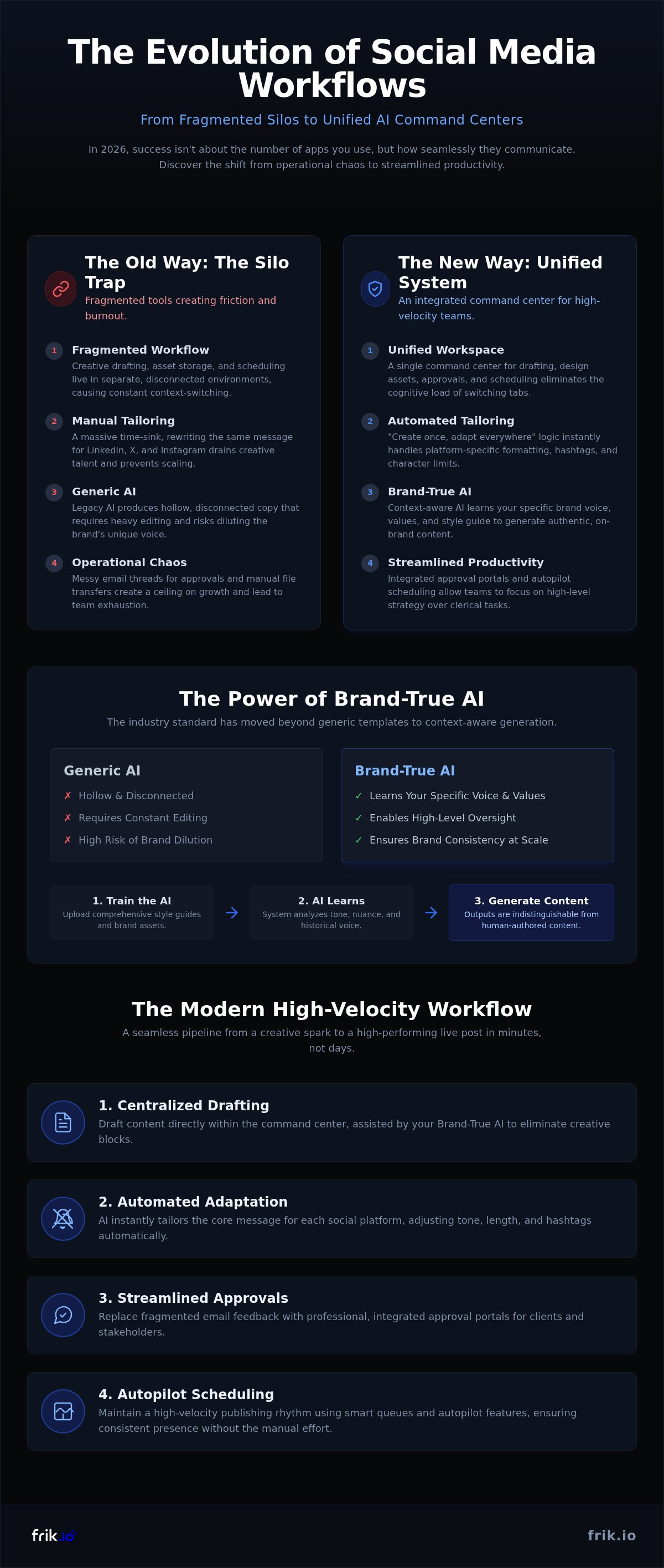
Fragmented tools create fragmented results. To truly master the best tools for content creation and social media management, you must move beyond a collection of apps and adopt a unified system. A modern workflow doesn't just store assets; it moves them through a logical progression from ideation to analytics. This 4-step framework eliminates the friction that typically stalls creative teams and allows you to scale without adding complexity.
- Step 1: Centralize the Creative Brief and Asset Storage. Establish a single foundational layer for all ideas and media. This prevents the "Silo Trap" where strategy lives in one app and files live in another.
- Step 2: Utilize AI to Draft Platform-Specific Variations. Use your centralized brief to generate tailored captions for every channel instantly. This ensures your message remains consistent while respecting the unique culture of each platform.
- Step 3: Implement a Client Approval Portal. Move finished drafts into a professional review environment. This step replaces messy email threads with a clear, branded interface for stakeholder feedback.
- Step 4: Automate Publishing and Monitor Performance. Deploy your content using autopilot scheduling. Use real-time data to identify what works and feed those insights back into Step 1.
The Client Approval Portal: Ending the Email Chain
Spreadsheets and email threads are where great campaigns go to die. They lack the professionalism and clarity required for high-level operations. A dedicated client approval portal provides a sense of "quiet authority," signaling to stakeholders that your process is disciplined and reliable. By providing a single, secure link for reviews, you eliminate version control issues and reduce revision cycles significantly. Collaborative feedback loops happen directly on the post draft, allowing your team to make adjustments and secure final sign-off in a fraction of the time. This shift alone can save agencies dozens of hours per month in administrative overhead.
Training Your AI on Your Unique Style Guide
The secret to high-velocity publishing is an AI that actually sounds like you. To achieve this, you must move beyond generic prompts and actively train your system on your brand's unique style guide. Start by "feeding" the AI your top-performing historical posts to establish a baseline for tone and rhythm. Equally important is the implementation of negative constraints. Explicitly define what the AI should never say, such as specific buzzwords, forbidden competitors, or off-brand slang. The result is a Brand-True AI that drafts captions indistinguishable from your best human writers. This level of precision allows you to generate high-quality drafts at a speed that manual methods can never match.
Ready to move from operational chaos to a state of streamlined productivity? Start building your integrated workflow with frik.io today and experience the relief of a unified command center.
Frik.io: The Unified AI Command Center for Professional Teams
Manual methods eventually hit a ceiling. If your team is struggling with the friction of disjointed apps, it's time for a foundational shift toward a unified system. frik.io serves as an efficient command center for those seeking the best tools for content creation and social media management. It is built for teams that have outgrown the limitations of legacy platforms and require a more sophisticated, AI-driven approach to digital operations. By integrating every step of the content lifecycle; it moves you from chaos to high-velocity publishing.
The platform positions itself as a "secret weapon" by unifying drafting and distribution. At its core is Brand-True AI content generation. This isn't a generic text generator; it's a context-aware system that learns your brand’s specific nuances. By training on your unique style guide and top-performing posts, it produces drafts that resonate with your audience immediately. This eliminates the "silo trap" where creative drafting and scheduling live in different worlds. You get the relief of knowing your automation is always on-brand and high-quality.
Why frik.io Wins for Agencies
Agencies face the unique challenge of maintaining distinct voices for dozens of clients simultaneously. Professional workflows require the best tools for content creation and social media management to remain competitive in a high-velocity market. frik.io solves this through multi-network management within a single, organized workspace. You can scale your operations without increasing your administrative burden. Automated platform tailoring handles the technical nuances of every post; ensuring your captions are optimized for the specific culture of each social channel. This high-velocity output is supported by transparent pricing designed for teams that are ready to grow. You focus on strategy while the platform handles the repetitive execution.
Getting Started: From Chaos to Streamlined Productivity
Transitioning to a unified system provides immediate relief. The onboarding process is designed for speed, allowing you to train the AI on your brand voice and consolidate your calendar in a single afternoon. You move quickly from a state of operational chaos to a state of streamlined productivity. The integration of a client approval portal ensures that feedback is professional and centralized, removing the friction of email chains once and for all. Stakeholders can approve posts via dedicated links, maintaining a sense of quiet authority throughout the process. It's a shift from manual labor to high-level command, where autopilot scheduling ensures your content reaches the audience at the peak of engagement.
Experience the Command Center-Start your frik.io trial today and see how a unified AI hub transforms your digital workflow.
Command Your Digital Presence with a Unified Stack
The transition from fragmented apps to a unified command center is no longer optional for teams that want to scale. By moving away from manual tailoring and spreadsheet approvals, you reclaim the creative energy needed to drive strategy. The best tools for content creation and social media management in 2026 are those that bridge the gap between ideation and execution through a single, foundational layer. You've seen how integrating brand-true AI and professional portals can move your operations from chaos to streamlined productivity.
Success in this high-velocity landscape requires precision and speed. Deploying AI brand voice training ensures your identity remains intact, while client approval portals and autopilot scheduling remove the friction that stalls growth. It's time to stop managing individual posts and start commanding a complete system that works for you. You have the framework; now you need the hub to execute it.
Master your social media workflow with frik.io and experience the relief of a truly integrated workspace. Your team is ready to lead the conversation with confidence and efficiency.
Common Questions About Modern Social Media Workflows
What are the most essential tools for a social media manager in 2026?
Unified command centers, brand-true AI generators, and automated tailoring tools are the foundation. These systems bridge the gap between drafting and distribution. You need tools that handle asset management, multi-platform scheduling, and analytics in a single workspace. This setup eliminates the cognitive load of switching apps. Focus on tools that prioritize interoperability and high-velocity publishing to keep your strategy agile and your workflow consistent.
Can AI really write in my brand’s specific voice?
Yes, modern systems use brand-voice training to replicate your unique tone and values. By feeding the AI your style guide and top-performing historical posts, it learns specific nuances like rhythm and vocabulary. This Brand-True AI ensures every output sounds like your best human writer. It moves you from constant editing to high-level oversight. You gain the efficiency of automation without sacrificing the authenticity of your brand identity.
How do client approval portals improve agency workflows?
Portals eliminate the friction of messy email chains and spreadsheet reviews. They provide a professional, branded interface where stakeholders can review, comment, and approve drafts in real-time. This quiet authority signals discipline and reliability to your clients. You reduce revision cycles and version control errors significantly. Moving to a dedicated portal allows your team to focus on creative execution rather than administrative follow-ups.
Is it better to use separate tools for creation and management or an all-in-one platform?
All-in-one platforms are now the industry standard for professional teams. Using the best tools for content creation and social media management within a single hub prevents the Silo Trap where assets and schedules are disconnected. A unified workspace centralizes your creative brief and distribution logic. It ensures that every post is platform-optimized and brand-consistent. You save time, reduce costs, and maintain a higher velocity of publishing.
What is the best way to schedule posts for multiple social media networks at once?
Use a centralized dashboard that offers multi-platform tailoring and autopilot scheduling. This approach allows you to create a core message once and adapt it for LinkedIn, Instagram, and X with a single click. High-velocity systems handle the technical formatting and character limits automatically. You maintain a broad digital footprint without multiplying your manual workload. It's the most efficient way to manage complex, cross-platform campaigns at scale.
How does autopilot scheduling differ from traditional social media calendars?
Traditional calendars require manual time-slot selection; autopilot scheduling uses data to publish when your audience is most active. It's a set-it-and-forget-it system that maintains a consistent rhythm without your constant intervention. This automation ensures your content hits peak engagement periods every time. You move from clerical scheduling tasks to strategic oversight. It's the difference between a static plan and a dynamic, high-velocity distribution engine.
Do I still need a graphic designer if I use AI content creation tools?
Yes, but their role shifts from repetitive production to high-level creative direction. AI tools handle the high-volume tasks like platform resizing and basic template generation. This allows your designer to focus on complex brand identity work and high-fidelity assets. The best tools for content creation and social media management empower your creative team rather than replacing them. You get better visual consistency across your entire digital presence.
How can I track social media ROI across different platforms effectively?
Implement automated reporting tools that pull cross-platform data into a single, digestible dashboard. Focus on conversion attribution and ROI metrics rather than vanity likes. Modern platforms identify which content variations drive the most business value. Use these insights to refine your creative strategy in real-time. Centralizing your data allows you to see the true impact of your social media efforts on your organization's bottom line.


