
What if your social media management software did more than just schedule posts? Most agencies are currently trapped in a cycle of manual tailoring and robotic AI drafts that require more editing than they're worth. You're likely managing a dozen different platforms while chasing clients through endless email chains for a single approval. It's an operational bottleneck that prevents your team from scaling. You need a command center, not just a calendar.
We understand the frustration of tools that promise efficiency but deliver extra work. This guide explores the next generation of social media management software designed for the 2027 landscape. You'll discover how to deploy AI that mirrors your specific brand voice and utilizes unified workspaces to eliminate friction. We'll preview the top platforms that automate content creation and accelerate client sign-offs. This transition moves your agency from operational chaos to streamlined productivity. By the end of this guide, you'll have a clear roadmap to a more professional, automated workflow.
Key Takeaways
- Shift from basic schedulers to AI-first command centers that provide a unified operational layer for your agency's digital presence.
- Discover how to train your social media management software on unique style guides to produce brand-true content that requires minimal editing.
- Replace manual tailoring and fragmented email chains with centralized workspaces and collaborative client approval portals.
- Move toward an "AI collaboration" model where technology handles the heavy lifting while your team focuses on final strategic sign-offs.
- Identify the high-end tools that empower agile teams to deliver professional, enterprise-level results with streamlined productivity.
What is Modern Social Media Management Software?
Modern social media management software has transcended its origins as a basic scheduling tool. In 2027, it serves as a unified operational layer for your entire digital brand presence. Agencies have outgrown fragmented apps that only solve the "when" of posting. Today, sophisticated teams require a command center that manages complex workflows, ensures brand consistency, and integrates intelligence at every touchpoint. It's the difference between a digital calendar and a strategic engine. You're no longer just managing accounts; you're orchestrating a multi-channel narrative from a single workspace.
The Evolution from Scheduling to Intelligence
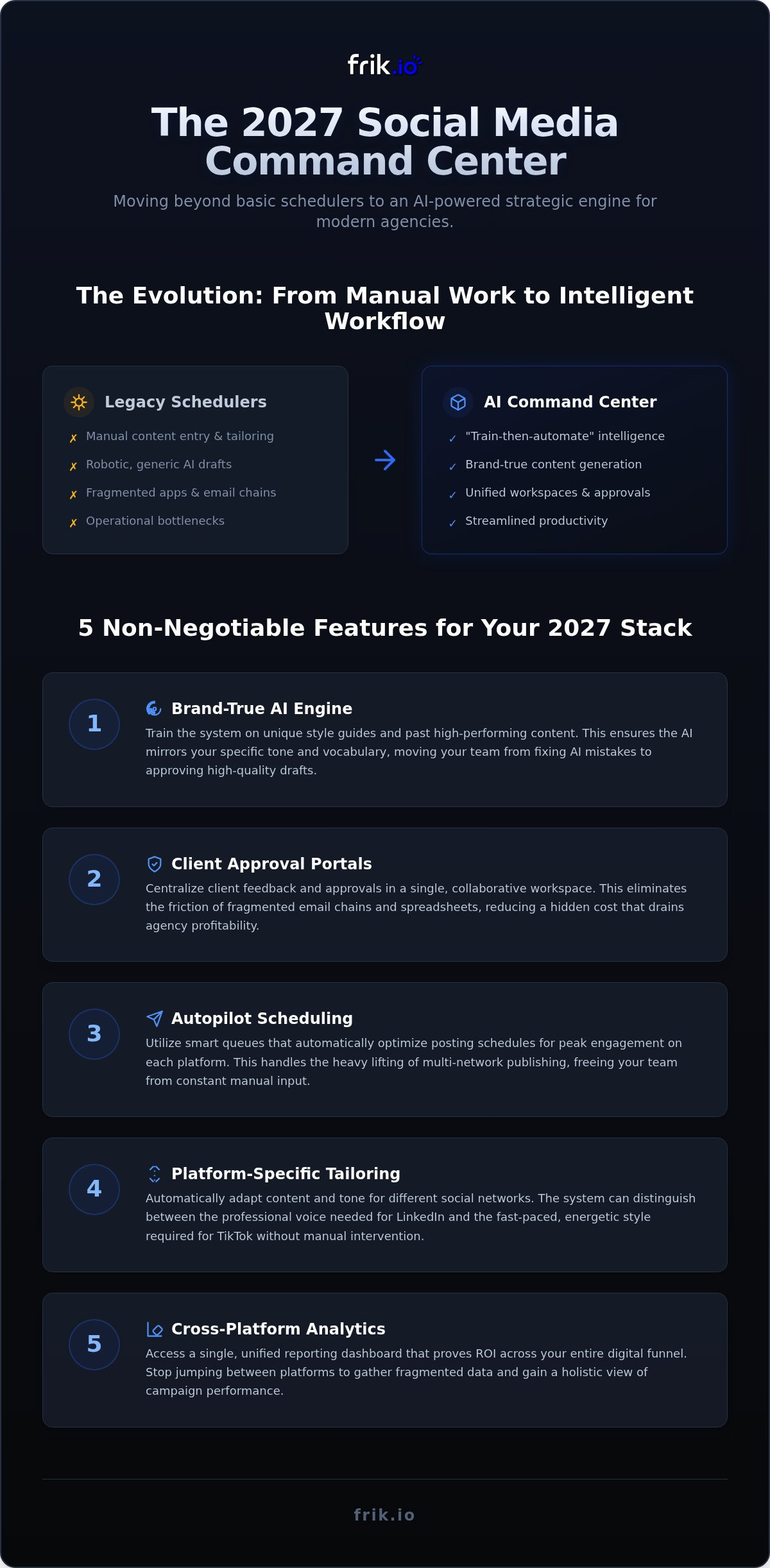
Early digital tools focused strictly on the logistics of distribution. They solved the problem of manual entry but ignored the heavy creative burden of content production. These legacy systems asked for the "when" while leaving the "what" entirely to the user. Modern intelligence engines have flipped this script. Instead of simply pushing a button, you now train a system to understand your brand soul. This shift from "set-it-and-forget-it" to "train-then-automate" ensures every post feels authentic rather than robotic. AI is no longer a sidebar feature; it's the core engine that generates drafts, suggests strategy, and maintains your unique voice across every platform. It moves your team from manual content entry to high-level strategic oversight, providing the relief of a streamlined workflow.
Core Components of a 2027 Tech Stack
A high-end stack isn't a collection of disparate tools. It's a foundational system designed for scale. To stay competitive, your modern social media management software must provide more than just a grid view. You need a suite of features that address the specific frustrations of modern digital workflows. A sophisticated stack should include:
- Unified Workspaces: Centralized visibility across every social channel to eliminate platform jumping and fragmented data.
- Brand-Voice Engines: AI trained on specific style guides to produce drafts that require minimal human intervention and zero "robot" phrasing.
- Automated Workflows: Systems like frik.io's autopilot scheduling that handle the heavy lifting of multi-network publishing without losing precision.
- Collaborative Loops: Integrated client approval portals that remove the friction of endless email chains and spreadsheets.
By integrating these components, you move from operational chaos to a state of empowered productivity. This foundational layer allows your team to focus on results rather than the mechanics of posting. You're building a scalable operation that relies on precision and intelligence, ensuring that your agency remains at the cutting edge of digital marketing.
5 Non-Negotiable Features for Your 2027 Social Stack
High-performance social media management software must do more than just broadcast content. It needs to act as a foundational layer that absorbs your brand identity and automates your busiest workflows. If your current tool still requires you to manually edit every "robotic" AI draft, it's a liability, not an asset. In 2027, the standard has shifted toward features that solve operational friction and creative fatigue. Look for these five capabilities to ensure your stack is built for scale:
- Brand-True AI: Train the system on your unique style guide to ensure every post sounds human and on-brand.
- Client Approval Portals: Centralize feedback to eliminate fragmented email chains and spreadsheets.
- Autopilot Scheduling: Use smart queues that optimize for peak engagement without constant manual input.
- Platform-Specific Tailoring: Distinguish between the professional tone of LinkedIn and the fast-paced energy of TikTok automatically.
- Cross-Platform Analytics: Access unified reporting that proves ROI across your entire digital funnel.
Brand-Voice Training: The AI Differentiator
Generic AI prompts fail because they lack brand nuance. Most software offers "AI help" that produces sterile, uninspired text. A sophisticated stack allows you to upload specific style guides and past high-performing content. This training process ensures the AI mirrors your specific tone and vocabulary. For agencies, this capability is the key to maintaining consistency across dozens of diverse client accounts. You move from fixing AI mistakes to approving high-quality drafts. This level of precision is what separates an efficient command center from a basic scheduler.
Seamless Client Approval Workflows
Friction in the approval process is a hidden cost that drains agency profitability. Chasing clients through spreadsheets and email chains leads to errors and frustration. Dedicated portals solve this by providing a unified workspace for review. Clients view live previews of posts and leave feedback in one central location. This transparency builds long-term trust and allows your team to scale without increasing administrative overhead. Real-time collaboration replaces static document reviews, keeping your creative momentum high.
Most tools treat every platform as a generic text box. However, the difference between a LinkedIn thought-leadership piece and a TikTok caption is immense. Modern software uses platform-specific intelligence to adjust formatting, hashtags, and engagement hooks automatically. It understands the context of the network, ensuring your content feels native rather than cross-posted. If your team is still manually adjusting every post for different networks, you're losing hours of productive time. Adopting an AI-driven social media management platform can recover that time immediately and move your agency into a state of streamlined productivity.
The Best Social Media Management Software for Scaling Teams
Selecting the right social media management software requires a strategic alignment between your agency's output volume and the platform's intelligence. While the market is flooded with legacy tools, the choice for 2027 comes down to how a system handles the creative and administrative burden. You need a solution that acts as a foundational layer, moving your team from manual execution to high-level oversight. For agencies managing high-stakes accounts, the following platforms represent the current standard for professional digital operations.
Frik.io: The AI-Powered Command Center
frik.io is the sophisticated solution for teams that have outgrown the limitations of manual drafting and fragmented communication. It positions itself as an "Efficient Command Center" by integrating Brand-True AI training directly into the workflow. Unlike tools that produce generic text, frik.io allows you to train the engine on specific style guides and past content. This ensures every post maintains your unique brand soul without requiring heavy human editing. The platform also includes a collaborative Client Approval Portal, which eliminates the friction of email chains by centralizing feedback in one workspace. With integrated autopilot scheduling and a built-in SVG converter for asset management, it provides the relief of a unified system designed for rapid scale.
Hootsuite: The Enterprise Standard for Security
Hootsuite remains a formidable "Social OS" for large-scale organizations that prioritize complex security and social listening. It's used by over 200,000 organizations worldwide, offering deep integrations that smaller tools often lack. If your agency requires enterprise-level compliance and the ability to monitor vast amounts of industry data, this is a reliable choice. However, the user interface can feel dense for agile teams focused on creative velocity. While its listening capabilities are a primary strength, the cost-to-value ratio for mid-market agencies often favors more streamlined, AI-first platforms. It serves best as a foundational layer for teams with dedicated security and analytics departments.
Entry-Level Schedulers for Small Teams
For solo creators or very small teams with simple needs, entry-level schedulers provide a clean, cost-effective entry point. These tools focus primarily on the "when" of posting, offering a basic grid view and multi-channel publishing. They're ideal if your workflow doesn't yet require advanced AI drafting or complex client approval loops. However, as you scale, the lack of a centralized command center often leads to operational bottlenecks. Moving to a more robust social media management software becomes necessary once the manual tailoring of content begins to starve your productivity. Choose these tools if simplicity is your current priority, but prepare to transition as your client roster expands.
Implementing AI Without Losing Your Brand Soul
Integrating AI into your social media management software shouldn't result in sterile, generic output. The goal is "AI collaboration," where the technology acts as a high-powered assistant rather than a blind generator. By maintaining a human-in-the-loop for final strategic sign-offs, you ensure that every post aligns with broader business objectives. Use AI to brainstorm creative angles or analyze performance data to find new content pillars. This approach preserves your brand's unique perspective while leveraging the speed of modern automation. You gain the relief of a faster workflow without sacrificing the precision of your brand voice.
Drafting with 'Quiet Authority'
Sophisticated drafts require more than just a simple prompt; they require deep context. High-end software uses your existing style guide to generate content that mirrors your professional tone. This capability is essential for overcoming the daily creative block that often slows down agency workflows. Instead of starting from a blank page, your team begins with a polished draft that adheres to benefit-first phrasing. You move from basic caption writing to sophisticated brand storytelling that resonates with your audience. This shift empowers your team to focus on high-level strategy rather than the mechanics of word choice. It turns a chaotic creative process into a streamlined production line.
Tailoring Content for Platform Nuance
Blasting an identical post across every channel is a strategy from the past. Modern digital environments demand platform-specific tailoring to remain effective and authentic. Your social media management software should automatically adjust the tone and format for different networks. A long-form LinkedIn thought-piece requires a different structure than an engagement-focused Instagram caption. Intelligent systems handle the technical heavy lifting so you don't have to.
- Auto-resize images to fit specific network requirements instantly.
- Adjust hashtag strategies based on current platform algorithms.
- Modify call-to-action language to suit the user behavior of each channel.
- Refine the "hook" to capture attention in platform-specific feeds.
Automation works best when it's grounded in a central style guide. This ensures that even as you scale your operations, your brand's core identity remains intact across every touchpoint. You're building a system that learns and evolves with your agency, providing a foundational layer for all future growth. To see how these intelligent workflows can transform your daily operations, explore the AI-powered social media management platform at frik.io. It's time to move beyond manual tailoring and embrace a unified, intelligent workspace that delivers results with speed and precision.
Conclusion: Choosing the Right Foundation for 2027
Modern social media management software has evolved into a strategic necessity rather than a simple convenience. The transition toward AI-integrated, agency-focused platforms reflects a deeper need for operational relief. You're no longer looking for a place to park posts; you're building a foundational layer for your digital brand. Moving from manual chaos to streamlined productivity requires a system that respects your brand voice and simplifies your client interactions. This shift empowers your team to focus on high-level strategy while the technology handles the heavy lifting of production and distribution.
Before committing to a new platform for 2027, use this final evaluation checklist:
- Voice Training: Can you train the AI on specific style guides and past content?
- Approval Friction: Does the tool include a dedicated portal to eliminate email chains?
- Network Intelligence: Does it automatically adjust formats for LinkedIn, Instagram, and TikTok?
- Operational Speed: Can it handle autopilot scheduling and multi-network publishing from one hub?
- Scalability: Does the workspace support team collaboration without adding complexity?
Scaling Without the Stress
The right software acts as a foundational layer that supports agency growth without increasing team burnout. Reducing approval friction delivers a massive long-term ROI by reclaiming hours previously lost to administrative follow-ups. When your workflow is unified, you gain the mental space to strategize rather than just schedule. This transition moves your agency from a state of reactive posting to proactive brand building. You're not just buying a tool; you're investing in a more professional, efficient future for your entire operation.
Get Started with frik.io
Experience the power of Brand-True AI content generation and see how it transforms your daily output. Setting up a collaborative client approval portal takes minutes, providing immediate relief from operational bottlenecks. You can move your team into a state of empowered productivity starting today. It's time to replace fragmented tools with a sophisticated, all-in-one solution designed for modern digital workflows. Take the first step toward a more streamlined agency by visiting the command center. Experience frik.io - The AI Social Media Command Center and reclaim your creative soul.
Build Your 2027 Agency Command Center
The transition from basic scheduling to intelligent brand orchestration is no longer optional for scaling agencies. You need social media management software that acts as a foundational layer, absorbing your unique voice and automating the friction out of your daily workflow. By moving toward a unified workspace, you replace operational chaos with a state of streamlined productivity. You've seen how Brand-True AI and collaborative portals can eliminate the bottlenecks that prevent growth. Now, it's time to choose the foundation that empowers your team to deliver high-end results with absolute precision.
Start your free trial of frik.io's AI command center and experience the relief of Brand-True AI training included with your account. You can streamline operations immediately with unlimited client approval portals and deploy content effortlessly using autopilot scheduling across 5+ networks. This is your high-end secret weapon for maintaining brand soul at scale. Stop managing posts and start orchestrating a multi-channel narrative that drives real ROI. You're ready to lead the next generation of digital presence with confidence and speed.
Frequently Asked Questions
What is the best social media management software for agencies in 2027?
The best choice for agencies in 2027 is a platform that prioritizes workflow intelligence over simple distribution. frik.io stands out as a sophisticated solution that integrates Brand-True AI with collaborative client portals. While enterprise-level tools like Hootsuite focus on security and broad listening, frik.io addresses the creative and administrative bottlenecks specific to agency life. It moves your team from a state of operational chaos to streamlined, high-level productivity.
Can AI social media tools really sound like my brand?
Modern AI tools can absolutely mirror your brand soul if they include specific voice-training capabilities. Generic generators produce uninspired text, but platforms like frik.io allow you to upload style guides and past high-performing content. This training process ensures every draft reflects your professional vocabulary and storytelling style. You gain the relief of a faster workflow while maintaining the precision of a human touch across every social channel.
How do client approval portals save time for social media managers?
Client approval portals save time by centralizing feedback and removing the friction of fragmented email chains. Managers can upload drafts directly to a unified workspace where clients provide real-time comments and sign-offs. This transparency builds long-term trust and prevents the errors common in static document reviews. It empowers your agency to scale its client roster without increasing the administrative burden on your creative team.
Is it worth paying for social media software if I only have a few accounts?
Investing in professional software is worth it even for a few accounts because it reclaims your most valuable asset: time. Manual posting is an operational bottleneck that prevents you from focusing on high-level strategy. A dedicated platform provides a foundational layer for your digital presence, offering automation and intelligence that free tools lack. It is an investment in scalability that moves you from creative block to a state of empowered productivity.
Does social media management software include analytics and reporting?
High-end social media management software provides comprehensive reporting to prove ROI across your entire digital funnel. These systems aggregate data from multiple networks into a unified workspace, eliminating the need for manual spreadsheets. Modern platforms in 2027 go beyond basic vanity metrics, focusing on how content quality drives engagement. You gain the clarity needed to make strategic decisions without getting bogged down in fragmented data silos.
Can I schedule posts for all platforms from one dashboard?
You can schedule and manage posts for every major platform from one centralized dashboard. This unified visibility eliminates the need to jump between different social networks, reducing the risk of errors. Sophisticated tools automatically adjust your content for platform-specific nuances like image aspect ratios and character limits. This level of automation ensures your brand remains native to every environment while maintaining a fast-paced, highly organized workflow.
How does autopilot scheduling work in modern platforms?
Autopilot scheduling uses intelligent queues to distribute content at the most effective times without manual input. You simply add your approved drafts to the hub, and the software handles the multi-network publishing logistics. This set-it-and-forget-it convenience allows you to maintain a consistent presence while your team focuses on strategic growth. It delivers the relief of a streamlined production line that works around the clock to drive engagement.
What is the difference between a social media scheduler and a management platform?
A social media scheduler is a basic tool focused on the logistics of distribution and the "when" of posting. A management platform acts as a unified operational layer that handles the entire content lifecycle, from AI-assisted drafting to client approvals. While a scheduler manages a calendar, a platform manages your entire agency workflow. It provides the sophisticated intelligence and centralized command center needed to scale professional digital operations in 2027.


