
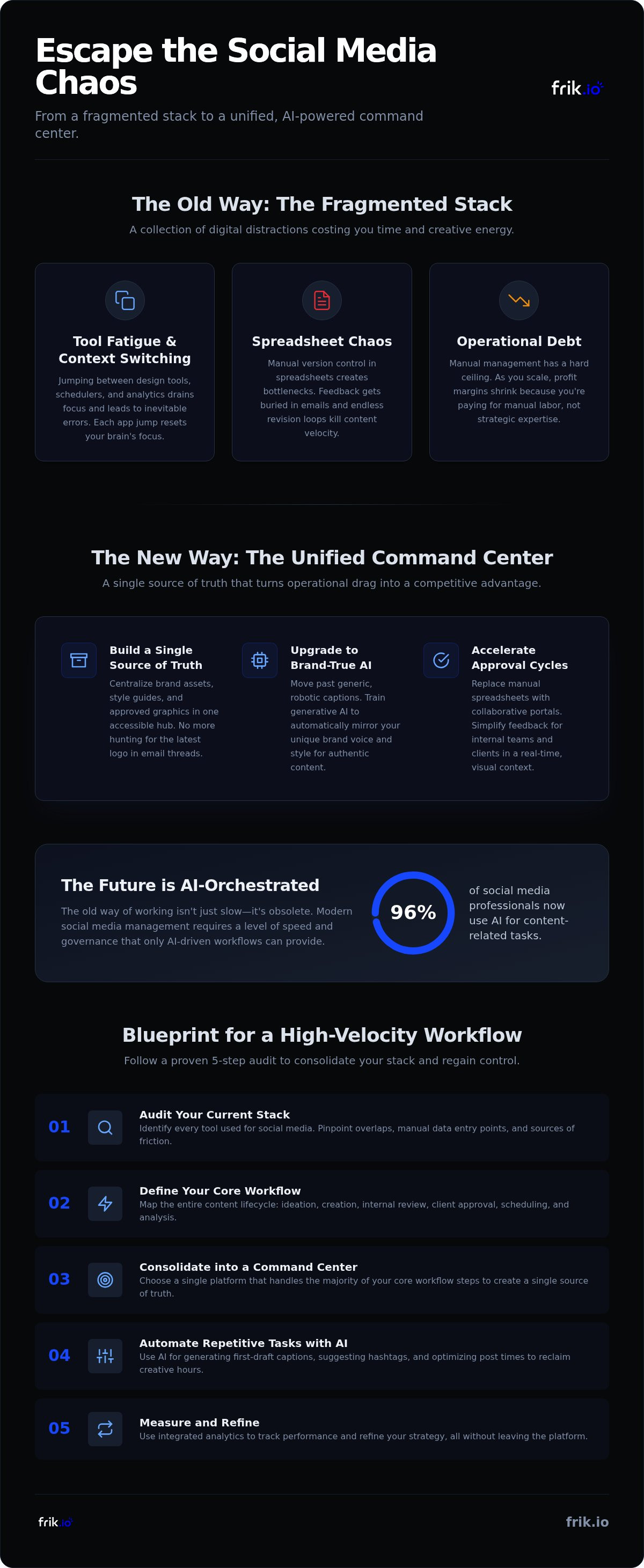
Your social media stack isn't a strategy; it's a collection of digital distractions that are costing you hours of billable time. Most teams try to manage social media tools by jumping between ten different browser tabs, manually updating spreadsheets, and chasing clients for approvals. It's a fragmented process that leads to context switching and inevitable errors. You already know that the "more is better" approach to software has failed. Instead of feeling in control, you're likely just keeping your head above water.
It's time to replace the chaos with a single, efficient command center. This guide will show you how to consolidate your workflow and use AI-driven automation to regain your schedule. You'll learn to move away from generic, robotic content and embrace AI that actually sounds like your brand. We'll explore how to replace slow approval cycles with streamlined portals and turn your fragmented stack into a unified source of truth. By the end, you'll have a blueprint for a workflow that scales without adding more noise to your day.
Key Takeaways
- Eliminate the hidden costs of tool fatigue. Learn why jumping between fragmented apps drains your team's creative energy and how to stop it.
- Build a single source of truth. Discover how a centralized workspace keeps brand assets and style guides organized in one accessible hub.
- Upgrade to Brand-True AI. Move past robotic, generic captions by training generative AI to mirror your unique brand voice automatically.
- Streamline your operations. Follow a proven 5-step audit to consolidate your stack and manage social media tools through a high-velocity command center.
- Accelerate your approval cycles. Replace manual spreadsheets with collaborative portals that simplify feedback for both internal teams and clients.
The Hidden Cost of Fragmented Social Media Management
Most digital teams believe that adding a new app to their stack will solve their productivity issues. In reality, the more apps you add, the more friction you create. This phenomenon, known as tool fatigue, turns your workflow into a maze of logins and notifications. When you try to manage social media tools across separate platforms, you're constantly forcing your brain to reset. Every jump from a design tool to a scheduling app drains your creative energy, leaving you with less focus for actual strategy.
The 2026 landscape has changed. We've moved past the era of manual scheduling into a period of AI-orchestrated workflows. With 96% of social media professionals now using AI for content tasks, the old way of working isn't just slow; it's obsolete. Modern Corporate Social Media management requires a level of governance and speed that fragmented systems simply can't provide. Agencies using disconnected spreadsheets for approvals often see communication break down entirely, leading to missed deadlines and off-brand posts.
Why Spreadsheets are Killing Your Content Velocity
Manual version control is where good content goes to die. Relying on spreadsheets to track drafts creates a bottleneck that stops your team from moving at the speed of social. This approach creates several points of friction that slow you down:
- Version confusion caused by multiple "final" files.
- Feedback buried in deep email threads or forgotten cells.
- Lack of visual context for how the post will actually look on the platform.
This "lost-in-translation" feedback forces creators to guess at intentions, leading to endless revision loops. You need a real-time, collaborative workspace where feedback lives directly alongside the content. Without it, you're just creating friction that prevents you from publishing on time and meeting the demands of your audience.
The Scalability Ceiling of Manual Management
Manual management has a hard ceiling. If your team spends four hours a day on manual posting and spreadsheet updates, they can only handle a limited number of clients before they burn out. This creates "Operational Debt," where your inefficient processes become a tax on your growth. As you try to scale, your profit margins shrink because you're paying for manual labor rather than strategic expertise.
To grow your agency, you must move away from the "more apps, more people" mindset. Success in 2026 depends on a unified command center that allows you to manage social media tools with precision and speed. Consolidating your stack isn't just about convenience; it's about reclaiming your time and turning operational drag into a competitive advantage.
What Defines a Modern Social Media Management Workspace?
A modern social media management workspace is more than a simple calendar or a list of scheduled posts. It is a centralized hub where your team handles the entire lifecycle of a campaign, from the first spark of an idea to final distribution. Unlike legacy tools that act as basic triggers for content, a true command center integrates creation, approval, and distribution into one seamless environment. This setup allows you to manage social media tools without the friction of jumping between disconnected apps.
Central to this architecture is the "Single Source of Truth." This concept ensures that every brand asset, style guide, and approved graphic lives in one accessible location. When your team executes Social media marketing strategies, they shouldn't spend time hunting for the latest logo version in Slack or email threads. Using a unified system to manage social media tools provides immediate access to these essentials, ensuring consistency across every channel.
Modern workspaces also leverage robust API integrations. These connections allow the system to maintain platform-specific best practices, such as character limits and aspect ratios, automatically. This ensures your content looks professional on every network without manual adjustment. It removes the guesswork from the publishing process, allowing your team to focus on high-level strategy rather than technical formatting.
Centralized Content Drafting and Ideation
Ideas are fragile. If you don't have a dedicated space for raw concepts, they often get lost in the noise of daily operations. A sophisticated workspace provides a repository for these early-stage thoughts, separate from the final scheduling queue. This prevents your content library from becoming repetitive and ensures a steady stream of fresh material. A unified workspace acts as the foundational layer of modern marketing, providing the structure needed for high-velocity teams to thrive.
Integrated Approval Portals for Stakeholders
The traditional "feedback loop of doom" is a major drain on agency resources. Modern command centers solve this by using integrated approval portals. These dedicated spaces allow clients or internal stakeholders to review drafts and approve them with a single click. Centralized comments keep the conversation tied directly to the content, eliminating the need for long email chains or confusing spreadsheets. Moving to an integrated portal provides instant relief for teams tired of manual follow-ups.
This architecture also offers significant security benefits. By using a portal, you keep clients out of your internal workspace where sensitive strategy and raw drafts live. It creates a professional barrier that protects your internal process while providing a sleek experience for the stakeholder. You can experience this streamlined flow by using a Client Approval Portal to handle your external workflows with quiet authority.
AI vs. Traditional Scheduling: The Evolution of Management
Traditional scheduling is a manual chore that relies on humans picking time slots and pasting captions into a calendar. This legacy approach is reactive. It assumes your primary goal is simply to "get a post out." Modern management uses AI as a strategic partner to move from manual entry to intelligent orchestration. As you manage social media tools in 2026, the transition to AI-driven workflows defines your team's efficiency. Legacy AI often relied on generic templates that felt robotic, but the new era of generative technology focuses on brand-true content that mirrors your specific identity.
The core difference lies in the level of control. Traditional tools require you to do the heavy lifting of creation and then use the software for distribution. Modern command centers flip this script. They use autopilot scheduling to determine the optimal timing and frequency for your posts based on real-time engagement data. This removes the guesswork from your daily routine. You aren't just filling a grid; you're deploying an intelligent system that understands the nuance of your strategy.
Training AI on Your Unique Brand Voice
The biggest objection to AI is the "robotic" feel of the output. This happens because most tools use generic models trained on the entire internet. You solve this by training an AI engine on your specific style guide and previous high-performing posts. Feed your brand’s "do’s and don’ts" directly into the system. This creates a "Brand-True" difference where the AI understands your tone, preferred vocabulary, and even your stance on industry trends.
The result is immediate relief for your creative team. Instead of spending hours rewriting robotic drafts, they move into an editorial role. You get drafts that require 10% editing instead of a 90% overhaul. This consistency across every platform ensures that your brand sounds the same whether it's on LinkedIn or Instagram, maintaining professional authority without the manual labor.
Platform-Specific Tailoring on Autopilot
Cross-posting is no longer a viable strategy for high-growth brands. A LinkedIn post should never be a copy-paste of a TikTok caption. The audiences are different, and the algorithms reward platform-specific formatting. Modern tools automatically adjust your content’s tone, hashtag count, and caption length for each network. This tailoring happens on autopilot, ensuring you meet the best practices of every platform without manual intervention.
Visual management is also part of this evolution. Using integrated tools like an SVG converter tool allows you to maintain high-quality graphics that scale across different screen sizes and platform requirements. This ensures your visual identity remains sharp and professional. When you manage social media tools through a unified command center, these technical adjustments happen in the background. You focus on the big picture while the system handles the granular details of cross-platform execution.
5 Steps to Streamline Your Social Media Management Workflow
Moving from operational chaos to a streamlined system requires a structured approach. You cannot simply manage social media tools by adding more software to an already broken process. Instead, you must rebuild your workflow around a central axis of efficiency. This five step framework allows you to reclaim your time and scale your output without increasing your headcount.
Auditing Your Marketing Technology Stack
Most teams suffer from "ghost tools," which are subscriptions that drain your budget while complicating your workflow. Before you can consolidate, you must identify where your time is leaking. Use this checklist to evaluate your current stack:
- Redundancy: Does this tool perform a function already covered by another app?
- Data Silos: Does this tool require manual exports to share data with the rest of your team?
- Scalability: Can this tool handle a 50% increase in client load without a total process redesign?
- Friction: Does using this tool require more than three browser tabs to be open simultaneously?
If a tool fails these checks, it is an obstacle to your growth. Transitioning to a unified system is the only way to maintain a high velocity. For more guidance on selecting the right foundational tech, read our guide on How to Choose a Social Media Scheduler.
Once you have cleared the clutter, move your content creation from fragmented spreadsheets into a unified workspace. This becomes your command center. Establish your brand voice baseline immediately by training your AI on your style guides. This ensures that the heavy lifting of drafting is handled automatically, leaving your team to focus on high level strategy and final polish.
Setting Up Your Client Approval Portal
Approvals are the bottleneck of scale. When you rely on email chains and manual follow ups, you create a ceiling for how many clients you can effectively manage. A dedicated portal changes the psychological dynamic of the relationship. It positions you as a high end, tech forward partner rather than a manual service provider. This professional environment builds client trust and significantly improves retention rates.
The setup process should be friction free for the stakeholder. They should receive a single link that grants access to their specific content queue. By centralizing comments and version history, you eliminate "feedback amnesia" and keep the project moving forward. As industry leaders often note, "Approvals are the bottleneck of scale, and a unified portal is the only sustainable solution."
The final step is to monitor your results through an integrated dashboard. Refine your strategy based on real time data rather than guesswork. When you manage social media tools through a single source of truth, you gain the clarity needed to scale. You can start building your efficient command center today by exploring the AI Social Media Management Platform and replacing your manual loops with automation.
Scaling with frik.io: The AI-Powered Command Center
frik.io serves as the "Efficient Command Center" for teams that have outgrown the limitations of basic apps. You don't just need to manage social media tools; you need to master your entire operational cycle. frik.io provides the foundational layer required to move from manual labor to automated excellence. It acts as the secret weapon for agencies and in-house teams that demand high-velocity output without sacrificing quality. By centralizing your operations, you eliminate the friction that typically slows down growing brands.
Content velocity depends on your ability to produce high-quality drafts instantly. frik.io’s Brand-True AI content generation is the primary driver of this speed. By training the engine on your specific voice, you eliminate the need for constant rewrites. This ensures your brand remains consistent and professional across every digital touchpoint. You move from a state of creative block to a state of streamlined productivity, allowing your team to focus on strategy rather than syntax.
The Client Approval Portal marks the end of spreadsheet-based chaos. It provides a sleek, collaborative environment where stakeholders can review and approve content with a single click. This creates a professional boundary that protects your internal workflow while providing clients with a high-end experience. Centralized comments and version history ensure that feedback is never lost in translation. This system replaces fragmented management with a single, efficient command center.
Autopilot Scheduling ensures your brand stays active 24/7 without manual intervention. The system determines the best times to post based on real engagement data, removing the need for manual time-slotting. You set the high-level strategy, and the platform handles the granular execution. This set-it-and-forget-it convenience allows you to manage social media tools with a level of precision that manual methods cannot match.
Unified Workspace for Growing Teams
frik.io creates a collaborative environment where creators and managers thrive together. It offers a workspace that simplifies complex tasks, making high-level professional capabilities accessible to agile teams. The platform features transparent pricing designed for scalability, ensuring your costs remain predictable as your business grows. This predictable cost structure, combined with automated workflows, provides the relief and empowerment needed to scale your operations without adding operational debt.
The Result: Reclaiming Your Creative Time
Imagine a workday where social media management takes minutes rather than hours. You move from the exhausting task of "managing tools" to the high-level work of "executing strategy." This shift empowers your team to focus on the creative work that actually moves the needle for your brand. The transition from operational chaos to streamlined control is not just a dream; it is an immediate reality with the right system in place. Streamline your workflow with frik.io today and experience the power of a unified command center.
Take Command of Your Social Media Strategy
Fragmentation is the enemy of growth. Continuing to manage social media tools through a disconnected stack of apps and spreadsheets only locks your team into a cycle of operational debt. You've seen how a unified workspace provides the foundational layer needed for scalability. By moving toward a single source of truth, you eliminate context switching and reclaim the creative energy required to execute high-level strategy. Relief comes from replacing manual loops with automated precision.
It's time to deploy a system that works as hard as you do. With Brand-True AI training and zero-spreadsheet approval portals, you can maintain total consistency across every platform without the manual grind. A unified multi-platform workspace ensures that your brand remains active and authoritative 24/7. Stop fighting your tools and start mastering your workflow. Start scaling your social media with frik.io today and move from chaos to complete control. Your more efficient future is just one command center away.
Frequently Asked Questions
What is the best way to manage multiple social media tools?
The best way to manage social media tools is to consolidate your stack into a unified workspace. This approach eliminates the friction of switching between ten different browser tabs and manual spreadsheets. By centralizing your creation, approval, and distribution into one command center, you gain a single source of truth. This shift allows your team to focus on high-level strategy instead of administrative overhead, turning operational chaos into a streamlined, high-velocity workflow.
Can I train AI to write social media posts in my specific brand voice?
You can train advanced AI to mirror your unique brand voice by feeding it your style guides and high-performing historical posts. Unlike legacy tools that produce generic, robotic copy, Brand-True AI content generation understands your tone and vocabulary. This results in drafts that require only minor editorial tweaks rather than a total rewrite. It provides immediate relief for creative teams, ensuring consistent messaging across LinkedIn, TikTok, and Instagram without the manual grind.
How do client approval portals replace traditional spreadsheets?
Client approval portals replace spreadsheets by centralizing the entire feedback loop within a dedicated, professional environment. Instead of chasing comments through deep email threads or messy cells, stakeholders use a single link to review and approve content with one click. This architecture eliminates version confusion and "feedback amnesia" by keeping all history tied directly to the post. It positions your agency as a tech-forward partner while protecting your internal raw drafts from client view.
Is it possible to schedule posts for all social platforms at once?
You can schedule posts for all platforms simultaneously, but modern success requires platform-specific tailoring. Advanced systems use Autopilot Scheduling to automatically adjust hashtags, caption lengths, and formatting for each network. This ensures a post meant for LinkedIn doesn't feel out of place on TikTok. By using a unified system to manage social media tools, you maintain a high-velocity presence across the entire digital landscape while ensuring every post meets specific platform best practices.
What features should I look for in a social media management platform in 2026?
In 2026, prioritize platforms that offer Brand-True AI training and integrated client approval portals. Look for features that move beyond simple scheduling, such as Autopilot orchestration and built-in SVG converters for visual scaling. A modern platform must act as a foundational layer for your operations, offering a unified workspace that handles the entire content lifecycle. These tools allow smaller, agile teams to access high-level capabilities that were previously reserved for massive agencies with huge headcounts.
How does autopilot scheduling work for different social networks?
Autopilot scheduling uses real-time engagement data to determine the optimal publishing frequency and timing for each individual network. It doesn't just blast content out; it orchestrates the distribution to maximize reach based on platform-specific audience behavior. This system handles the technical adjustments, like caption tailoring and hashtag optimization, in the background. You simply set the strategic parameters, and the automation ensures your brand stays active and authoritative 24/7 without manual time-slotting.
Can a unified workspace really reduce context switching for marketing teams?
A unified workspace significantly reduces context switching by keeping your entire content lifecycle in one interface. Research indicates that jumping between fragmented apps drains creative energy and leads to avoidable errors. By consolidating your tools, your team avoids the "mental reset" required every time they switch from a design app to a scheduler. This streamlined flow allows creators to stay in a state of deep work, producing higher-quality content in a fraction of the usual time.
Is AI social media management safe for brand reputation?
AI management is safe for your reputation when it includes a collaborative approval layer and brand-voice training. Using a system that allows for human oversight ensures that every post aligns with your values before it goes live. Additionally, professional tools help you stay compliant with 2026 regulations, such as the New York AI disclosure law. By combining intelligent drafting with a strict approval portal, you gain the speed of automation without risking off-brand or synthetic errors.


