
What if AI could turn the questions your customers already ask into social posts they want to read? If you’ve searched for AI-driven content suggestions for my industry, you may have found plenty of ideas that sound polished but could fit almost any business. The missing ingredient usually isn’t another generic prompt. It’s context: your audience’s concerns, your industry knowledge, and the platform where each post will appear.
That disconnect is frustrating. Researching relevant topics takes time, and an inaccurate or off-brand post can undermine trust. AI can speed up ideation, but it works best as a starting point, with people supplying expertise and reviewing the result.
This guide shows you how to turn industry signals, customer questions, and platform context into useful social content suggestions. You’ll learn a repeatable workflow for generating ideas, checking accuracy, and refining posts for your brand and audience. You’ll also see what to compare in AI content tools, from the inputs and voice controls they support to collaboration, platform tailoring, and publishing. With a style guide and human review in the loop, AI suggestions can move beyond generic prompts and give your team ideas it can confidently develop.
Key Takeaways
- Make AI-driven content suggestions for my industry more relevant by grounding prompts in a specific audience, sector context, and brand goal.
- Use customer FAQs, reviews, community discussions, and credible industry publications to uncover useful content signals.
- Compare AI tools by how well they support industry context, style-guide input, human review, and team workflows.
- Turn one audience question into distinct post angles, then capture and refine ideas through a repeatable weekly process.
- Carry approved concepts toward publication with brand-voice drafting, platform-specific tailoring, collaboration, scheduling, and publishing in one workflow.
What Makes AI-Driven Content Suggestions Relevant to Your Industry?
A social post idea is industry-specific when it connects a real audience need with the realities of a sector and a clear brand goal. A prompt about “creating engaging content” can produce familiar advice. A prompt based on a question customers actually ask, the audience asking it, and the purpose of the post gives AI a more useful starting point. For a foundational overview of AI’s role in marketing, see Artificial intelligence marketing (AI marketing).
Industry relevance and brand voice solve different problems. Industry context guides what the post is about, including the customer concern, product category, or sector issue. Brand voice guides how the idea is expressed, including tone, language, and level of detail. You need both. A post can sound exactly like your brand and still miss the audience’s real concerns.
AI can draft and organize ideas, but it can’t replace the judgment of someone who knows the business and its customers. Check claims for accuracy, consider whether a topic is timely, and decide whether the suggestion fits the intended audience and channel before developing it into a post.
What Inputs Make a Social Content Idea Industry-Specific?
Start with first-party insight: customer questions, recurring objections, and themes from support conversations. Add approved product information, audience segments, and current business priorities. These inputs help distinguish what customers need to know from what a broad industry prompt might suggest. Industry terminology and current themes can add precision, but verify their meaning and relevance against credible sources before using them.
- Audience evidence: Questions and concerns customers raise directly.
- Business context: Approved information and the audience you want to reach.
- Purpose: The priority the post should support.
- Sector context: Relevant terminology or developments, checked against reliable sources.
Why Generic AI Prompts Produce Generic Post Ideas
Prompts without an audience, channel, or objective leave too much open. “Suggest social media ideas for a fitness business” may invite broad themes, but adding a niche alone still doesn’t show what its customers ask or what the brand wants to achieve. Specify the audience, evidence, platform, and goal to give the model meaningful boundaries.
Industry-specific AI suggestions are post ideas shaped by verified sector context, real audience needs, and a clear brand objective. That definition keeps the focus on relevance, rather than simply adding industry keywords to a prompt.
How to Turn Industry Signals Into Better AI Content Suggestions
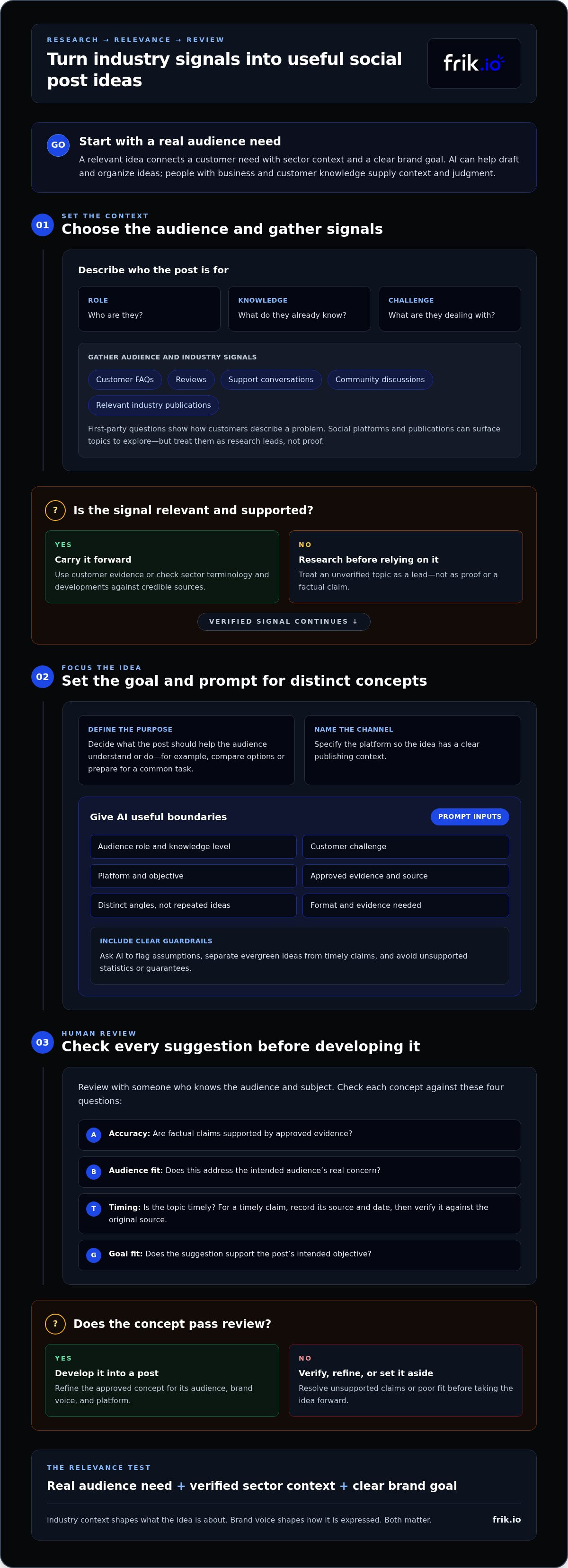
Use a short research-to-review workflow to turn audience evidence into post concepts, not just a list of topics. If you’re searching for AI-driven content suggestions for my industry, start with the people you need to reach and the signals they’re already giving you.
- Choose an audience. Describe who the post is for, including their role, knowledge level, and current challenge.
- Gather signals. Collect customer FAQs, reviews, support conversations, community discussions, and relevant industry publications.
- Set a goal. Decide what the post should help the audience understand or do, such as compare options or prepare for a common task.
- Prompt for concepts. Give the AI your evidence, audience, channel, and objective. Ask for distinct angles rather than repeated versions of one idea.
- Review each suggestion. Check factual claims, audience fit, timing, and alignment with your goal before developing the idea into a post.
Choose Reliable Industry Signals Before Prompting
Start with first-party questions and feedback. They show how customers describe a problem, which can be more useful than guessing at their language. LinkedIn, Reddit, and industry publications can surface topics worth exploring, but treat them as research leads, not proof. Separate evergreen needs, such as recurring questions, from timely topics. For any timely claim a draft may repeat, record its source and date, then verify it against the original source before publishing.
Build a Prompt That Produces Usable Content Ideas
Give the model enough direction to make its suggestions actionable. Name the audience’s role, knowledge level, challenge, and desired next action. Specify the channel and objective, then provide approved evidence. Ask for distinct concepts with a suggested format, angle, and evidence needed. Require the model to flag assumptions and avoid unsupported statistics or guarantees.
Prompt template:
“For [industry], suggest [number] distinct social post concepts for [audience role and knowledge level] who are dealing with [challenge]. The channel is [platform], and the objective is [goal or desired next action]. Use only this approved evidence: [FAQs, customer feedback, product information, or verified source with date]. For each concept, provide a format, angle, and evidence needed. Flag assumptions, separate evergreen ideas from timely claims, and don’t invent statistics or guarantees.”
Review the output with someone who knows the audience and subject. Refine promising concepts into platform-ready posts, then route them through your team’s approval process. A shared workspace such as frik.io’s social content workflow can help carry approved ideas toward tailoring, scheduling, and publishing.
How to Compare AI Tools for Industry-Specific Content Ideas
A useful tool should do more than generate a long list of plausible topics. Compare how it accepts context, shapes suggestions for your audience, supports review, and carries an approved idea toward publishing. If you’re evaluating AI-driven content suggestions for my industry, test the workflow your team will actually use, not just the quality of a sample caption.
| What to compare | What to look for | Why it matters |
|---|---|---|
| Input control | Can you provide source material, audience details, objectives, and relevant industry context? | Specific inputs help suggestions reflect real business needs instead of broad category themes. |
| Brand guidance | Can the tool use your team’s style guide, approved terminology, and tone preferences? | Brand guidance shapes expression while industry context shapes the subject matter. |
| Platform fit | Can you adapt a concept for each social platform instead of copying one version everywhere? | Different channels call for different formats and presentation. |
| Review and collaboration | Can teammates, strategists, or clients review and approve drafts in the workflow? | Shared review keeps expert judgment connected to content creation. |
| Publishing workflow | Can approved ideas move into content planning, scheduling, and publishing? | A connected workflow reduces handoffs between ideation and execution. |
Which Capabilities Improve the Relevance of AI Suggestions?
Prioritize tools that let you include audience needs, objectives, source material, and tone guidance in the same brief. Check whether your team can adapt a promising idea for different platforms, then refine and review it together. If strategists and clients share approvals, collaboration features can keep feedback attached to the content instead of scattered across separate channels. A team style guide also helps maintain consistent brand expression in drafts.
Separate idea generation from trend monitoring. A tool that suggests post concepts doesn’t necessarily track live industry signals or verify that a topic is current. Treat trend monitoring as a distinct capability to assess. If you use timely developments as inputs, confirm them with current, credible sources before relying on an AI-generated suggestion.
How to Score Suggestions Without Trusting Fluency Alone
Run the same brief through each tool you’re considering. Keep the audience, objective, channel, and approved evidence consistent so you can compare the outputs fairly. Score each suggestion for audience fit, industry specificity, source quality, originality, usefulness, and the effort needed to edit it. Flag unsupported claims, clichés, sensitive topics, and ideas that need expert review.
Polished language is not evidence of accuracy. A fluent suggestion still needs a source check and a human decision about whether it belongs in your content plan. The strongest tool is one that produces relevant starting points your team can verify, improve, and move through its actual workflow.
How to Build a Repeatable AI Content Suggestion Workflow
A reliable workflow turns scattered research into approved post concepts on a steady cadence. Capture audience questions during the week, organize them, then use AI to explore angles before someone checks and routes the strongest ideas. This keeps AI-driven content suggestions for my industry connected to real audience needs instead of making every brainstorming session a fresh start.
From Research Notes to a Useful Content Brief
During your weekly research capture, record each signal with its source and group it by audience problem, content pillar, funnel stage, and evidence strength. A content pillar is a broad theme that supports your content plan. Before prompting, choose one communication objective, such as helping a beginner understand a process or helping an experienced buyer compare approaches. For a broader planning perspective, connect each theme to your content pillar strategy.
Then ask AI for distinct creative directions from one question. For example, “How do I prepare for a routine equipment inspection?” might lead to:
- A beginner-friendly explainer of what preparation involves.
- A practical checklist of information to gather beforehand.
- A myth-versus-fact post addressing a common misconception.
- A question-led post inviting the audience to share their preparation challenges.
Each concept serves a different purpose. Ask for varied angles, not several rewrites of the same basic tip.
Review, Adapt, and Route Suggestions for Approval
Before a concept enters the calendar, assign a knowledgeable reviewer to check facts, sensitive claims, and industry-specific nuance. Edit for clarity and brand voice, then adapt the format and framing for the intended platform. For team and client work, define who reviews, who approves, and which changes require another review. Use a team or client approval process before scheduling so ideas don’t bypass the human judgment that makes them publishable. Style guidance can also help keep approved drafts consistent with your brand voice.
Track workflow performance with separate measures: how often ideas are accepted, how much editing they need, whether publishing stays consistent, and how audiences engage with the resulting posts. These measures reveal different things. A high acceptance rate doesn’t prove an idea performs well, and strong engagement doesn’t show whether the workflow saved editing time.
Bring research capture, brand-voice drafting, platform tailoring, review, and publishing into a connected workflow. Build your social content workflow with frik.io.
How Frik.io Helps Teams Move From AI Suggestions to Published Posts
Relevant AI suggestions only create value when your team can review, adapt, and publish them. The frik.io social media workspace connects those steps. Its AI can draft captions using your team’s style guide, tailor posts for different platforms, and support collaborative review that moves a promising concept toward the content calendar. These capabilities help teams carry industry-specific ideas into execution while keeping human judgment in the process.
Keep Brand Guidance and Platform Adaptation in the Workflow
Give AI your own style guide to inform its drafts. The guide can shape language and tone, while your industry evidence and audience context determine what each post should address. Review every suggestion for accuracy and fit before using it. For deeper implementation ideas, explore a guide to AI brand voice content generation.
Then adapt the approved concept for its destination. A post written for one network may need a different structure or framing on another. frik.io can tailor social posts by platform, so teams can refine the presentation rather than treating every channel identically. This helps preserve the core message while shaping each version for its platform.
Move From Drafts to Team Review and Publishing
A practical workflow can move through clear stages:
- Generate: Draft a caption from an approved idea, audience context, and style-guide input.
- Edit: Have a knowledgeable team member check claims, clarify the message, and refine the voice.
- Tailor: Adapt the post for the intended social platform.
- Review: Route the content through a client approval portal or team review process.
- Schedule and publish: Move approved content into the publishing workflow.
A shared workspace can help teams coordinate content across multiple brands or clients, keeping creation, review, scheduling, and publishing connected across social networks. Client approval portals organize feedback and approvals within the content process, while reviewers remain responsible for checking the work.
Bring brand-guided drafting, platform tailoring, approvals, scheduling, and publishing into one social content workflow. Explore frik.io’s social media workspace.
Turn Better Ideas Into a More Reliable Content Workflow
Relevant social content starts with real audience questions and credible industry context. A clear prompt turns those signals into distinct ideas, while human review protects accuracy, timing, and audience fit. That’s the practical foundation for generating AI-driven content suggestions for my industry without settling for interchangeable posts.
Keep the process moving by bringing ideation and execution closer together. Frik.io can draft captions using your team’s style guide, tailor posts for different social platforms, and support collaborative review through client approval portals. Your team stays in control of what gets refined, approved, scheduled, and published.
Ready to connect your ideas to the publishing workflow? Explore Frik.io’s social media workspace to move from brand-guided drafts to reviewed, platform-ready posts. Start with the audience insights you already have and build a workflow that helps your best ideas reach the right channels.
Frequently Asked Questions
How can AI generate content suggestions for my industry?
AI can turn audience information, industry context, and a clear content goal into social post concepts. A prompt for AI-driven content suggestions for my industry should identify who you want to reach, what they care about, which platform you’re using, and what the post should achieve. Add approved source material, such as customer questions or product information, then review each idea for accuracy and relevance before developing it.
What information should I give AI to get industry-specific content ideas?
Give AI a specific audience, their role or knowledge level, a challenge they face, and the action you want them to take. Add the social platform, your content objective, approved product details, relevant customer questions, and brand voice guidance. For timely topics, include a credible source and its date. Clear inputs give the model useful boundaries and help your team assess whether an idea fits.
Can AI suggest social media content for a niche industry?
Yes. AI can suggest ideas for a niche industry when you provide context beyond the industry label. Include the audience’s needs, recurring questions, relevant terminology, and evidence from credible sources or customer feedback. For example, asking for ideas for a specific professional audience facing a defined challenge gives the model a sharper brief than naming a niche alone. Have a subject-matter expert check specialized claims and language.
How do I know whether AI-generated content ideas are accurate?
Check each factual claim against its original, credible source before publishing. Confirm that timely information is current, and ask a subject-matter expert to review specialized or sensitive topics. Customer feedback can support audience relevance, but it doesn’t automatically verify broader industry claims. Treat AI suggestions as drafts, not evidence. Flag unsupported statistics, guarantees, and assumptions, then remove them or substantiate them with reliable sources.
What is the difference between AI content suggestions and AI content generation?
AI content suggestions are concepts or angles for what to post, such as an explainer, checklist, or question-led post. AI content generation takes an idea further by drafting the caption or other copy. A team might first ask for several approaches to a customer question, select one, then use AI to draft platform-specific text. Both stages benefit from clear context and human review.
Can AI tailor one industry content idea for different social platforms?
Yes. AI can adapt a central idea for different platforms by adjusting format, length, framing, and call to action. Avoid copying the same post everywhere without considering each channel’s audience and conventions. Frik.io can tailor social posts for different platforms, helping teams carry an approved concept into channel-specific drafts. Review each version to make sure it preserves the intended message and brand voice.
How often should I use AI to generate industry content suggestions?
Use AI as often as it supports your planning rhythm, rather than prompting for ideas without a clear purpose. A weekly research and ideation session can help teams capture customer questions, review relevant developments, and prepare concepts for upcoming posts. Generate ideas sooner when a timely opportunity arises, but verify current information first. Track which suggestions your team accepts and how much editing they need, then adjust your cadence.


