
What if AI’s biggest social media advantage isn’t writing faster, but keeping every step connected? The phrase ai features social media management saas 2024 2025 points to a fast-moving category, but feature labels alone don’t show whether a tool solves real work. A polished caption still needs to sound like your brand, fit the channel, pass review, and reach the right publishing queue.
AI drafts can feel generic, while creation, approvals, and scheduling remain scattered across separate tools. The useful question isn’t simply whether a platform has AI. It’s whether its capabilities reduce handoffs and help teams produce consistent, publish-ready content without giving up editorial control.
This article looks at how social media SaaS AI capabilities developed through 2024 and 2025, then considers what to look for in 2026. You’ll learn the main feature categories, compare them by workflow impact rather than marketing terminology, and identify a practical feature set for a team, agency, or growing brand. We’ll focus on the connected workflow: brand context, channel adaptation, approvals, and publishing. That’s where AI can move from an impressive demo to useful operating support.
Key Takeaways
- Use the ai features social media management saas 2024 2025 timeline to distinguish dated product changes from broader feature trends.
- Map AI capabilities across the content lifecycle to see where they can reduce handoffs and where human judgment still matters.
- Compare drafting, brand context, channel adaptation, approvals, scheduling, and analytics by their effect on the workflow, not by feature names alone.
- Test a platform with representative posts and approval scenarios, then assess its controls and evidence before choosing it.
- Look for connected brand-style drafting, platform adaptation, client approvals, and publishing to support a repeatable workflow.
AI Social Media SaaS Changes in 2024-2025
AI features in social media management SaaS are software capabilities that use artificial intelligence to assist with or automate parts of creating, organizing, publishing, and assessing social content. There’s no single feature set that defines the category. Tools differ in what they offer, how much work they perform, and how much human review they require.
What counts as an AI feature in a social media platform?
“AI” can describe several distinct jobs. Content assistance generates or revises copy; workflow automation carries out steps such as scheduling; analytics support summarizes performance data; and platform-level controls help govern how AI is used. These capabilities affect different parts of social media marketing, from Social Media Marketing content creation to engagement and measurement.
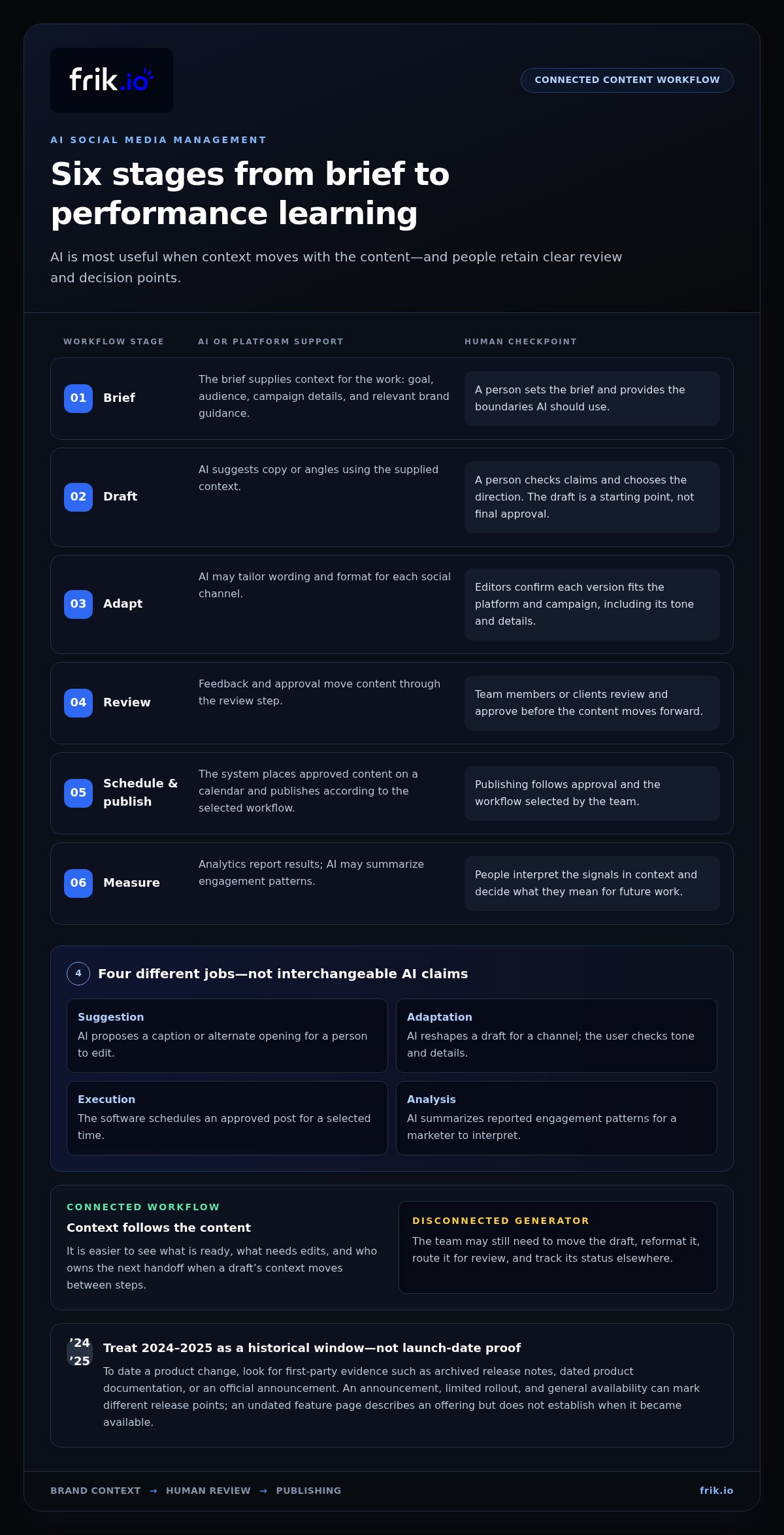
- Suggestion: AI proposes a caption or alternate opening for a person to edit.
- Adaptation: AI reshapes a draft for a particular channel, leaving the user to check its tone and details.
- Execution: The software schedules an approved post for a selected time.
- Analysis: AI summarizes reported engagement patterns, which a marketer interprets in context.
The distinction matters. A suggested post isn’t the same as an action the platform completes, and an automated action isn’t automatically useful. Assess output quality, control points, and fit with your process rather than treating an AI label as evidence of value.
How should readers interpret the 2024-2025 timeline?
Treat 2024-2025 as a historical window, not proof that a particular capability launched in either year. A dated product timeline needs first-party evidence, such as archived release notes, dated product documentation, or an official announcement. An undated feature page can describe what a platform offers now, but it can’t establish when that capability became available.
Read dates precisely. An announcement, a limited rollout, and general availability may mark different points in a feature’s release. Documentation can also show whether access depends on a subscription or gradual rollout. Without dated primary evidence for a specific change, don’t assign it to 2024 or 2025. This keeps a historical comparison grounded instead of turning current marketing language into an unsupported timeline.
When assessing the ai features social media management saas 2024 2025 period, focus on how capabilities fit real work, not on whether every vendor followed the same path. Compare documented changes with what a platform supports in 2026. Features can vary by provider, plan, and release, so don’t generalize one product’s timeline to the whole market.
This distinction leads to a practical evaluation: identify what the system suggests, what it executes, and where people retain review and decision-making. A feature can save effort at one stage while leaving approvals or publishing elsewhere. Next, examine how the capabilities connect across the content workflow.
How AI Social Media SaaS Features Connect Across the Content Workflow
AI creates practical value when it helps content move through a complete workflow, not just when it produces a quick draft. Each handoff matters: an idea can lose audience context during adaptation, wait in a separate approval channel, or miss the publishing calendar. Context and handoffs determine whether AI support fits the team’s process or adds another disconnected step.
Think of the lifecycle as a sequence with clear inputs and control points:
- Brief: A person sets the goal, audience, campaign details, and relevant brand guidance.
- Draft: AI suggests copy or angles using the supplied context. A human checks claims and chooses the direction.
- Adapt: AI may tailor wording and format for each social channel. Editors confirm that each version suits the platform and campaign.
- Review: Team members or clients provide feedback and approve the content before it moves forward.
- Schedule and publish: The system places approved content on a calendar and publishes it according to the selected workflow.
- Measure: Analytics report results; AI may summarize patterns, while people decide what those signals mean for future work.
From brief and draft to platform-specific adaptation
A brief gives AI useful boundaries: what the post should achieve, whom it should reach, and which brand guidelines apply. The output is still a starting point. A post adapted for one channel may need a different length, structure, or call to action on another. Rewriting and idea generation can help teams move faster, but they don’t replace fact-checking, campaign judgment, or final editorial approval.
That distinction separates a connected workflow from a pile of generators. A generator may create copy, but the team still has to move it, reformat it, route it for review, and track its status elsewhere. A connected system preserves the draft’s context as it passes between steps, making it easier to see what’s ready, what needs edits, and who owns the next handoff.
From review and scheduling to performance learning
Approval is a deliberate checkpoint, not an administrative extra. Reviewers can catch a factual error, off-brand wording, or a mismatch with campaign timing before content is scheduled or published. Scheduling links approved posts to a planned calendar. Analytics show reported results, such as engagement patterns; an AI-generated recommendation is an interpretation of those results, not proof that a particular change caused better performance.
Keep people responsible for strategic choices: audience priorities, sensitive topics, campaign claims, and responses to unexpected events. Let automation handle repeatable transitions where the rules are clear, and make review visible wherever judgment matters. Teams comparing ai features social media management saas 2024 2025 can use this workflow map to see whether a feature removes a real handoff or simply adds another output to manage.
For example, frik.io’s connected social publishing workflow brings brand-style AI drafting, platform-specific adaptation, client approvals, scheduling, and publishing into one workspace. Assess how those steps fit your team rather than relying on the presence of an AI label alone.
Which AI Social Media Management Features Matter Most, and Which Claims Need Scrutiny?
There’s no universally best AI feature. The right priority depends on where your team loses time or control: drafting, adapting, approvals, scheduling, or learning from results. Compare what a feature actually does with evidence you can observe in a realistic workflow. A broad promise like “smarter social” is a label, not proof that a capability works well or solves your bottleneck.
Use this matrix to separate practical functionality from marketing language:
Drafting | Creation. Evidence: generate and revise a post from a representative brief. Human control: verify facts, tone, and sensitive claims.
Brand context | Planning and creation. Evidence: provide brand voice, audience, goals, and source material, then assess whether the output reflects them. Human control: decide which guidelines and campaign priorities apply.
Channel adaptation | Editing. Evidence: produce distinct versions for selected platforms while preserving the core message. Human control: check each version’s format, meaning, and suitability for its audience.
Approvals | Review. Evidence: route content to the right reviewers and show its status. Human control: make responsibility for edits and final sign-off visible.
Scheduling | Publishing. Evidence: place approved posts on a calendar and show when they’re set to publish. Human control: retain oversight of timing and publishing decisions.
Analytics | Measurement. Evidence: inspect reported metrics and any AI-generated summaries alongside the underlying results. Human control: interpret patterns without assuming a recommendation proves causation.
How to assess AI content generation and brand context
Test with a real brief, not a generic prompt. Supply the brand guidance, audience, objective, and source material your team would normally use. Then compare channel-specific drafts: do they maintain the central message while adjusting wording and format? Review for unsupported claims, factual errors, tone drift, and sensitive content. Good assistance makes revision easier; it doesn’t remove editorial responsibility.
How to assess automation, approvals, and measurement
Separate scheduling from autonomous decision-making. Scheduling places selected content into a publishing plan; broader automation may execute additional steps. Identify what triggers each action, who can review it, and who owns approval. For analytics, distinguish displayed results from recommendations generated from them. A summary can help teams investigate patterns, but it can’t establish that an AI suggestion caused a change in performance.
Judge features as a workflow, not a checklist. A capable draft that can’t move cleanly through review may leave the real bottleneck untouched. Teams researching ai features social media management saas 2024 2025 should test representative content and approval scenarios, then prioritize capabilities that reduce friction while preserving clear human control.
How to Evaluate AI Features in Social Media SaaS for Your Team
Evaluate AI against the work your team needs to do, not the number of features in a product tour. Use this five-step method to identify useful capabilities, expose workflow gaps, and keep the right decisions in human hands.
- Map the tasks. Trace a typical post from brief to reporting. Note who creates, edits, approves, schedules, and reviews it, including the tools and handoffs between those steps.
- Identify bottlenecks. Pinpoint where work stalls or repeats. Is the challenge creating a first draft, keeping channel versions consistent, gathering client feedback, or coordinating a publishing calendar? Prioritize the constraint, not the flashiest AI label.
- Define controls. Decide what AI may suggest or execute, which actions need approval, and who owns sign-off. Set review expectations for facts, brand voice, sensitive content, and campaign requirements.
- Test the workflow. Use a representative brief and follow it through drafting, adaptation, review, and scheduling. A polished demo may skip the handoffs your team needs to assess.
- Review the evidence. Record time spent, edits required, review friction, and control needs. Compare those observations with your current process. Don’t treat projected savings or broad product claims as measured results.
Match feature priorities to team size and workflow
Solo operators may value efficient drafting and a straightforward path from approved post to publishing calendar. Agencies can prioritize repeatable client reviews, style guidance, and coordination across accounts. Growing brands may focus on collaboration, consistent channel messaging, and reporting that helps teams assess content. These are starting points, not fixed rules. Let your actual bottlenecks determine the feature mix.
Run a practical feature-fit test
Choose a real brief with clear goals, audience context, and brand guidance. Assess the draft, channel versions, and how much editing they need. Then run a realistic approval handoff: track whether reviewers understand the post’s context, can provide feedback, and can see what happens next. Note the work and decisions required rather than assuming a faster first draft means a faster full workflow.
Use the results to compare tools on repeatable work and handoff friction, not feature counts. For a team assessing ai features social media management saas 2024 2025, a small, structured test can reveal whether brand context, adaptation, approvals, and scheduling fit together in practice. Keep your notes consistent across platforms so the comparison reflects the same task and review requirements.
If a connected workspace fits your evaluation criteria, explore frik.io to see how its social content workflow brings brand-style drafting, platform adaptation, client approvals, and publishing together.
How frik.io Brings AI Content, Brand Voice, Approvals, and Publishing Together
After setting neutral criteria, frik.io offers a practical example of how capabilities can connect in a social content workflow. Teams can create, schedule, and publish content across multiple networks in one workspace, with AI drafting, brand-style guidance, platform-specific adaptation, collaboration, and client review portals supporting different stages. The goal isn’t to remove human judgment. It’s to bring repeatable work into a shared process where teams can shape, review, and prepare content for publishing.
Create and adapt content with brand context
AI drafting can use a team’s own style guide, giving writers a starting point shaped by brand context rather than a generic prompt alone. Teams can also tailor posts for different social platforms, adapting each version while keeping the intended message in view. Treat the result as a draft: editors remain responsible for checking accuracy, tone, campaign fit, and details that need a human decision.
This matters for teams managing several channels or recurring content. A shared style guide gives the drafting process relevant brand direction, while platform adaptation supports channel-specific versions instead of relying on one identical post everywhere. The writer or reviewer can refine the language, verify claims, and decide whether each version is ready to move forward.
Move approved content toward publishing in one workspace
Creation is only one part of the workflow. frik.io includes client approval portals and team collaboration to support review, along with scheduling and publishing across multiple networks. Keeping these capabilities in one workspace gives teams a shared process for preparing content and planning its release. Analytics provide a way to review social performance after publishing.
- Draft with context: Use a team style guide as input, then review and refine the generated copy.
- Adapt for channels: Tailor posts for different social platforms and check each version before approval.
- Coordinate review: Use client portals and collaboration workflows to bring reviewers into the content process.
- Plan and assess: Schedule and publish approved content, then use analytics to examine reported performance.
These capabilities address the questions behind ai features social media management saas 2024 2025: does AI use brand context, can teams adapt content for distinct channels, and can work continue through review and publishing without unnecessary tool handoffs? frik.io brings these capabilities together in one workflow, while leaving teams in control of editorial decisions and approvals. Analytics can inform future planning, but they don’t guarantee that a particular post or change will produce a specific result.
To learn more about this connected approach, explore frik.io’s AI social media workspace.
Make Your Next Social Workflow Easier to Improve
Your next step doesn’t have to be a platform-wide overhaul. Choose one recurring workflow, set a clear baseline, and identify where AI should assist while people retain editorial control. Then evaluate whether the process is easier to manage and whether your team can learn from the results. That practical test is more valuable than chasing every new feature label tied to ai features social media management saas 2024 2025.
For teams ready to put connected capabilities into practice, frik.io combines AI drafting that can use a team’s own style guide with client approval portals for collaborative review. Content creation, scheduling, and publishing sit in one workspace, giving teams a shared place to move work forward while maintaining review and approval.
Explore frik.io’s AI social media workspace and see how its connected workflow could fit your team. Start with one real use case, learn from the process, and build from there. A measured next step can make social operations more manageable without losing the human perspective that makes your brand distinct.
Frequently Asked Questions
What are AI features in social media management SaaS?
They’re software capabilities that use artificial intelligence to assist with social media work, such as suggesting caption revisions or adapting copy for a channel. Some platforms connect this assistance with collaboration, scheduling, or analytics. If you’re comparing ai features social media management saas 2024 2025, assess a specific task: what information does the feature use, what does it produce or execute, and where can a person review the result?
Can AI social media software write posts in a brand voice?
It can help draft or revise copy using brand guidance, but consistency depends on the context and examples provided. Try different post types, such as a product update and an educational tip, then compare their wording with your brand standards. Check whether the tool keeps the voice appropriate for each audience and channel. Assess brand fit across real examples rather than treating it as a guaranteed result.
Is AI-generated social media content accurate?
No, accuracy isn’t automatic. A draft might invent a product detail, misstate a date, or omit a qualification from the original brief. Before publishing, compare factual claims with an authoritative source, test links, and verify names and dates. For a product announcement, confirm every specification against the approved product information. Assign an editor to these checks, especially when a post covers sensitive or consequential topics.
Does AI-generated social media content need to be disclosed?
Disclosure expectations depend on the content, platform rules, applicable law, and whether the post includes realistic synthetic media. No single assumption safely covers every post and channel. Before publication, consider whether people could be misled about a person, event, or source, then review the relevant platform policy and legal guidance for that use. Build that decision into editorial review rather than leaving it to an individual poster.
Can AI replace a social media manager?
AI can assist with repeatable tasks, but it doesn’t take responsibility for strategy, audience understanding, or communication choices. A team might use it to prepare caption variations, while a manager selects the version that fits a launch or responds to an emerging issue. Keep a named person accountable for priorities, approvals, and audience interactions. The practical goal is to streamline suitable tasks without removing ownership of decisions.
How should teams evaluate privacy when using AI social media tools?
Review what information the tool processes, how account access is managed, and what its provider says about data use and retention. Set an internal rule for information staff may enter. For example, a team might use a generalized customer scenario rather than paste identifiable customer messages into a prompt. If sensitive material is involved, document the intended use and involve the appropriate privacy or security reviewer before proceeding.
Can AI automatically publish social media posts without human approval?
Some workflows may allow posts to be published automatically, but available controls vary by platform and settings. Before enabling this, define which content can follow an automated path and which requires sign-off. A routine evergreen reminder may need a different review process from a public response about a service issue. Assign responsibility for exceptions and keep an explicit approval step for content where context or brand risk calls for human judgment.


