
What if adapting a post for every platform didn’t mean rewriting your strategy from scratch? AI that adapts to different platform formats can reshape one core idea into channel-specific content, but speed alone isn’t enough. Copying the same post everywhere may save a step, while rewriting every version by hand takes time. The practical goal is to create drafts that fit each channel without losing the point of the original.
The better approach is to change the format, not the strategic intent. AI can help tailor structure, tone, and presentation, while clear brand guidance keeps the message recognizable. Human review still matters: it catches factual drift, sharpens the angle, and checks that each variation sounds like your brand.
This guide explains what platform adaptation involves, how to assess AI workflows for quality, and how to build a repeatable create-review-publish process. You’ll learn how to preserve your brand voice, keep the original idea intact, and reduce repetitive work without giving up editorial control.
Key Takeaways
- Learn how platform adaptation changes a post’s structure and presentation without changing its strategic intent.
- Give AI a clear source idea, audience, objective, key message, and brand guidance to produce more relevant variations.
- Compare manual rewriting, generic prompts, and AI that adapts to different platform formats using message fidelity, format fit, and editing effort.
- Use a pre-publication checklist to check accuracy, audience fit, platform format, brand voice, and the intended action.
- See how frik.io brings AI-assisted adaptation, collaborative review, and scheduling into a connected content workflow.
What Does Platform-Adaptive AI Actually Do?
One campaign idea rarely fits every social platform unchanged. A detailed product insight might work as a professional LinkedIn post but feel too formal as a short-form video concept or too dense for a concise update on X. Copying the same caption everywhere saves a step, but it doesn’t necessarily make the message fit each channel.
Platform adaptation reshapes content to fit a platform’s conventions and available formats while preserving the source message. AI that adapts to different platform formats can adjust structure, length, and presentation rather than simply swapping a few words. It builds on language-generation technology: Natural Language Generation describes how computer systems produce understandable text from data.
That’s different from three common shortcuts. Cross-posting republishes the same content with little or no change. Paraphrasing changes the wording but may leave the structure and context untouched. Fully autonomous publishing goes beyond adaptation by moving content toward publication without the same human review at each step. Adaptation should give your team tailored drafts to assess, not change the strategy or remove editorial control.
What changes when a post moves between platforms?
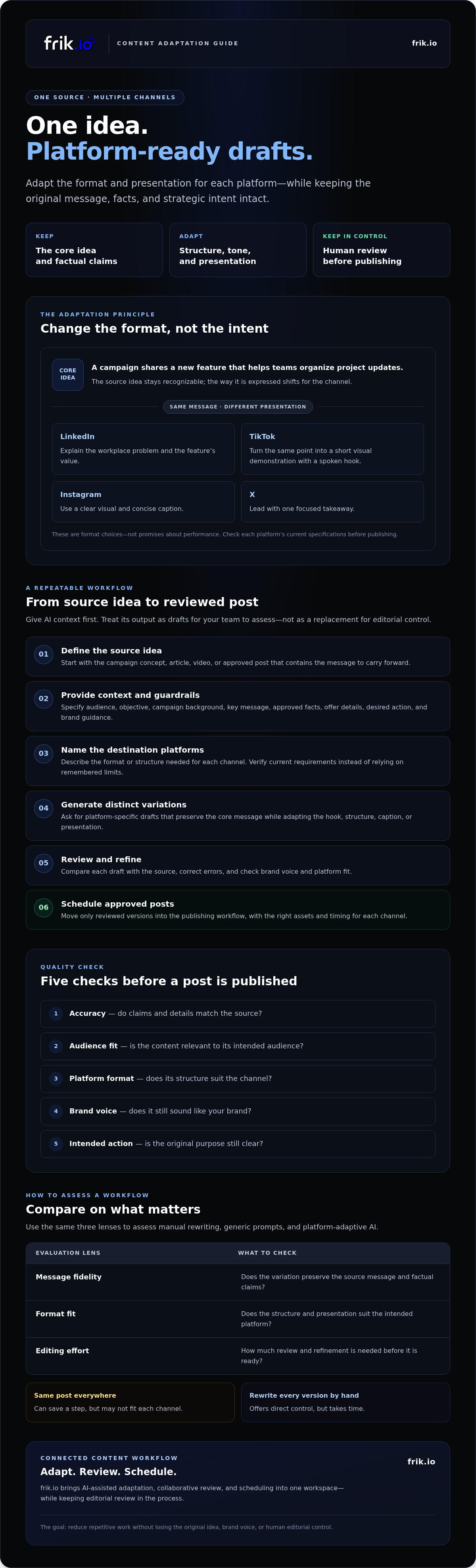
Consider a campaign sharing a new feature that helps teams organize project updates. A LinkedIn version might explain the workplace problem and the feature’s value. A TikTok adaptation might turn the same point into a short visual demonstration with a spoken hook. An Instagram version could use a clear visual and concise caption, while an X post might lead with one focused takeaway. These are format choices, not promises about performance.
Before publishing, check each platform’s current specifications for character counts, image dimensions, and video requirements. Limits and capabilities can change, so don’t build a reusable workflow around unverified numbers.
What should AI preserve across every version?
Keep the core message, factual claims, offer details, and intended audience consistent. Then adapt the hook, caption, call to action, and structure to fit the channel. Approved brand language should remain recognizable, even when a post becomes shorter, more visual, or more conversational.
Give the AI clear guardrails: what must stay, what can change, and which phrases or claims need approval. A documented AI brand voice strategy guide can help teams define those rules and keep variations aligned. The aim is a set of platform-aware drafts that still sound like the same brand.
How AI Turns One Core Idea Into Platform-Ready Social Content
A reliable adaptation workflow starts before the prompt. Give the AI a clear source, explain what the content needs to accomplish, and review each version before it enters the publishing queue. This keeps the tool focused on reshaping your idea instead of guessing at your strategy.
Useful adaptation combines source context with platform-specific requirements. Treat platform instructions as creative cues and practical constraints, not guarantees of reach or engagement. A format can make a post more appropriate for a channel, but audience response is never assured.
- Define the source idea. Start with the campaign concept, article, video, or approved post that contains the message you want to carry forward.
- Provide context. Specify the audience, objective, campaign background, key message, approved facts, offer details, and desired action. Add brand guidance so the AI has a reliable reference for tone.
- Select platforms. Name the channels you’re preparing content for and describe the format or structure you want for each. Check current platform requirements rather than relying on remembered character or media limits.
- Generate variations. Ask for distinct drafts that preserve the core message while adapting the hook, structure, caption, or presentation for each destination.
- Review and refine. Compare every draft with the source, correct errors, and check that the voice and platform fit are right.
- Schedule approved posts. Add only reviewed versions to your publishing workflow, with the right assets and timing for each channel.
Which inputs help AI adapt content accurately?
Specific inputs reduce guesswork. State the post’s goal, intended audience, campaign context, approved facts, and the action you want readers to take. Include source material, plus a style guide or examples drawn from your own brand content. If a detail is missing, instruct the AI to flag the gap for review instead of filling it with an invented claim.
For example, a prompt can explain that a feature announcement is for existing customers, identify the confirmed feature benefits, and ask for a concise draft that invites readers to learn more. Clear boundaries make it easier to spot where human judgment is needed.
How should a team review AI-generated variations?
Check each draft for factual accuracy, message consistency, brand voice, and suitability for its intended platform. Review creative assets separately from captions: an image, clip, or layout may need changes even when the text is ready. For a broader view of how these steps fit into content operations, see this AI social media management platform guide.
Teams looking to connect adaptation with review and scheduling can explore frik.io’s social media workspace as one option for managing those steps in a shared workflow.
How to Compare AI Platform Adaptation With Manual and Generic Workflows
Choose a workflow by looking at which tasks it removes and which decisions stay with your team. Manual rewriting offers direct editorial control. Generic prompts can speed up first drafts. AI that adapts to different platform formats may reduce repetitive tailoring when it follows platform-specific instructions. None guarantees publish-ready content. Compare the options against your platform mix, content volume, and approval requirements.
| Quality criterion | Manual rewriting | Generic AI prompting | Platform-aware AI adaptation |
|---|---|---|---|
| Message fidelity | High control, though details can be missed during repeated rewrites. | Depends on the prompt and how closely drafts are checked against the source. | Can retain the shared message when source context and constraints are clear; still needs review. |
| Format fit | Relies on the writer’s knowledge of each platform. | May need detailed instructions for every version. | Designed to tailor drafts to platform-specific requirements and conventions. |
| Brand consistency | Depends on each writer applying brand guidance. | Can vary unless the prompt includes usable voice guidance. | Can use brand voice controls or style guidance, but output should be checked. |
| Editing effort | More hands-on work for each version. | May reduce drafting time, with extra edits if context is missing. | May streamline repeat adaptation; editing needs depend on the draft. |
| Review control | Built into the process, though coordination can take effort. | Depends on how the team handles drafts and approvals. | Look for editable drafts and review steps before scheduling or publishing. |
Use the comparison as a decision aid, not a universal ranking. A small team publishing to a limited set of channels may prefer manual adaptation for important posts. A team handling recurring content across several platforms may value a shared source and tailored drafts, especially when multiple stakeholders need to review them. The right balance depends on how much content you manage and how tightly you need to control approvals.
When is manual adaptation still the better choice?
Keep a human closely involved with sensitive announcements, nuanced executive communications, or high-stakes claims. These often depend on context, tone, or subject expertise that’s difficult to capture fully in a prompt. AI can help explore wording or transform an approved draft, but someone with the right knowledge must verify the result and remain accountable for what gets published.
What makes an AI tool genuinely platform-aware?
Check whether it can produce tailored versions from a shared source and apply platform-specific instructions. Then assess brand voice controls, editable drafts, collaboration, approvals, and fit with your publishing workflow. These details distinguish a useful adaptation system from a text generator that simply returns alternate wording. For more on maintaining authenticity as content scales, see this guide to AI brand voice content generation.
A Practical Checklist for Reviewing AI-Adapted Social Posts
A polished draft can still lose a key fact, miss its audience, or feel wrong for the channel. Before scheduling, review every variation against the source post. Each version should fit its platform and retain the same approved central message. Use this checklist to catch gaps before they reach your audience.
- Check accuracy. Verify names, dates, product details, claims, and links against approved source material. Remove any detail the AI introduced without evidence.
- Compare with the source. Confirm the main point, offer, and intended audience are intact. Look for omitted qualifications or wording that changes the original meaning.
- Assess audience fit. Ask whether the hook and explanation make sense to the people this post is meant to reach, and whether they have enough context to understand it.
- Review platform fit. Confirm the structure, caption, and creative asset suit the intended channel. Check current platform requirements and verify the publishing workflow supports the format you plan to use.
- Check voice and action. Make sure the wording matches approved brand examples and the call to action is clear, relevant, and appropriate for the post.
- Confirm ownership and approval. Assign a human reviewer for sensitive facts, campaign details, and claims. Schedule or publish only after the required approval is recorded.
How can teams catch generic or off-brand AI copy?
Watch for vague hooks, unsupported superlatives, repeated phrasing, and calls to action that don’t explain why someone should act. Compare the draft with approved brand examples, then replace language that sounds unlike your organization. AI that adapts to different platform formats can create a useful starting point, but it can’t take responsibility for whether a sensitive claim is accurate or appropriate. Give a human owner final approval on important facts and campaign details.
How should agencies manage reviews across multiple clients?
Keep each draft attached to the right client and campaign. Make the reviewer, approval status, and next step visible so no one mistakes a draft for cleared content. A client review and approval workflow can collect feedback before scheduling or publishing. Record recurring edits, such as preferred terminology or phrases to avoid, in that client’s style guidance. This helps future drafts start closer to approval, but past feedback does not replace review.
Put the checklist into practice with a shared create-review-publish process. Explore frik.io’s social media workspace to manage adapted drafts, collaborative approvals, and scheduling in one workflow.
Use frik.io to Adapt, Review, and Schedule Content From One Workspace
Once your team has clear quality criteria, the next question is operational: can you create platform-specific drafts, collect feedback, and prepare approved posts without moving between disconnected tools? frik.io brings AI-assisted content creation, platform tailoring, collaborative review, and scheduling into one social media workspace.
Teams can train the AI using their own style guide, then generate drafts aligned with their brand voice. That guidance gives the adaptation process a consistent reference point, while editable drafts and human review keep your team in control. AI that adapts to different platform formats can support the creative workflow, but it doesn’t guarantee that every version is accurate or ready to publish without checking.
Where does platform adaptation fit in frik.io’s workflow?
Start with a core idea or source material. Use AI to create and tailor draft versions, then refine them before routing content through collaborative feedback and client approval. Once approved, prepare posts for scheduling and publishing from the workspace. This connected flow can reduce handoffs between writing, review, and scheduling tools, particularly as teams and client workflows grow.
Before adopting any platform for a specific channel, verify its current network support and the publishing capabilities available for the formats you use. Confirm that the workflow meets your needs for each destination rather than assuming every post type can be published the same way.
Who benefits most from an integrated adaptation workflow?
A shared create-review-publish process may suit teams managing content across multiple platforms, brands, or clients, especially when posts need recurring approvals. Agencies can keep feedback connected to the right draft, while in-house teams can reduce repetitive rewriting without giving up editorial oversight. If your current process relies on copying content between documents, chat threads, and scheduling tools, assess whether consolidating those steps would make reviews easier to manage.
frik.io is worth evaluating if you’ve outgrown manual adaptation and want brand guidance, platform tailoring, approvals, and scheduling connected in one workspace. Start by mapping your current workflow: identify where drafts are created, who reviews them, and what must be checked before publishing. Then see whether the platform fits those requirements.
Explore frik.io’s AI social media workspace to assess whether its adaptation and review workflow suits your team.
Build a Content Workflow That Scales With You
Effective platform adaptation isn’t about publishing the same post everywhere or letting AI make every decision. It’s about using AI that adapts to different platform formats to create tailored drafts while keeping the approved message intact. Clear source material and brand guidance help those drafts stay relevant. Human review catches changed meaning, unsupported claims, and details that don’t fit the channel.
Make quality checks part of the workflow, not a last-minute fix. Compare each version with its source, confirm platform requirements, and give the right people a chance to review before scheduling. For teams managing multiple channels or client approvals, Frik.io can bring platform-tailored AI drafts, style-guide guidance, collaborative review, and scheduling into one workspace.
Ready to see whether a connected workflow suits your process? Explore Frik.io’s AI social media workspace. Start with one core idea, review each adaptation, and build a repeatable process that gives your team more room to create with confidence.
Frequently Asked Questions
What does AI that adapts content to different platform formats mean?
It means using AI to reshape a core piece of content for the structure and conventions of different social platforms. The tool might adjust a caption’s length, opening, layout, or call to action while keeping the approved message intact. That’s more than copying the same post everywhere or paraphrasing it. Give the AI source material, audience details, and brand guidance, then review each variation before publishing.
Can AI create different versions of one social media post?
Yes. Provide an original post or campaign idea, explain its objective and audience, and identify the platforms you’re preparing for. AI can then draft variations with different hooks, structures, or presentation while carrying forward the central point. Treat each version as an editable draft, not a finished asset. Check that it reflects the source accurately and suits the intended channel before adding it to your publishing workflow.
How does AI adapt a post for Instagram, TikTok, LinkedIn, or X?
AI can follow instructions for each destination and suggest a suitable content structure. For example, a product update might become a visual-first caption, a short video concept, a professional explanation, or a concise text post. These are options, not fixed rules about what every audience expects. Review the creative asset as well as the caption, and verify each platform’s current format limits and publishing capabilities before scheduling.
Will AI-adapted posts still sound like my brand?
They can, especially when the tool uses clear brand guidance, such as a style guide or approved examples. Frik.io allows teams to train AI using their own style guide and generate captions in their brand voice. Still, review drafts for unusual wording, generic claims, or a tone that doesn’t match your organization. Brand guidance gives AI a reference point, but human editing helps keep each post consistent and appropriate.
Is platform-specific AI content better than cross-posting the same caption?
Platform-specific drafts can fit each channel’s format and audience context more closely than an unchanged caption. Cross-posting may suit content that already works in the same form across destinations, but it can overlook differences in structure or presentation. Neither approach is automatically better for every post. Choose based on your goal, platform mix, and review capacity, then compare each variation with the original to confirm the message remains clear.
What should I check before publishing AI-generated social content?
Verify facts, names, claims, offer details, and links against approved source material. Confirm that the post fits its audience and platform, sounds like your brand, and has a clear, suitable call to action. Check creative assets separately from captions, and verify current platform requirements and publishing capabilities before scheduling. Assign a human reviewer, especially for sensitive claims or campaign details, and record approval before the post moves forward.
Can AI adapt social posts without changing their meaning?
It can preserve the intended meaning when you provide accurate source material and clear instructions about what must stay unchanged. But don’t assume an adaptation tool will preserve every nuance automatically. Compare each draft with the original and check that key facts, qualifications, offer details, and audience remain consistent. If the AI omits context or introduces a claim, revise the draft or return it for human review before publishing.


