
If you’re searching for how to train AI on my brand's tone, you’ve likely seen the problem: drafts sound generic, guidance is scattered across documents, and every post needs another round of edits. Better AI content starts with a usable voice system, not an ever-longer prompt.
Instead of adding instructions one request at a time, turn your brand voice into practical guidance the AI can use. Support it with approved examples, clear boundaries, and a repeatable review process. This gives your team a stronger starting point while keeping the judgment that makes content feel right with people.
This guide explains how to build an AI-ready voice guide, choose examples that demonstrate your style, and test drafts across channels. You’ll learn how to distinguish a consistent brand voice from a tone that shifts with context, improve AI output through human review, and keep the process useful as your team grows. The goal is to reduce repeated prompting and make consistent content easier to create.
Key Takeaways
- Turn brand personality into observable rules for sentence structure, vocabulary, audience, and context.
- Gather strong content examples and clear voice guidance before deciding how to provide instructions to an AI tool.
- Choose an approach to training AI on your brand's tone that fits your workflow, and check the tool’s documentation for its capabilities.
- Use a repeatable test cycle and a simple rubric to assess voice fit, audience relevance, clarity, and factual accuracy.
- Adapt content for each social platform while keeping your brand’s core identity consistent across channels and contributors.
How to Train AI on Your Brand’s Tone Starts With Defining the Voice
Your audience may recognize your brand in a distinctive post, while an AI draft comes out polished but interchangeable. The gap usually isn’t a lack of writing ability. It’s a lack of direction: the AI doesn’t know which specific choices make your brand sound like itself.
Training AI on your brand’s tone means giving it usable context, rules, and examples so it can generate copy closer to your intended voice. In many content workflows, “training” doesn’t mean retraining the underlying AI model. It means guiding the tool with information it can use, such as saved instructions or a style guide. The available setup depends on the tool and its controls.
What does it mean to train AI on a brand’s tone?
AI systems use patterns in language to interpret requests and produce text. Natural language processing provides a technical foundation for how computers work with human language. Your guidance makes the output more relevant to your brand: give the tool a clear task, useful reference material, and examples of the copy you want it to produce.
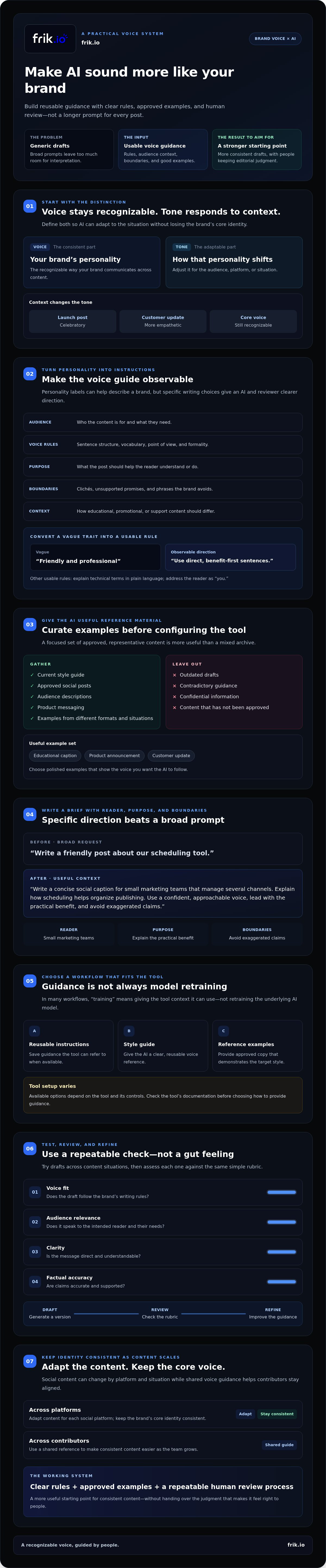
Keep voice and tone distinct. Voice is your brand’s consistent personality; tone is how that personality shifts to suit the audience, platform, or situation. A brand might stay concise and expert while sounding celebratory in a launch post or more empathetic in a customer update. Defining both helps AI adapt without losing the core identity.
Why do generic prompts produce off-brand content?
A label like “friendly and professional” can mean many things. One draft may sound casual; another may lean formal. Without a defined audience, context, and examples, the AI has little direction beyond broad instructions.
For a practical answer to how to train AI on my brand's tone, replace vague adjectives with observable direction. Specify who the post is for, what it should help them do, and how the brand communicates. For example, ask for direct sentences, a benefit-led opening, and plain-language explanations of technical terms.
Illustrative example
- Before: “Write a friendly post about our scheduling tool.”
- After: “Write a concise social caption for small marketing teams that manage several channels. Explain how scheduling helps organize publishing. Use a confident, approachable voice, lead with the practical benefit, and avoid exaggerated claims.”
The second brief gives the AI a reader, a purpose, and boundaries. That’s a more useful starting point for consistent drafts. A voice guide makes those instructions easier to reuse.
Build a Brand Voice Guide AI Can Actually Use
A useful voice guide turns scattered knowledge into a shared reference. Before configuring an AI tool, collect materials that show how your brand communicates and what it can accurately say. Start with your current style guide, approved social posts, audience descriptions, and product messaging. Include examples from different formats and situations, such as an educational caption, a product announcement, and a customer update.
Curate the material instead of uploading everything. Remove outdated drafts, contradictory guidance, confidential information, and content that hasn’t been approved. A polished example that reflects the voice you want is more useful than a large archive of mixed-quality copy. Research from Harvard Business School offers a case study on replicating a leader’s writing style, a reminder that matching style is only one part of communicating effectively with an audience.
Use observable rules, not just personality adjectives
Words like “bold” or “friendly” can help describe a brand, but they don’t tell an AI what to write. Convert those traits into instructions a reviewer can recognize. For example: “Use direct, benefit-first sentences,” “explain technical terms in plain language,” or “address the reader as ‘you.’” Specify preferred vocabulary, sentence length, formality, and point of view. Add clear exclusions, including clichés, unsupported promises, and phrases your brand avoids.
Voice can shift by context without losing its core. An educational post might explain a process step by step; a promotional post can lead with a practical benefit; a customer-support reply may need more empathy and less sales language. State those differences explicitly so the AI has direction for each type of content.
Voice-guide checklist
Use this inventory to create a concise reference before adding guidance to an AI tool:
- Audience: Who the content is for and what they need.
- Voice: Core personality traits expressed as specific writing rules.
- Language: Preferred terms, point of view, formality, and sentence style.
- Boundaries: Words, clichés, claims, and topics to avoid.
- Examples: Approved content across formats and situations.
- Context: How the voice adapts for educational, promotional, and support content.
Keep the guide easy to update, and make sure contributors use the same approved version. For more ideas, see this AI Brand Voice Tool guide. frik.io supports style-guide-based AI training for brand-voice content, helping teams put documented guidance to work. Check the tool’s current documentation for setup details and supported inputs.
Choose the Right Way to Teach AI Your Brand Voice
The right method depends on how often you create content, how many people need to use the guidance, and what controls the AI tool provides. A reusable prompt may be enough for occasional drafts. Teams producing content across channels may benefit from persistent instructions or style-guide context that makes approved guidance easier to reuse.
Compare the main approaches
| Approach | Setup effort | Repeatability | Control | Best suited to |
|---|---|---|---|---|
| Reusable prompts | Low | Depends on people reusing the prompt | Instructions are easy to edit for each task | Occasional or exploratory drafting |
| Saved instructions | Low to moderate | Can reduce repeated setup if the tool retains them | Varies by tool and how instructions are applied | Recurring tasks with stable guidance |
| Style-guide context and examples | Moderate | Can provide a shared reference, depending on tool support | Guidance can be grounded in approved material | Teams creating regular content across formats |
| Fine-tuning | Higher and more technical | May support a specialized workflow | Requires a separate technical process | Specific needs that justify exploring model customization |
For many everyday content workflows, clear reusable instructions and strong examples are a practical place to start. Fine-tuning is a separate technical approach, not a default requirement or a feature to assume every tool provides. None of these methods guarantees perfect voice consistency. Generate drafts, review them against your rules, and refine the guidance where it falls short.
If you’re researching how to train AI on my brand's tone, check each product’s documentation for the material it accepts, whether instructions persist between tasks, and which settings your team can control. Availability and setup vary. Don’t assume a tool supports a particular input or training method without confirming it.
Compare tools against your actual workflow
Look beyond the generation screen. Check whether the tool lets your team provide its own style guidance and approved examples, and whether it can adapt drafts for different platforms while preserving the core voice. Consider who needs to review content, how feedback is handled, and whether clients or other contributors need an approval step.
For social teams, an AI social media platform may bring voice-guided generation, platform-specific adaptation, and collaborative review into one workflow. frik.io supports style-guide-based AI training, brand-voice captions, platform-tailored posts, and client review through approval portals. Review its current documentation for setup details and supported inputs. The AI content workflow may be relevant if those capabilities match your needs.
For more on applying voice guidance to content production, read the AI brand voice content generation guide.
Test AI Drafts and Improve Brand-Voice Consistency
A voice guide gives AI direction. A review cycle shows whether that direction is working. Test drafts against specific rules, not just a general feeling that something sounds “right.” Use the same process for each test: brief, generate, score, revise, and update the guidance when you see recurring issues.
Score each draft against a simple rubric
Rate each area as meets the standard, needs revision, or fails the standard. Add a short note explaining the result so reviewers can compare feedback and spot patterns.
- Voice fit: Does the draft follow the brand’s vocabulary, sentence rhythm, point of view, and formality rules?
- Audience relevance: Does it address the intended reader’s needs and use language that fits their familiarity with the topic?
- Clarity: Is the main point easy to understand, and does the draft follow the platform’s format conventions?
- Factual accuracy: Are product details, claims, names, and other facts correct and supported?
Keep the accuracy check separate from the tone score. A caption can sound exactly like the brand and still contain an incorrect claim. Give sensitive topics and high-impact communications extra human review.
Turn feedback into better guidance
After scoring a draft, revise it and note why. If reviewers repeatedly remove exaggerated wording, add a specific instruction against unsupported claims. If they keep shortening long introductions, define a preference for concise openings. Turn recurring edits into rules or approved examples instead of fixing each draft in isolation.
Keep the reference set current, too. Replace examples that no longer reflect the brand, and resolve conflicting instructions rather than layering on more rules. This makes the voice system easier for contributors to follow and reduces repeated corrections.
Human review is quality control, not a sign that AI has failed. People provide context, judgment, and accountability that a voice guide alone can’t supply. For social content, check that platform adaptations preserve the intended message as well as the brand’s identity. The AI social media management strategy guide offers more workflow context.
To put the cycle into practice, take one brief and compare the first draft with the revised version. If you’re exploring how to train AI on my brand's tone, use the differences to sharpen the next instruction. frik.io’s brand-voice content workflow combines style-guide-based generation with collaborative review, an approach to consider when assessing your team’s process.
Scale Brand-Voice Training Across Social Channels and Teams
A documented voice system becomes more valuable as more people create content. It gives employees, agency contributors, and client reviewers a shared reference instead of relying on individual instincts. Keep the core guidance in one approved place, make ownership clear, and update it when your positioning, audience, or messaging changes.
Keep the voice consistent, not the copy identical
Each platform has different conventions. Adapt length, structure, and format to fit the channel while retaining the same brand personality, vocabulary preferences, and factual boundaries. A LinkedIn post might provide more context; a shorter social caption may lead with the main benefit. Copying one version everywhere can feel out of place, even if the wording is on-brand.
Before expanding the workflow, test sample outputs for every channel you use. Check that platform-specific edits improve fit without changing the core message. Then document the differences in your guidance so contributors know what to adapt and what must remain consistent.
Choose a workflow that supports your team
As you scale how to train AI on my brand's tone across accounts and contributors, look for a workflow that can apply documented voice guidance, adapt content for different platforms, and support collaborative review. Decide who drafts, who gives feedback, and who approves the final post. Clear roles help prevent conflicting edits and keep client content aligned with agreed guidance.
Frik.io is an AI-powered social media management platform that supports style-guide-based AI generation, platform-tailored posts, and client review through approval portals. These capabilities may suit teams and agencies that want to connect brand-voice content with a shared review workflow. Check current product documentation for setup details and supported inputs, then assess the platform against your requirements.
Start small: select a few representative accounts or channels, test the guidance with each, and review the drafts before widening access. This gives your team a practical way to catch gaps before the system supports more contributors and content.
Information about Frik.io’s AI social media workspace can help you assess its brand-voice generation and review capabilities against your workflow.
Turn Your Brand Voice Into a Repeatable Workflow
Consistent AI content doesn’t come from finding one perfect prompt. It comes from a clear voice guide, useful examples, and a review process that helps your team refine the guidance over time. Keep the core brand identity steady, then adapt the format and tone to fit each audience and platform.
If you’re figuring out how to train AI on my brand's tone, start with the essentials: document specific writing rules, test drafts against them, and use reviewer feedback to improve the system. Human judgment still matters. It checks context, accuracy, and nuance before content goes out.
Frik.io supports AI generation based on a user’s style guide, platform-tailored content, and collaborative review workflows. These capabilities can help bring voice guidance and social content approvals into a more connected process. Check the current product documentation to confirm setup details and supported inputs.
With a practical system in place, you can make production more repeatable while keeping drafts closer to the brand people recognize.
Frequently Asked Questions
How do I train AI to write in my brand’s tone?
To learn how to train AI on my brand's tone, give the tool clear instructions, reliable reference material, and examples of approved writing. Describe your audience, preferred vocabulary, sentence style, and phrases or claims to avoid. Generate a draft, review it against those rules, and adjust the guidance when you spot recurring issues. This process usually guides the AI’s output; it doesn’t necessarily retrain the underlying model.
What should I include in an AI brand voice guide?
Include your audience, core voice traits expressed as specific writing rules, preferred vocabulary, point of view, sentence style, and level of formality. Add phrases, clichés, and unsupported claims to avoid. Include current, approved examples from different formats, plus guidance on how tone changes for educational, promotional, or customer-support content. Remove confidential, outdated, or conflicting material, and keep the guide accessible to everyone creating or reviewing content.
Can AI learn my brand voice from examples?
Yes, examples can show an AI what your instructions mean in practice, provided the tool lets you supply reference content or examples. Choose approved pieces that represent the voice you want, and include different formats or situations. You can also explain what makes each example effective, such as its direct opening or approachable vocabulary. Examples guide generation, but they don’t guarantee every draft will match, so review outputs and confirm tool-specific capabilities.
Do I need to fine-tune an AI model to match my brand tone?
No. Fine-tuning is not the default requirement for brand-voice content. Reusable prompts, saved instructions, or style-guide context may be sufficient for many workflows, depending on the AI tool and how often your team creates content. Fine-tuning is a separate technical approach, and its availability and setup vary. Start with documented guidance and examples, then check the tool’s documentation before deciding whether a more technical method is necessary.
How do I keep AI-generated social media posts on-brand?
Use one current voice guide, give each task a clear audience and purpose, and check every draft against specific standards. Review voice fit, relevance, clarity, and factual accuracy separately. Also confirm that the post fits the platform and doesn’t make unsupported claims. Record recurring edits and turn them into clearer instructions or examples. Human review remains important for context, accuracy, sensitive topics, and final approval.
How often should I update my AI brand voice instructions?
Update your instructions whenever your brand positioning, audience, product messaging, or content standards change. Also review them when feedback reveals recurring problems, such as drafts that sound too formal or use outdated terms. Replace examples that no longer represent approved content, and resolve conflicting rules rather than adding more layers. A regular review helps keep guidance useful, but the right cadence depends on how often your brand and workflow change.
Can AI adapt my brand voice for different social media platforms?
Yes, if the tool supports platform-specific content generation or adaptation. Provide the same core voice rules, then specify how each post should change in length, structure, or format for its channel. Adaptation should fit platform conventions without changing the brand’s identity or factual boundaries. Review sample outputs for each platform before scaling the workflow. Capabilities vary by tool, so check its documentation for supported channels and controls.
Explore frik.io’s AI social media workspace to assess its brand-voice generation, platform adaptation, and review features for your team’s workflow.


