
What if the biggest change artificial intelligence social media brings isn’t just more content, but a new question about what deserves your trust? AI can recommend what appears in your feed, help create posts, analyze audience activity, or power chatbots. Those roles are often blurred together, even though each affects your experience differently.
It’s reasonable to wonder whether AI-assisted posts will feel generic or make a brand seem less genuine. Used without review, AI can flatten a distinct voice and spread mistakes faster. Used with clear direction, it can reduce repetitive work while leaving strategy, context, and final judgment to people.
This article explains how AI shapes social media for creators and audiences, where it can help, and what risks to watch. You’ll learn to distinguish content generation from recommendations and analytics, assess trust and disclosure concerns, and apply practical safeguards. The goal isn’t to automate every interaction or reject useful tools. It’s to make deliberate choices that protect human connection while making your workflow more efficient.
Key Takeaways
- Separate AI’s roles in social media, from drafting and analysis to recommendations, moderation, and audience interaction.
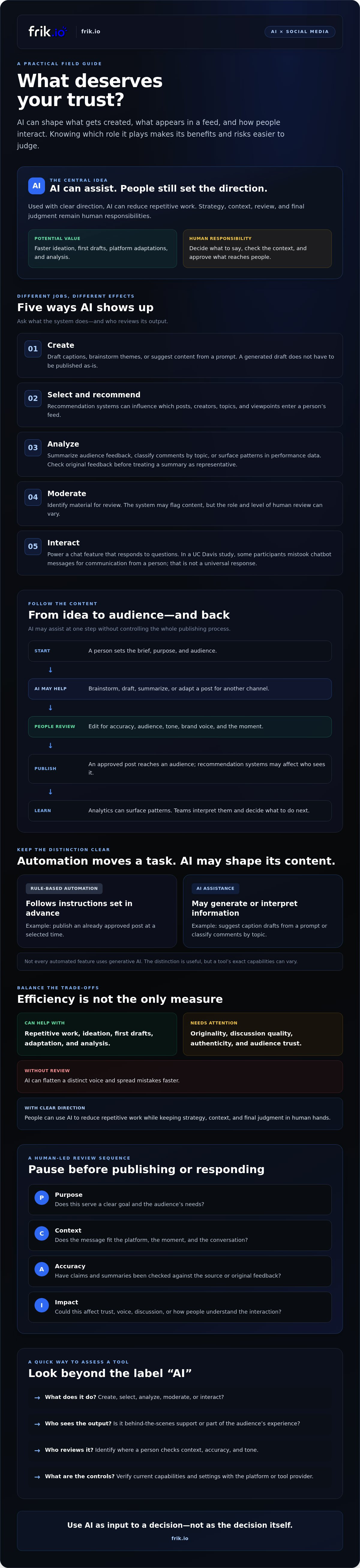
- Trace how AI-assisted content moves through adaptation and review before it reaches an audience.
- Weigh efficiency against tradeoffs in originality, discussion quality, and audience trust.
- Use a human-led review sequence to check purpose, context, accuracy, and impact before publishing or responding.
- See how artificial intelligence social media tools can support brand-true content and platform adaptation without replacing editorial judgment.
What Does Artificial Intelligence in Social Media Actually Mean?
Artificial intelligence (AI) is a capability: systems use data and learned patterns to generate, classify, recommend, or interpret information. A social media platform is the environment where those capabilities may be built in or connected through other tools. In practice, artificial intelligence social media can mean AI that drafts a caption, summarizes engagement patterns, recommends posts for a feed, flags content for review, or powers a conversational feature.
These uses aren’t interchangeable. Some are visible to audiences, while others support creators and social media teams behind the scenes. A generated caption, for example, doesn’t have to be published as-is. A person can provide the brief, compare drafts, edit the wording, and approve the final post. AI may assist at one step without controlling the whole publishing process. For broader context, see this overview of how AI is used in marketing, including social computing and virtual influencers.
How Is AI Different from Social Media Automation?
Rule-based automation follows instructions set in advance. A scheduling workflow, for example, can publish an approved post at a selected time. AI may instead generate options or interpret information: a writing assistant could suggest caption drafts from a prompt, while an analytics feature might classify comments by topic. The distinction is useful, but not every automated feature uses generative AI. Automation moves a task along; AI may help produce or assess its content.
Where Does AI Show Up in a Social Media Experience?
Look at both sides of the screen. Audiences may encounter recommendation systems that select feed content, moderation systems that identify material for review, or chat features that respond to questions. Teams may use AI to draft copy, adapt a post for another channel, summarize audience feedback, or spot patterns in performance data. These are different functions, and they aren’t a standard set of features available everywhere.
To understand what a particular system does, check whether it creates, selects, analyzes, or moderates content, and who reviews the output. Platform capabilities and controls change, so verify current features directly with the platform or tool provider before relying on them. Knowing the difference helps teams choose an appropriate workflow and helps audiences better understand how content reaches them.
How AI Shapes Social Media for Creators and Audiences
AI can influence a post before it exists and after it reaches a feed. A creator might use a system to brainstorm themes, draft caption options, or adapt a message for different platforms. A person then edits the draft for its audience, accuracy, and tone. After approval, the post may be published. Recommendation systems can influence who encounters it, while analytics may help the team decide what to create next.
Not every AI influence is visible. A person can write and approve a post while AI works behind the scenes to sort comments or recommend content. Conversely, an AI-generated image or caption is part of the published experience itself. The distinction matters: one use shapes how content is managed or discovered, while the other affects what audiences see and may want to evaluate.
What Changes for Social Media Creators and Teams?
AI can speed up ideation, first drafts, platform adaptations, and analysis. It can’t supply the full strategy. Teams still need to decide what they stand for, what their audience needs, and whether a message fits the moment. A short caption that works on one platform may need more context on another. Brand knowledge and editorial judgment turn a quick draft into communication that feels intentional.
Analysis can inform publishing choices, too. A summary of comments or engagement patterns may surface topics worth investigating, but it isn’t a substitute for reading feedback in context. Check the original comments before treating a summary as representative. Use AI output as input to a decision, not as the decision itself.
What Changes for People Scrolling and Responding?
Recommendations can affect which creators, topics, and viewpoints enter someone’s feed. Interactive AI can shape conversations, too. In a UC Davis study, some participants mistook chatbot messages for communication from a person. That finding illustrates a possible perception, not a universal response to every chatbot or social interaction. A separate Nature study tested defined forms of AI assistance in a specific group-discussion setting; its results shouldn’t be treated as a prediction of behavior across all social platforms.
Young people’s experiences are another part of the picture. The Pew Research Center survey examines teens’ use of social media and AI chatbots, offering context for how these technologies can enter everyday digital life. Together, recommendations, generated posts, and interactive systems shape what gets published and how audiences encounter and respond to it.
AI shapes both the choices creators make before publishing and the content and interactions audiences experience afterward. Teams that want to keep this process human-led can explore brand-voice content and collaborative review workflows to support drafting and adaptation while keeping people involved in approval.
AI on Social Media: Where Efficiency Meets Authenticity
AI can make a social media workflow faster without making its output more relevant, accurate, or engaging. A draft generator may give a team several caption options quickly, leaving more time for review. But speed is an operational benefit, not proof of better audience response or business results. The value depends on how the team uses that time.
| Potential benefit | Possible tradeoff | Context needed |
|---|---|---|
| Draft options help teams move past a blank page. | Generic phrasing can dilute originality or sound unlike the brand. | Does the draft reflect a real audience need, brand voice, and specific point of view? |
| Adaptation can help teams scale content across platforms. | Repeating similar posts may make feeds feel uniform. | Has each version been edited for the platform’s format and audience expectations? |
| AI can summarize comments or surface patterns for review. | Automated summaries may miss nuance and reduce complex discussion to broad themes. | Have people checked the original feedback before drawing conclusions? |
| Interactive AI can make responses or conversation prompts easier to produce. | Unclear or overly scripted interactions may affect trust and discussion quality. | Is a person monitoring sensitive exchanges and correcting errors? |
Can AI Make Social Media Content More Effective?
AI can make parts of content production more efficient. Teams can use it to explore different openings, draft alternatives, or reshape a message for another platform. That can reduce repetitive work and leave more time for research, creative direction, and review. But output volume is only a workflow measure. It doesn’t establish that more people will see, value, or act on a post.
A Nature study tested specific AI interventions in small-group discussions, not across every social platform or marketing workflow. Results varied: some interventions increased participation or content volume, while perceived discussion quality or authenticity could fall. The defined setting and tested interventions limit how broadly those findings can be applied. More content does not automatically mean better content; quality depends on relevance, accuracy, originality, and audience response.
Why Can AI-Assisted Content Feel Less Authentic?
Risk rises when a draft is published without enough context or editing. Generic language, missed cultural cues, and repeated structures can make posts feel interchangeable. AI assistance alone, however, doesn’t make content inauthentic. Audience perception depends on the message, the situation, and how the tool is used. A human-led edit that adds specific experience and a clear point of view can preserve the brand’s voice while still benefiting from AI support.
How to Use Artificial Intelligence in Social Media Responsibly
Responsible use starts with a clear purpose and ends with a person accountable for the result. A repeatable review process helps teams use artificial intelligence social media tools for efficiency without handing over editorial judgment, audience trust, or sensitive decisions.
What Should a Human Review Before Publishing?
Assign an owner to approve each AI-assisted post and handle sensitive interactions. That person needs enough context to spot errors a fluent draft can hide and to know when a topic needs additional review. Use this sequence before publishing:
- Define the purpose. Identify the audience need and the task AI is meant to support, such as generating draft options.
- Check the context. Review the brief, source material, timing, and conversation the post will enter. Remove private or unnecessary sensitive information from prompts.
- Edit for voice and fit. Replace generic language, check platform conventions, and make sure the post reflects the brand’s actual point of view.
- Verify the details. Confirm facts, names, claims, links, and any statements that could mislead or harm someone. Don’t treat confident wording as evidence.
- Assess the impact. Consider how the post could be interpreted, whether disclosure is appropriate, and who will monitor responses after it goes live.
Before approval, run a quick checklist:
- Accuracy: Are factual claims checked against reliable information?
- Tone: Does the message sound clear, respectful, and consistent with the brand?
- Audience fit: Does it answer a real need in language this audience understands?
- Privacy: Does it expose personal, confidential, or unnecessary information?
- Transparency: Could people reasonably mistake generated or altered content for something else?
How Can Teams Protect Trust and Measure Quality?
Set disclosure practices with the content and audience in mind, then check current platform policies and applicable requirements before publishing. Rules can differ by platform, content type, and location, so don’t rely on an old checklist as a universal standard. Escalate sensitive, safety-related, or high-stakes posts and replies to an appropriate human reviewer.
Measure quality alongside speed. Before testing a workflow, choose indicators such as factual corrections, review time, audience feedback, or whether posts meet editorial standards. Compare results over a defined period, and treat changes as signals to investigate, not proof that AI alone caused an outcome. Use what you learn to refine prompts, brand guidelines, and approval steps.
For teams looking to formalize human review, explore brand-voice content and approval workflows that keep people involved in the publishing process.
What Responsible AI in Social Media Looks Like for a Brand
Responsible use isn’t about handing a brand’s voice or strategy to AI. It’s about using AI to support repeatable tasks while keeping people accountable for the message, its context, and its approval. A draft can be useful without being ready to publish.
What Should a Brand Look for in an AI-Assisted Workflow?
Look for tools that let your team provide brand guidance, edit drafts, adapt content for different platforms, and review changes before publication. A workflow is easier to coordinate when creation and publishing steps connect, rather than being scattered across documents and conversations. A guide to using an AI brand voice tool can help teams consider how brand guidance should inform generated drafts.
frik.io is one example of human-led AI assistance. Teams can train content generation with a style guide, draft captions in their brand voice, and adapt posts for different platforms. Collaborative approvals and a client review portal keep relevant people involved before a post is published. These controls support review; they don’t replace a team’s judgment about whether the content is right for its audience.
When Does a Social Media Platform Become Useful?
Disconnected processes can become harder to coordinate as more people contribute to drafting, review, and publishing. If your team regularly loses track of edits, approvals, or platform-specific versions, a shared workspace may help keep those steps together. The useful question isn’t whether a platform promises to run social media on autopilot. It’s whether its capabilities support your existing human-led workflow without taking over strategy.
frik.io supports creating, adapting, scheduling, and publishing content, alongside collaborative review. Teams still decide what to say, check the final copy, and approve publication. To assess whether this type of setup fits your process, read the AI social media management platform guide.
Choose artificial intelligence social media tools based on the work they help your team do and the review they make possible. If you want to bring brand-voice drafting, adaptation, and approvals into a shared publishing workflow, explore the platform guide as a next step.
Put AI to Work Without Losing the Human Touch
Artificial intelligence social media tools can help teams create and adapt content, surface useful insights, and coordinate publishing. But efficiency alone isn’t the goal. Strong results depend on human judgment: checking context, protecting accuracy, and making sure each post serves its audience. AI-assisted content can still sound like your brand when people guide the draft and make the final editorial decisions.
Build a workflow that keeps review visible. frik.io supports brand-voice content generation informed by a team’s style guide, along with collaborative client review and approval. Teams can create, adapt, schedule, and publish content across multiple social networks from one workspace, while keeping people involved before posts go live.
If your team is ready to coordinate these steps in one workflow, explore frik.io’s AI-powered social media workspace. Use AI where it can reduce repetitive work, and keep human insight at the center of every connection.
Frequently Asked Questions
What is artificial intelligence in social media?
Artificial intelligence in social media is the use of AI systems to generate, classify, recommend, or interpret information connected to social platforms. It can help draft a caption, sort feedback, recommend posts for a feed, or flag content for review. AI is a capability, not a specific platform or tool. It may work behind the scenes or produce content people see directly, and it doesn’t always operate without human input.
How is artificial intelligence used in social media?
Teams can use artificial intelligence social media tools to brainstorm ideas, draft captions, adapt posts for different platforms, and summarize audience feedback. Platforms may use AI to recommend feed content, moderate material, or support interactive features such as chatbots. These functions are distinct: drafting affects how a post is created, while recommendations affect what someone may encounter. Capabilities vary by platform and tool, so check current feature details before relying on them.
Does AI improve social media engagement?
AI may help teams produce drafts or analyze audience activity more efficiently, but that doesn’t guarantee higher engagement. Reach, comments, shares, and other outcomes depend on factors such as relevance, timing, audience needs, and the platform. Treat efficiency and engagement as separate measures. Before testing an AI-assisted workflow, define the quality and audience indicators you’ll track, then review the results in context rather than assuming a change came from AI alone.
Can people tell when social media content is AI-generated?
Sometimes, but not reliably from appearance alone. Generic phrasing, repeated structures, errors, or mismatched context may make a post seem machine-generated. Other AI-assisted content may be heavily edited and difficult to distinguish from human-written material. Perception also depends on the audience, content type, and how AI was used. Don’t rely on guesswork to judge authenticity; focus on whether the post is accurate, relevant, transparent when appropriate, and genuinely useful.
What are the risks of using AI on social media?
AI can produce inaccurate claims, generic language, or content that misses cultural and conversational context. It may also encourage teams to publish more without enough review, weakening originality or discussion quality. Sharing private information in prompts can create privacy concerns, and automated replies may mishandle sensitive interactions. Reduce risk by checking facts, limiting personal data, editing for audience fit, and assigning a human owner to review posts and escalate high-stakes conversations.
Should brands disclose AI-generated social media content?
Brands should check the current rules of each platform and any applicable disclosure requirements before posting. The right approach may depend on the content, audience expectations, and how realistic or consequential the generated material is. Don’t assume every AI-assisted edit requires the same label, or that no disclosure is needed because a person reviewed it. Set a clear team policy, keep it current, and disclose when required or when clarity would help audiences understand what they’re seeing.
How can brands use AI on social media without losing their voice?
Give AI clear brand guidance, use its output as an editable starting point, and have a person make the final decisions. A style guide can provide examples of preferred language, tone, and topics to avoid. Then edit each draft for platform fit, audience context, and accuracy. Teams can use tools such as frik.io to generate brand-voice content from a style guide and coordinate collaborative review, while retaining human approval before publication.


