
The concept of a static peak hour is dead. In 2026, hitting publish at a fixed time is no longer a strategy; it's a gamble. You've likely experienced the frustration of high-quality content yielding low engagement because it missed a shifting algorithmic window. Managing global time zones and the manual grind of after-hours posting has become an operational bottleneck for teams that have outgrown basic tools. It's time to replace the guesswork with a high-velocity command center.
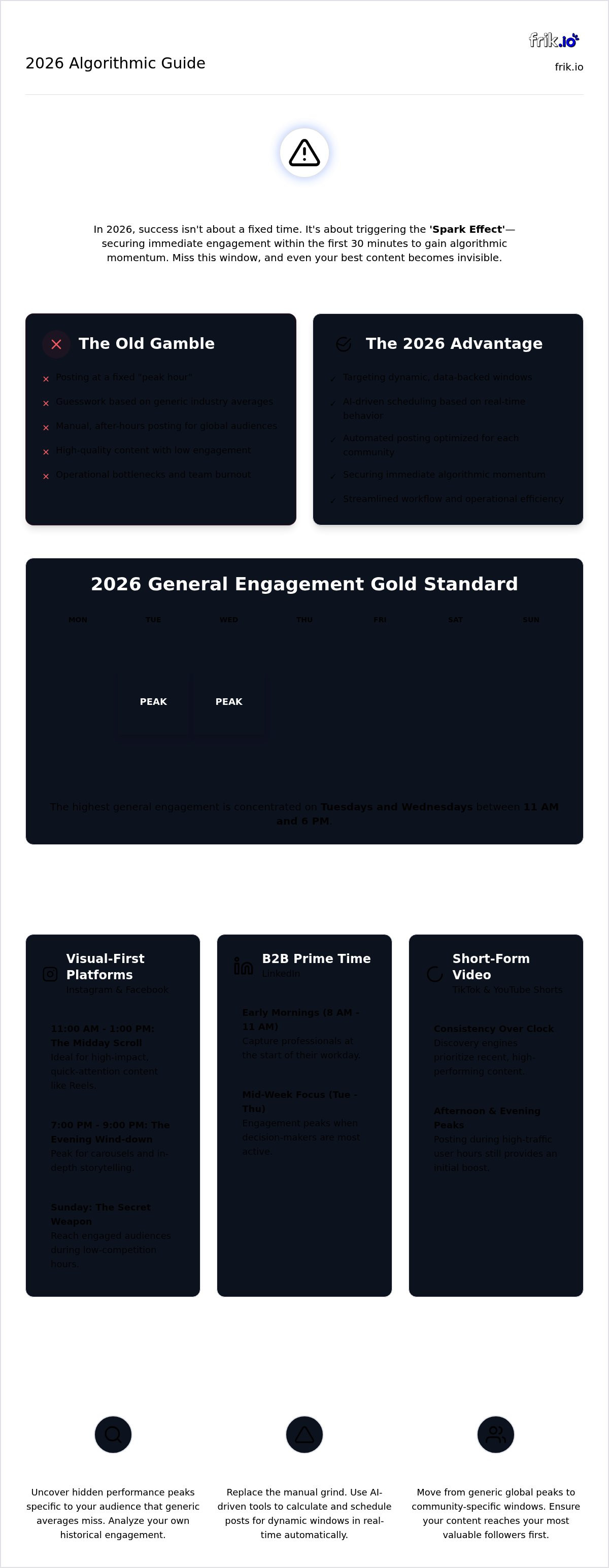
This article provides the precise, data-backed windows for the best time to post on social media in 2026. You'll gain a clear schedule tailored to the current engagement landscape, where Tuesdays and Wednesdays between 11 a.m. and 6 p.m. have emerged as the gold standard for reach. We'll preview the specific nuances for TikTok, Instagram, and LinkedIn while revealing how AI-driven scheduling eliminates the manual burden. By the end of this guide, you'll possess a streamlined workflow that transforms your social presence into an automated engine for growth. Move from creative block to operational efficiency with a strategy built for the 2026 algorithm.
Key Takeaways
- Pinpoint the best time to post on social media by utilizing the 2026 "spark effect" to secure immediate algorithmic momentum.
- Learn why the B2B Prime Time for LinkedIn has shifted to early mornings and how to capitalize on the Instagram midday scroll.
- Audit your historical data to uncover hidden performance peaks that generic industry averages frequently overlook.
- Deploy Autopilot scheduling to replace the manual grind and calculate dynamic posting windows in real-time.
- Master the transition from global peaks to community-specific windows to ensure your content reaches your most valuable followers first.
The Truth About Social Media Posting Times in 2026
In 2026, the best time to post on social media isn't a static slot on a digital calendar. It's a dynamic window for algorithmic momentum. We call this the 'spark' effect. Your post needs an immediate burst of engagement to signal quality to the platform's discovery engine. Without this initial velocity, even high-end content remains invisible. This shift reflects a deeper change in how social networks function. They no longer just show what's new; they show what's gaining heat. If you miss that initial window, the algorithm assumes the content isn't relevant to the wider community.
We've moved beyond global peak hours. Your audience doesn't live in a single time zone; their habits aren't monolithic. Effective Social media optimization now requires community-specific targeting. This is where ai social media management redefines the workflow. Instead of guessing when your followers are active, sophisticated systems analyze real-time behavior to trigger Autopilot scheduling. These tools don't just look at when people are online. They look at when they are likely to comment or share. This data-driven precision is what separates high-performing brands from those stuck in the manual grind.
Let's clear the air on third-party schedulers. The "shadowban" fear is a relic of the past. Modern APIs are the industry standard. Platforms prioritize content that drives meaningful interaction, regardless of the tool used to publish it. Efficiency shouldn't be sacrificed for outdated myths. Determining the best time to post on social media is no longer a manual task for the modern marketer; it's an automated win for the efficient command center.
Recency vs. Relevancy: How Algorithms Decide
The first 30 minutes are critical. Algorithms use this window as a litmus test for quality. If your core community engages immediately, the platform pushes your content to a broader discovery feed. This initial relevancy score determines your total reach. In 2026, AI discovery engines prioritize "freshness" alongside user interest. Winning the clock means winning the algorithm. It's about being present when the "spark" is most likely to catch, ensuring your content isn't bypassed by more timely updates.
The Cost of Ignoring the Clock
Posting during off-peak hours leads to the "buried content" problem. Your post sits at the bottom of the feed, struggling against engagement decay. Every hour that passes without interaction reduces the post's half-life. For agencies, managing this manually for multi-time-zone clients is a recipe for burnout. You need a unified strategy that automates these windows across every workspace. Efficiency isn't just a luxury; it's the difference between a viral hit and a digital ghost town. When you ignore the clock, you're essentially letting your best work go to waste.
2026 Engagement Windows: Every Major Platform Analyzed
Platforms in 2026 aren't monolithic. While general benchmarks suggest midweek peaks, your specific audience behavior dictates the actual ROI. The American Marketing Association highlights that timing remains a pillar of visibility, yet the "when" has splintered across different user intents. Finding the best time to post on social media requires a platform-by-platform breakdown that accounts for these shifting habits. You can't apply a LinkedIn strategy to a TikTok audience and expect the same velocity.
Visual-First Platforms (IG, TikTok, Pinterest)
Instagram and Facebook engagement now centers on two distinct phases: the Midday Scroll and the Evening Wind-down. For 2026, the Midday Scroll (11:00 AM to 1:00 PM) captures users during breaks, making it ideal for high-impact Reels that require quick attention. Conversely, the Evening Wind-down (7:00 PM to 9:00 PM) is the peak for carousel posts and long-form storytelling. While Sundays have historically shown lower engagement, creators are now using them as a "secret weapon" to reach audiences during low-competition hours. Success here depends on mapping your social media analytics for agencies to these visual peaks. If you're managing multiple high-growth accounts, use Autopilot Scheduling to ensure your content hits these windows without manual intervention.
TikTok and YouTube Shorts operate on a different logic. Consistency often outweighs specific hour-slots because the discovery engine prioritizes recent high-performing content regardless of the exact upload minute. However, midweek windows between 3:00 PM and 5:00 PM consistently show the highest concentration of active users. The goal is to feed the algorithm enough data to identify your community-specific peak.
Professional and Text-Heavy Networks (LinkedIn, Threads)
LinkedIn has seen a significant shift toward early morning engagement. The 2026 "B2B Prime Time" now starts at 7:00 AM and runs until 9:00 AM as professionals catch up on industry news before the workday begins. The Tuesday through Thursday "Golden Triangle" remains the most reliable window for reach, but a new "Coffee Break" window has emerged between 10:00 AM and 11:30 AM. This is when users seek professional distractions between meetings.
Threads and X engagement patterns are driven by real-time news spikes. Unlike the older logic of scheduled broadcasting, these platforms reward accounts that post during active conversations. Threads specifically sees high engagement during morning news hours (8:00 AM to 10:00 AM), where the community-driven nature of the platform favors discussion-based threads over static announcements. Precision in these windows transforms your social presence from a background noise into a central hub for your industry.
Why 'Static' Best Times are Obsolete (and What to Use Instead)
Relying on industry averages is a strategy for brands that haven't yet scaled. If every business follows the same generic heatmap, the feed becomes a crowded battleground where reach is expensive and attention is scarce. Your best time to post on social media isn't a fixed point on a chart; it's a moving target dictated by your specific community's behavior. The flaw in static averages is simple: they treat your audience as a monolith rather than a dynamic group of individuals with unique scrolling habits. Professional teams have outgrown these broad guesses in favor of precision.
Transitioning from a 'Calendar View' to a 'Velocity View' is the next logical step for a modern workspace. A traditional calendar shows you where content sits, but a Velocity View shows you where it gains momentum. Autopilot scheduling leverages real-time data to identify these windows as they open, ensuring your content doesn't just go live, but goes live when it has the highest probability of triggering the 'spark' effect. When you pair this with Brand-True AI, you ensure that the quality of your captions matches the precision of your timing. This creates a seamless bridge between creative intent and algorithmic success.
The Power of Personalized Data
Standard heatmaps only show you when people are online, not when they are ready to engage. frik.io identifies your unique engagement 'fingerprint' by analyzing historical interaction patterns at the individual level. This personalized approach is the only way to truly master the best time to post on social media for a diverse, modern audience. AI-driven scheduling reduces creative friction by 40% by eliminating the manual decision-making process. By automating the 'when,' you free up your team to focus on the 'what,' turning your social presence into a high-output engine that runs with minimal oversight.
Managing Global Reach Without the Fatigue
International brands face the manual grind of time-zone confusion. Posting at peak hours for audiences in different global markets or across various coastal regions shouldn't require midnight alarms or complex manual math. A 'Follow the Sun' strategy allows you to maintain a consistent presence across every time zone without operational chaos. By automating time-zone offsets within a unified command center, you eliminate the risk of human error and missed opportunities. This unified workspace approach ensures that your reach is scalable and sustainable, allowing your brand to remain active 24/7 without the associated fatigue. Efficiency is the ultimate secret weapon for modern digital workflows.
Actionable Guidance: Building Your 2026 Posting Strategy
Building a resilient strategy in 2026 requires moving beyond passive observation. You need a proactive framework that aligns high-quality content with the best time to post on social media. This isn't a one-time setup; it's a four-step cycle of audit, definition, training, and automation. A perfect schedule fails without a structured execution plan that accounts for both timing and voice. Professional teams use this logic to move from creative block to operational efficiency.
- Audit historical engagement: Identify hidden peaks where specific topics outperformed the average. These outliers often reveal your true community-specific windows.
- Define content pillars: Establish frequency targets for educational, promotional, and cultural content. Diversity in your feed prevents audience fatigue.
- Train your AI: Upload your style guide to ensure every post maintains your unique brand voice at scale. Consistency is the foundation of trust.
- Implement Autopilot: Schedule evergreen content to recycle automatically during high-traffic windows. This ensures your feed remains active without constant manual input.
Mapping Content to the Clock
Not all content is created equal. Save your prime assets, such as high-production videos or deep-dive industry reports, for the absolute peak windows identified in your analytics. Educational content typically thrives in the early morning "Coffee Break" windows when users are looking for professional insights. Promotional posts require the high-velocity "Midday Scroll" to drive conversions while purchase intent is high. Use Action-Result phrasing in your captions to trigger immediate engagement. Begin with a verb and immediately follow with the benefit for the user. This structure captures attention and drives the algorithmic "spark" needed to maximize the best time to post on social media.
The Human-in-the-Loop Workflow
Efficiency shouldn't come at the cost of oversight. Reviewing AI-generated drafts in seconds allows you to maintain total control while moving at ten times your previous speed. For agencies, the Client Approval Portal is a critical tool for maintaining momentum without the friction of endless email chains. You can refine your strategy in real-time based on 2026 ROI reporting, shifting your schedule as audience habits evolve. This streamlined logic transforms your social presence from a fragmented tool into an efficient command center. Deploy Autopilot Scheduling to eliminate the manual grind and start winning the 2026 engagement landscape.
Frik.io: The Efficient Command Center for 2026 Schedulers
Strategy is useless without execution. While knowing the best time to post on social media is a competitive advantage, manually managing those windows across fragmented platforms is an operational bottleneck. frik.io transforms these insights into automatic wins by acting as your efficient command center. It replaces the manual grind with a unified workspace designed for teams that have outgrown basic scheduling tools. You no longer need to set alarms for global peak hours; you simply set the strategy and let the system handle the velocity.
Turn one idea into five platform-specific wins instantly. The platform allows you to tailor content for peak reach across every major network without rewriting every caption from scratch. By managing 10 or more brands from a single workspace, you achieve a level of scalability that was previously reserved for massive agencies. This unified approach ensures that your brand presence remains consistent and high-performing, regardless of how many accounts you oversee. It is the sophisticated solution for modern digital workflows.
The Autopilot Scheduling Advantage
Eliminate the decision fatigue associated with daily posting. Set your engagement targets and let the AI find the optimal gaps in the 2026 algorithmic landscape. Autopilot scheduling doesn't just fill slots; it identifies the best time to post on social media based on real-time community behavior. This allows you to scale post volume without sacrificing brand integrity. You move from creative block to streamlined productivity in three clicks, ensuring your content always hits the "spark" window for maximum momentum. It is a set-it-and-forget-it workflow that actually delivers results.
Streamlining Agency Growth
Replace fragmented spreadsheets and endless email chains with integrated approval portals. The Client Approval Portal allows stakeholders to review and approve AI-generated drafts in seconds, maintaining agency speed without losing human oversight. This transparency builds trust and accelerates the publishing cycle. You can prove ROI using platform-specific analytics that connect timing to tangible engagement growth. By centralizing your operations, you free up the mental bandwidth needed to focus on high-level strategy rather than administrative chaos. Scale your social media with the frik.io command center and transform your workflow into a high-velocity engine for growth.
Master the 2026 Engagement Landscape
The era of guessing the best time to post on social media is over. We've established that peak reach in 2026 depends on algorithmic momentum and community-specific data rather than generic heatmaps. Midweek windows remain high-value, but your unique brand fingerprint is the ultimate signal for growth. Relying on manual decision-making only creates operational bottlenecks that slow your progress. Success now belongs to those who utilize data-driven automation to trigger the "spark" effect exactly when their audience is ready to act.
Scaling this strategy across multiple platforms requires a command center that handles the technical complexity for you. You can move from creative block to streamlined productivity by integrating sophisticated tools into your daily workflow. Start your frik.io trial and automate your peak posting windows to leverage Autopilot scheduling logic and Brand-True AI content generation. With seamless client approval portals, you can manage global growth without the operational fatigue of manual workflows. It's time to reclaim your schedule and let your content work for you. Empower your team with a system that turns complex data into automatic wins.
Frequently Asked Questions
Is there an overall best time to post on social media in 2026?
The best time to post on social media in 2026 is generally Tuesdays and Wednesdays between 11 a.m. and 6 p.m. local time. These windows capture the highest peak engagement across most platforms. However, your specific community behavior is the ultimate authority. Use these broad benchmarks as a foundation but rely on AI-driven insights to pinpoint the exact minutes your followers are most likely to interact with your content.
Does using a scheduling tool like frik.io hurt my organic reach?
Using a professional scheduling tool like frik.io does not hurt your organic reach. Social networks prioritize the quality and engagement signals of your content rather than the method of delivery. Modern platforms use official APIs to ensure seamless integration. In fact, scheduling tools often improve reach by ensuring your content hits the algorithmic "spark" window consistently, which is nearly impossible to manage through manual posting alone.
How many times a day should I post for maximum engagement?
Most brands find success posting 1 to 2 times per day on primary platforms like Instagram or LinkedIn. For high-velocity networks like TikTok or Threads, you can increase this frequency as long as the quality remains high. The 2026 algorithm favors consistency over volume. It's better to post one brand-true masterpiece at the optimal time than five mediocre updates that fail to trigger meaningful engagement or community discussion.
What is the worst day to post on social media?
Sunday is consistently the worst day to post on social media across nearly every major network. Engagement rates drop significantly as audiences shift away from digital feeds and toward personal rest. While some creators use Sundays to reach a low-competition environment, most professional brands see a higher ROI by concentrating their efforts on the Tuesday through Thursday "Golden Triangle." Save your high-impact assets for the midweek peak.
Can AI really find my brand's specific best time to post?
Predictive AI identifies your unique engagement fingerprint by analyzing millions of data points from your historical performance. It moves beyond generic heatmaps to find the best time to post on social media for your specific followers. This technology tracks when your audience isn't just online, but when they are most likely to comment or share. It eliminates the manual guesswork that often leads to buried content and wasted creative effort.
How do I manage different time zones when scheduling posts?
Managing global time zones requires a unified workspace that automates time-zone offsets. Instead of calculating manual math for every region, sophisticated platforms allow you to set a "Follow the Sun" strategy. You simply schedule the content once, and the system triggers the post at the local peak time for each specific audience segment. This approach ensures your reach remains consistent worldwide without requiring your team to work outside of standard business hours.
What is the difference between bulk scheduling and autopilot?
Bulk scheduling involves uploading a fixed list of posts to specific, static time slots on a calendar. It requires significant manual planning. Autopilot scheduling is a more sophisticated, dynamic approach. You define your content pillars and frequency targets, and the AI automatically finds the optimal gaps for engagement. Autopilot ensures your content hits the algorithmic windows in real-time, providing a "set-it-and-forget-it" level of convenience that static bulk tools cannot match.
How do I schedule TikToks and Reels for the best engagement?
Scheduling TikToks and Reels requires focusing on midweek windows, specifically between 3 p.m. and 5 p.m. for maximum visibility. These visual-first platforms thrive on immediate velocity. Use a unified command center to tailor your captions for each platform instantly. By hitting these high-traffic windows consistently, you provide the algorithm with the data it needs to push your content into the wider discovery feeds where new audiences can find your brand.


