
Scaling a multi-client agency in 2026 is no longer about how many hours your team can bill; it's about how much friction you can eliminate from your daily operations. If your current workflow relies on endless email chains for approvals and generic AI that misses the mark on brand voice, you're losing money every time you hit publish. Identifying the most effective social media scheduling tools for multi-brand agencies is the only way to stop high per-seat costs from eroding your margins. You need a system that acts as an efficient command center rather than a fragmented collection of tabs.
We understand that the transition from manual methods to automated scale feels daunting when brand integrity is on the line. You've likely outgrown legacy platforms that treat every client the same. This article promises to show you exactly which elite schedulers offer the automated approval portals and brand-true AI content you need to stay competitive. We'll preview the top-performing platforms of 2026, comparing their ability to handle complex workflows and provide the relief of a truly streamlined publishing process.
Key Takeaways
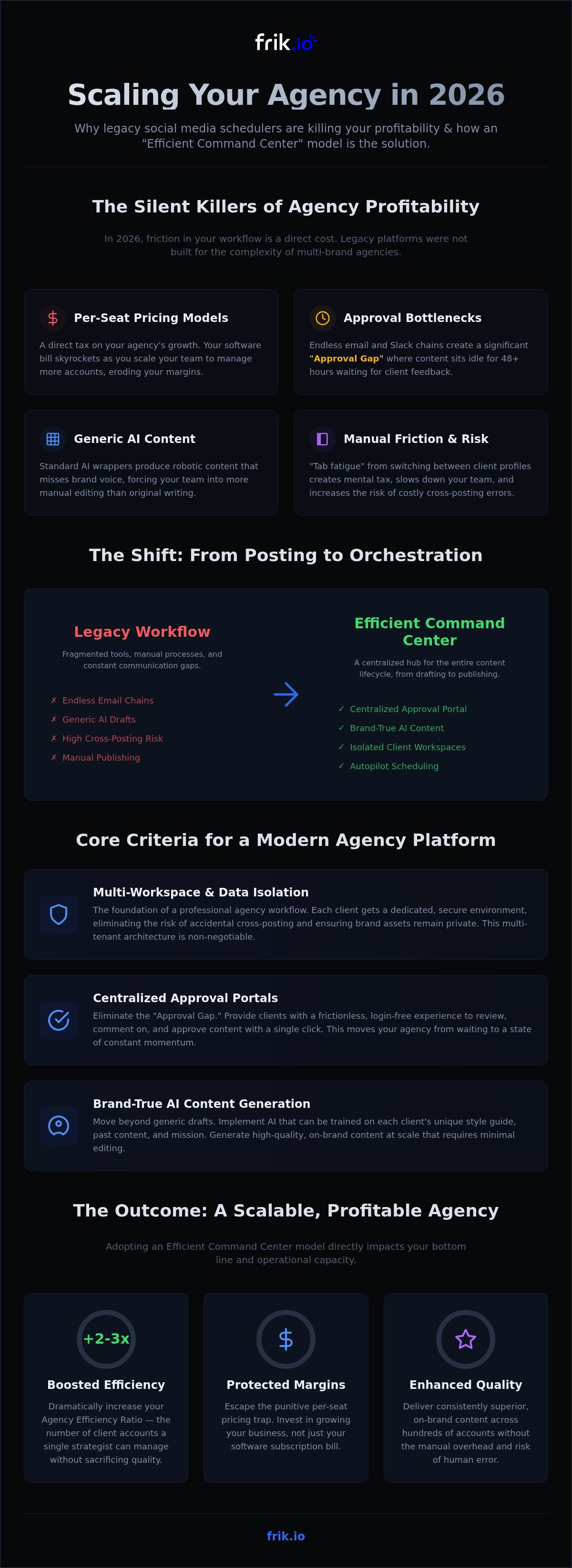
- Identify why legacy tools and per-seat pricing models are the silent killers of agency profitability in 2026.
- Evaluate the most effective social media scheduling tools for multi-brand agencies based on their multi-tenant architecture and data isolation.
- Move beyond generic AI by implementing brand-voice training that perfectly mirrors each client's unique style guide and mission.
- Eliminate communication bottlenecks with centralized approval portals that provide clients with a clear, login-free feedback loop.
- Shift from manual publishing to an "Efficient Command Center" model that uses autopilot scheduling to scale across hundreds of accounts.
Why Legacy Schedulers Fail Multi-Brand Agencies in 2026
Legacy platforms were designed for a simpler era. They struggle when faced with the complexity of modern multi-tenant workflows. Agencies today manage dozens of distinct identities, each requiring precision and total data isolation. When you're forced to jump between accounts, you aren't just losing time; you're increasing the risk of cross-posting errors. Finding the most effective social media scheduling tools for multi-brand agencies requires looking past basic features and focusing on total operational efficiency.
Tab fatigue is a real threat to your bottom line. Switching between ten or more client profiles creates a mental tax that slows down even the most experienced team members. This manual friction often leads to the "Generic AI Trap." Standard GPT wrappers produce content that sounds like a machine because they lack client-specific style guides. Your team ends up spending more time editing AI drafts than they would have spent writing from scratch. This defeats the purpose of automation and dilutes the unique brand identities you're paid to protect.
Hidden costs also hide within your subscription model. Seat-based pricing acts as a direct tax on your agency's growth. As you scale your team to manage more accounts, your software bill skyrockets. This eats into your margins and penalizes success. You need a system that supports scalability without the financial friction of legacy per-seat tiers. High-performance agencies have outgrown these manual, restrictive methods in favor of unified command centers.
The Shift from Posting to Orchestration
Scheduling is now a commodity feature. Any tool can push a post to a feed. Modern agencies need orchestration. This means using a centralized workspace to manage the entire content lifecycle from brand-trained drafting to automated publishing. Moving from manual drafting to AI-assisted orchestration allows your team to focus on high-level social media measurement and strategy. You aren't just posting; you're managing a sophisticated digital ecosystem with precision and speed.
Identifying Your Agency’s Workflow Bottlenecks
Audit your current time-to-publish for a single post. You'll likely discover a significant "Approval Gap" where content sits idle for 48 hours or more while waiting for client feedback via Slack or email. This friction is a profit-killer that stalls your momentum. In 2026, your Agency Efficiency Ratio is the number of client accounts a single strategist can manage without compromising on brand-true quality. Streamlining these touchpoints is the only way to maintain high margins as you scale your client list.
Core Criteria for Evaluating Multi-Brand Management Tools
Selecting the most effective social media scheduling tools for multi-brand agencies requires a shift in perspective. You aren't just buying a calendar; you're investing in an infrastructure that prevents human error and maximizes output. To scale without chaos, your platform must provide absolute isolation between client data and workspaces. When every client has a dedicated environment, you eliminate the risk of accidental cross-posting and ensure that sensitive brand assets remain secure. This multi-tenant architecture is the foundation of a professional agency workflow.
Modern tools must also bridge the gap between drafting and delivery through integrated approval portals. These portals provide a frictionless, login-free experience for stakeholders, allowing them to review and approve content with a single click. This removes the "Approval Gap" identified earlier, moving your agency from a state of waiting to a state of constant momentum. By centralizing these touchpoints, you maintain a unified command center that keeps every project on track.
Security and Multi-Workspace Isolation
Managing 50 brands on a single shared calendar is a massive liability. It leads to data leaks and confusion among team members. Professional agency tools solve this by using separate API tokens and permissions for every client workspace. This ensures that a mistake in one brand's settings doesn't impact the rest of your portfolio. Maintaining this level of isolation allows your team to collaborate freely within specific client contexts while ensuring total privacy for each stakeholder. It's a non-negotiable requirement for agencies that have outgrown manual, fragmented methods.
AI Content Tailoring at Scale
Effective scaling requires moving beyond "one post for all platforms." You need an ai social media management platform that understands platform-native nuances. This means automatically generating a punchy hook for TikTok while crafting a professional summary for LinkedIn from the same core idea. By following social media best practices, agencies ensure every post feels native to its environment. AI should ingest a client's style guide to mirror their voice perfectly, transforming a generic draft into a brand-true asset. This level of precision is what separates high-end agencies from those using standard, low-velocity tools.
Finally, your chosen tool must connect activity to outcomes. Integrating your workflow with social media analytics for agencies ensures that every scheduled post contributes to a measurable business goal. If your current stack feels like a collection of workarounds, it's time to switch to a system built for agency scale. Explore how frik.io serves as the high-end command center for your multi-brand operations.
Top Social Media Scheduling Tools for Agencies: 2026 Comparison
The landscape of the most effective social media scheduling tools for multi-brand agencies has split into two distinct paths: enterprise legacy platforms and AI-native command centers. Choosing the right one depends on whether your priority is deep historical listening or high-velocity content production. While enterprise tools offer stability, they often lag behind the rapid content demands of 2026. Agencies managing a diverse portfolio need a tool that balances technical depth with operational speed to maintain healthy margins.
- Sprout Social: The enterprise heavyweight. It excels in deep listening and complex reporting for large-scale operations requiring extensive data.
- Planable: The visual specialist. Best for teams that require high-touch design approvals and pixel-perfect previews within a collaborative grid.
- frik.io: The AI command center. It uses brand-true AI to scale high-volume content without losing the client's unique voice or mission.
- Loomly: The mid-market option. A reliable choice for simple brand success workflows and smaller client sets that don't need complex automation.
The Heavy Hitters: Sprout vs. Hootsuite
Legacy features often clash with modern agency requirements. Sprout Social remains a powerful choice for data-heavy teams, but the "Total Cost of Ownership" can be staggering for agencies with 50 or more clients. With median contracts reported at $18,960 per year, the per-seat pricing model acts as a direct growth tax on your success. Hootsuite offers similar enterprise stability, but both platforms struggle to match the AI-first agility required to manage hundreds of accounts simultaneously. High-performance teams often choose enterprise tools for their reporting depth while looking to more modern systems for creative orchestration.
The AI-First Contenders: frik.io and Content Studio
Agencies are moving toward platforms that prioritize Social media for business strategy through deep automation. frik.io leads this category by using custom brand voice training to reduce manual editing by 70%. Instead of generic output, you get content that mirrors your client's style guide from day one. This efficiency directly impacts profit margins by allowing one strategist to manage a significantly larger portfolio. Autopilot scheduling then takes over the publishing layer, ensuring a steady stream of native-feeling content across every network without manual intervention.
- Voice Training: frik.io (Advanced/Custom) | Content Studio (Standard)
- Image Generation: frik.io (Brand-Integrated) | Content Studio (Stock-Integrated)
- Auto-Tailoring: frik.io (Platform-Native Hooks) | Content Studio (Basic Resizing)
If your current stack feels like a collection of workarounds, it's time to switch to a system built for agency scale. Explore how frik.io serves as the high-end command center for your multi-brand operations.
Eliminating the Approval Bottleneck: A Practical Framework
Spreadsheets are where agency productivity goes to die. Relying on manual status updates and fragmented email threads creates a black hole of billable hours that you can never recover. To transition into an elite operation, you must implement a framework that removes every possible friction point between a draft and a live post. The most effective social media scheduling tools for multi-brand agencies don't just host content; they manage the human psychology of the approval process to keep projects moving.
- Step 1: Centralize your drafting within a workspace that mirrors the exact final look of the post across all networks.
- Step 2: Generate unique, login-free approval links for every client stakeholder to eliminate technical access barriers.
- Step 3: Implement "Single-Click" approvals to turn feedback into action instantly without messy back-and-forth threads.
- Step 4: Use automated reminders to ensure stakeholders review content before the best time to post on social media window passes.
Designing a Frictionless Client Portal
Requiring a client to remember another password just to see a post draft is a strategic mistake. Every barrier to entry is an opportunity for a client to delay their review or ignore the request entirely. A professional portal should feel like a natural extension of their workflow, not a technical chore. The psychology of a clear, green "Approve" button triggers a sense of completion that an open-ended "Feedback" email does not. By standardizing this cycle, you protect your team's time and move projects from "Pending" to "Published" with minimal manual intervention.
Automating the Feedback Loop
Feedback doesn't have to be a manual bottleneck. Modern AI can summarize fragmented client comments and suggest immediate edits that align with the established brand voice. This level of automation keeps your momentum high even during complex revisions. Version control is equally vital; it replaces messy file naming conventions with a clean, chronological history of every change made to a post. Once the final check is complete, move your approved content directly to "Autopilot" for final publishing. This ensures your team stays focused on strategy rather than logistics.
Stop losing margins to email back-and-forth and spreadsheet fatigue. Start scaling your agency with the client approval portal built for modern, high-velocity workflows.
Scaling with Brand-True AI Content Generation
Generic AI has become a liability for the modern agency. Using standard, untrained models produces bland, recognizable text that dilutes client trust and damages brand equity. The most effective social media scheduling tools for multi-brand agencies have evolved past simple prompting. They now utilize trained models that act as a digital extension of your creative team. By moving from generic outputs to a "Trained Brand Voice," you gain the ability to produce high-volume content that remains indistinguishable from human-written copy.
This technological shift provides a massive competitive advantage. You can now deliver 5x more content for your clients without the need to 5x your headcount. You're effectively reducing the "First Draft" time from 60 minutes of staring at a blank screen to 60 seconds of refined, brand-aligned generation. This isn't just a marginal gain; it's a total transformation of your agency's profit margins. It allows your strategists to focus on high-level orchestration rather than getting bogged down in repetitive drafting tasks.
Training AI on Your Client’s Unique Style
The training process begins by ingesting a client's core brand assets into your unified workspace. This includes mission statements, specific voice guidelines, and visual preferences. The "Style Mirroring" process ensures the AI adapts to specific nuances, whether it's a luxury brand's understated elegance or a tech startup's rapid-fire jargon. By analyzing past top-performing posts, the system learns exactly what resonates with each specific audience. This maintains absolute consistency across a global multi-brand portfolio, ensuring every post feels intentional and brand-true from day one.
Future-Proofing Your Agency Workflow
Social algorithms in 2026 prioritize high-frequency, high-quality engagement that feels native to the platform. Agencies that fail to adopt trained AI brand voices will be priced out of the market by 2027. They simply won't be able to match the output speed or the creative precision of AI-first competitors. Adopting these tools today ensures your workflow remains resilient against algorithm shifts and rising client expectations. It moves your team from the production line to the strategy desk, where they can provide the most value. If you're ready to lead the market, it's time to scale your agency with frik.io’s AI Command Center and unlock the power of brand-true automation.
Take Command of Your Agency’s Future
Scaling in 2026 demands a shift from manual execution to strategic orchestration. You've seen how legacy platforms fail to meet the multi-tenant needs of a growing portfolio. The path forward requires a unified workspace that prioritizes data isolation and brand-true AI. By implementing a frictionless approval framework, you remove the bottlenecks that stall your momentum and erode your margins. Move beyond the limitations of per-seat pricing and fragmented tools to secure your agency's future.
The most effective social media scheduling tools for multi-brand agencies are no longer just about the calendar; they're about the command center. You can now eliminate approval bottlenecks with dedicated portals and train AI on your clients’ unique brand voices. This is your opportunity to move from operational chaos to streamlined productivity. Scale multi-platform publishing on autopilot and reclaim your billable hours for high-level strategy. Your agency's growth shouldn't be limited by the number of tabs your team can keep open.
Start scaling your agency with frik.io’s AI-powered scheduler. Build a system that empowers your team to deliver excellence at scale. You're ready to outgrow manual work and lead the market with precision.
Frequently Asked Questions
What is the best social media scheduler for agencies with 20+ clients?
frik.io is the premier choice for agencies managing 20 or more clients because it utilizes a multi-tenant architecture that ensures total data isolation. Unlike legacy tools that force you into a single shared calendar, frik.io provides dedicated workspaces for every brand. This structure eliminates accidental cross-posting and allows your team to scale without the mental tax of switching between accounts. It's built to function as an efficient command center for high-volume operations.
How do I manage social media approvals without using spreadsheets?
You can eliminate spreadsheets by using a dedicated client approval portal that centralizes the entire feedback loop. Instead of tracking status updates in cells, you generate unique, login-free links that allow stakeholders to review drafts in a real-time preview. This removes the friction of email chains and ensures version control is handled automatically. It's the most effective way to move content from drafting to publishing without the burden of manual status tracking.
Can AI really write in a specific brand voice for different clients?
Modern AI can mirror a specific brand voice perfectly if it's trained on a client's style guide and past top-performing posts. Unlike generic GPT wrappers that produce bland text, brand-true AI ingests mission statements and technical jargon to adapt its tone. This ensures consistency across a global portfolio while reducing the time spent on manual editing. It allows one strategist to maintain high-quality output for multiple distinct brand identities simultaneously.
Is Sprout Social worth the cost for a mid-sized agency in 2026?
Sprout Social offers deep listening and reporting, but the high per-seat costs often penalize growing agencies. For a mid-sized agency, the total cost of ownership can exceed $18,960 annually, which significantly eats into profit margins. If your priority is creative orchestration and high-velocity publishing, an AI-native platform might offer better ROI. You must weigh the value of enterprise reporting against the agility and cost-efficiency of modern, automated workflows.
How does frik.io handle multi-platform post tailoring?
frik.io handles multi-platform tailoring by automatically adjusting captions and media to feel native to each specific network. It generates punchy hooks for TikTok while crafting professional summaries for LinkedIn from the same core idea. This autopilot scheduling ensures that your content meets platform-specific requirements without requiring manual intervention for every post. It's a foundational feature of the most effective social media scheduling tools for multi-brand agencies today.
What features should I look for in a client approval portal?
A professional client approval portal must provide a login-free experience to remove technical barriers for stakeholders. Look for features like version control, real-time post previews, and automated reminders that keep clients on schedule. These tools should offer a single-click approve button to trigger immediate publishing or move content to a scheduled queue. This level of automation protects your agency's time and eliminates the approval gap that stalls project momentum.
How do I scale my agency’s social media services without hiring more managers?
Scaling without increasing headcount requires shifting from manual drafting to AI-assisted orchestration. By using an AI social media management platform, a single manager can oversee significantly more content without losing brand quality. Autopilot scheduling handles the repetitive publishing tasks while brand-voice training reduces the need for extensive editing. This improves your agency efficiency ratio, allowing your team to focus on high-level strategy and client relationships rather than production logistics.


