
The era of the daily posting grind is officially dead. If you're still logging in every morning to manually schedule social media posts, you're operating on a legacy system that can't scale with the demands of 2026. This manual approach does more than just waste time. It leads to creative burnout and a fragmented brand voice that eventually alienates your audience.
We know the frustration of managing messy approval loops while trying to hit high engagement targets across multiple platforms. You need a workflow that offers both relief and empowerment. This guide teaches you how to master the art of automated management with total confidence. We'll move you from operational chaos to a state of streamlined productivity.
You'll learn to build a centralized command center using Autopilot Scheduling to maintain a consistent presence across all channels. We're breaking down a weekly "set-it-and-forget-it" system that protects your brand voice while reclaiming hours of your labor. It's time to stop being a slave to the refresh button and start acting as the architect of your digital authority.
Key Takeaways
- Shift your perspective from simple calendar management to building a high-velocity content engine that rewards long-term consistency.
- Identify the core content pillars that define your authority and map them to the specific platforms where they perform best.
- Learn how to schedule social media posts using the anchor method to prioritize your most valuable content across the entire week.
- Implement style guide training for AI tools to ensure every automated post sounds like your brand, not a generic bot.
- Adopt a streamlined traffic light system to eliminate approval bottlenecks and keep your production moving at scale.
The Strategic Value of Social Media Scheduling in 2026
Modern digital authority isn't built on sporadic bursts of inspiration. It's built on a reliable content engine. In 2026, the ability to schedule social media posts has evolved from a basic time-saving hack into a foundational layer for Social media optimization (SMO). High-performing brands no longer view scheduling as a digital calendar. They treat it as a command center that ensures every asset hits the right audience at the precise moment of maximum impact.
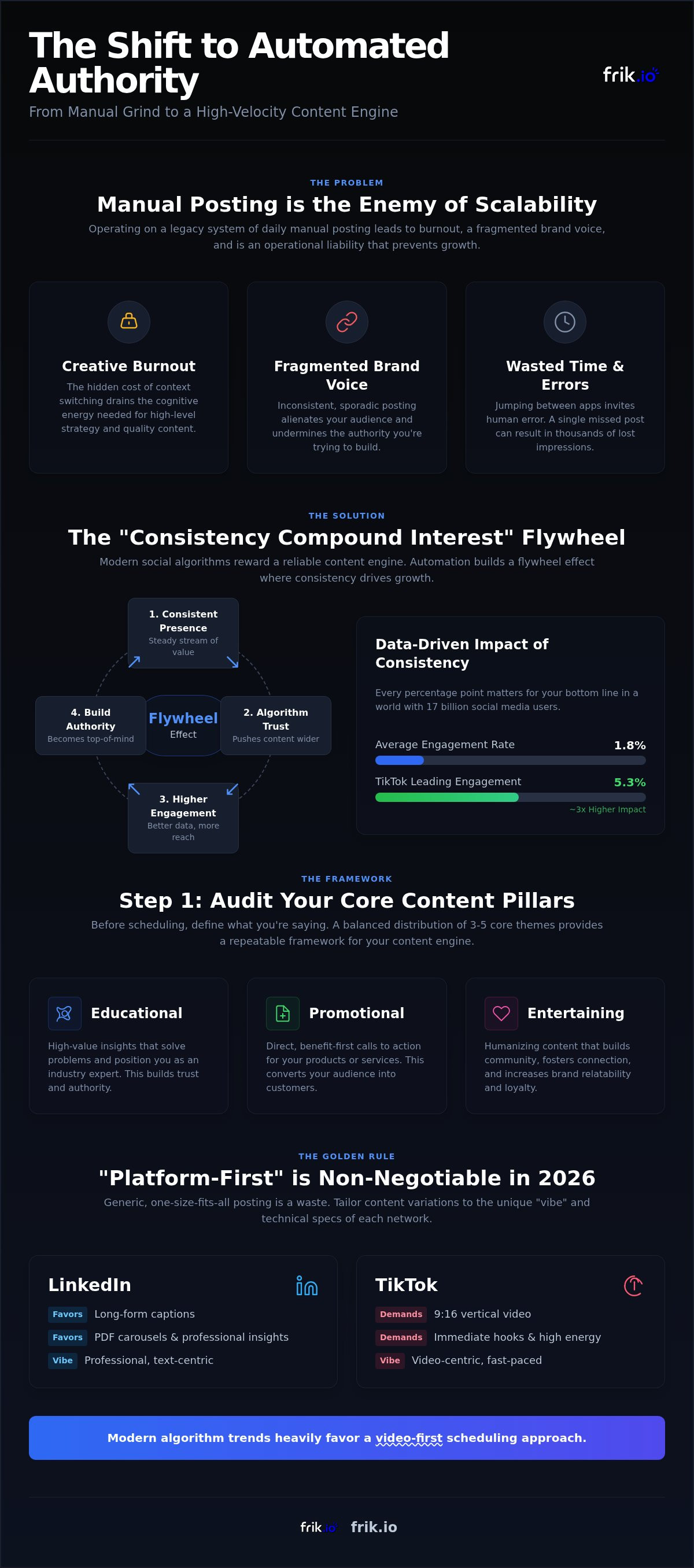
Social algorithms now reward what we call "Consistency Compound Interest." Platforms like Instagram and TikTok prioritize accounts that provide a steady stream of value. When you maintain a predictable presence, the algorithm trusts your brand more, pushing your content to wider audiences. This creates a flywheel effect. Better consistency leads to better data, which leads to higher engagement rates. With the average engagement rate sitting at 1.8% across platforms, and TikTok leading at 5.3%, every percentage point matters for your bottom line.
Why Manual Posting is the Enemy of Scalability
Manual workflows are the silent killers of creative momentum. The hidden cost of context switching, jumping between apps and browser tabs to post in real-time, drains the cognitive energy your team needs for high-level strategy. It also invites human error. A single missed window for the best time to post on social media can result in thousands of lost impressions. For agencies managing more than three clients, manual posting isn't just inefficient. It's an operational liability that prevents you from scaling your services.
The Data-Driven Case for Automated Distribution
Automated distribution allows you to move from a reactive "daily posting" scramble to a proactive "weekly batching" mindset. This shift reduces the daily cognitive load on your creative team, allowing them to focus on quality over sheer volume. By leveraging social media analytics for agencies, you can inform your scheduling frequency with actual performance data rather than guesswork. An "always-on" presence builds deep brand trust. It ensures your message stays top-of-mind for the 17 billion people worldwide who now use social media. Transitioning to a centralized workspace creates a unified system that turns fragmented efforts into a sophisticated digital presence.
Step 1: Auditing Your Content Pillars and Platform Mix
Before you can effectively schedule social media posts, you must define exactly what you're saying and where it belongs. Generic, one-size-fits-all posting is a waste of digital bandwidth. High-authority brands use a structured audit to ensure every post aligns with their overarching business goals. This process begins by identifying 3 to 5 core themes, or content pillars, that define your expertise and brand authority.
Defining Your Content Pillars
Content pillars are the skeletal structure of your social strategy. They provide a repeatable framework that ensures you never stare at a blank screen. A balanced distribution typically involves grouping your expertise into three distinct segments:
- Educational: High-value insights that position you as an industry expert.
- Promotional: Direct, benefit-first calls to action for your products or services.
- Entertaining: Humanizing content that builds community trust and relatability.
Grouping your knowledge into these repeatable segments allows you to build a robust "Content Bank." This repository of ideas serves as the raw fuel for your automation. It enables you to fill a scheduler for 30 days or more, moving you from a state of creative block to streamlined production. When you have a bank of pillar-aligned content, you're no longer reacting to the calendar; you're commanding it.
Platform-Specific Requirements for 2026
The "Platform-First" rule is non-negotiable in 2026. A post that thrives on LinkedIn's professional feed will likely fail on TikTok's high-energy, video-centric ecosystem. You must understand the unique "vibe" and technical specs of each network to avoid sounding out of place. For instance, LinkedIn favors long-form captions and PDF carousels, while TikTok demands 9:16 vertical video with immediate hooks.
Modern algorithm trends heavily favor video-first scheduling. Even brands traditionally rooted in text are finding success by converting their core insights into short-form clips. Using an AI Social Media Management Platform helps you tailor these variations from a single workspace. This ensures you meet specific aspect ratios, caption lengths, and hashtag limits for each network without manual rework. By auditing your platform mix, you ensure your scheduled posts feel native to the environment they land in, maximizing your reach and engagement across the board.
Step 2: Crafting the Perfect Posting Calendar
A strategic calendar transforms your content bank into a high-performance distribution engine. When you schedule social media posts, you aren't just filling slots; you're orchestrating a brand narrative. The "Anchor Post" method is the foundation of this workflow. Identify your most impactful content, such as a deep-dive video or a major product launch, and place these items first. By anchoring your week with high-value assets, you ensure your primary business objectives are always met. The remaining slots then serve to support and amplify these core messages.
Maintain a sleek, tech-forward aesthetic by visualizing your grid in advance. This bird's-eye view prevents visual clutter and ensures your feed looks like a cohesive brand experience rather than a fragmented collection of images. It's also vital to leave deliberate "white space" in your schedule. Over-automation can make a brand feel robotic. Leaving 15-20% of your calendar open allows you to pivot quickly for trending topics or real-time community engagement, keeping your presence authentic and agile.
How to Map Out Your Monthly View
Effective monthly planning starts with the big picture. Map out major launches, industry events, and holidays first. Once these fixed points are set, fill the gaps with evergreen content from your previously defined pillars. Use color-coding within your workspace to categorize content types. This visual system provides an immediate check on your content mix. If you see too much promotional content and not enough educational value, you can rebalance the week in seconds.
Timing and Frequency Optimization
Frequency should be dictated by your capacity for quality, not a generic industry average. Use historical data to find your specific audience peak hours. There's a critical distinction between "Active Hours" and "High Engagement Hours." Your followers might be scrolling at 8 AM, but they may only engage deeply with complex content at 7 PM. Test different time slots by shifting your schedule in small increments. Analyze the results to refine your Autopilot Scheduling settings, ensuring your posts land when they have the highest probability of conversion.
Step 3: Automating with AI Without Losing Your Brand Voice
Many creators fear that when they schedule social media posts using automation, they lose their unique edge. This only happens if you treat AI as a generic generator rather than a trained assistant. In 2026, sophisticated teams use the 80/20 rule. AI handles 80% of the heavy lifting, including drafting and research, while you provide the final 20% of strategic polish and human nuance. This approach ensures scalability without sacrificing the quiet authority of your brand.
Automation should also handle the repetitive tasks that drain your creative energy. Use AI to perform real-time hashtag research and generate descriptive ALT text for every image. These small details are vital for accessibility and searchability, yet they are often the first things skipped during a manual scramble. By automating these "boring" parts, you free up your mental bandwidth for high-level campaign strategy.
Training Your AI on Brand-True Content
The secret weapon for scaling digital authority is Brand-True AI Content Generation. Instead of using generic prompts, you should upload your highest-performing existing posts to define your specific voice. A modern AI social media management platform allows you to set strict "Never-Say" rules. This prevents the system from using overused buzzwords or phrases that don't align with your professionalism. You can also create distinct personas for different client accounts within a single workspace, ensuring that a tech SaaS brand never sounds like a lifestyle boutique.
Scaling Content Volume with AI Drafts
Speed is a major competitive advantage in a crowded digital landscape. You can turn one comprehensive blog post into ten platform-specific snippets in seconds. AI acts as a creative catalyst, not a replacement. It takes your core idea and tailors the caption for LinkedIn’s professional tone while simultaneously creating a high-energy version for Instagram. This ensures your message is optimized for the specific "vibe" of each network without requiring hours of manual rewriting. Experience the relief of a streamlined workflow by exploring frik.io's Brand-True AI tools today. By leveraging these intelligent drafts, you maintain a high-velocity output that keeps your brand at the center of the conversation.
Step 4: Streamlining Approvals and Multi-Platform Publishing
The final hurdle in a professional workflow isn't content creation. It's the approval process. Most teams lose hours in "Spreadsheet Hell," chasing clients or leads for feedback across fragmented email threads and chat apps. To schedule social media posts with true efficiency, you must centralize these interactions. Implementing a "Traffic Light" system within your workspace allows for instant status updates. Red means revision needed, yellow signals pending review, and green indicates the post is ready for the queue. This visual logic keeps your production line moving without a single meeting.
The Client Approval Portal Advantage
A professional Client Approval Portal replaces messy spreadsheets with a sleek, branded interface. This gives your clients the confidence that their brand is in expert hands. By moving approvals into a dedicated environment, you reduce feedback loops from days to minutes. You can use Autopilot Scheduling to keep your queue full of evergreen content while you wait for specific sign-offs on time-sensitive campaigns. This ensures your presence never dips, even when the human element of the process slows down.
Executing the Multi-Platform Launch
True scalability requires the ability to launch cross-platform campaigns with minimal friction. You shouldn't have to rebuild a post four times for four different networks. Utilize one-click tailoring to adjust image dimensions and caption lengths automatically. When you schedule social media posts across a complex network of channels, choosing the most effective social media scheduling tools for multi-brand agencies is essential to maintaining a centralized command center. This high-level oversight allows you to synchronize global launches while maintaining platform-specific nuances.
Before you hit the final button, run through this 5-point Quality Assurance checklist:
- Link Integrity: Do all destination URLs work and include tracking parameters?
- Visual Formatting: Is the media correctly cropped for each platform's 2026 specs?
- Voice Check: Does the caption align with the brand-true persona established in Step 3?
- Timing: Is the post set for a high-engagement window rather than just an active one?
- Compliance: Are all AI disclosures and commercial labels correctly applied?
Completing these checks ensures that your automated workflow remains a mark of quality rather than a source of error. You've moved from operational chaos to a state of streamlined productivity, turning your social presence into a reliable asset for brand growth.
Master Your Digital Command Center
Transitioning from reactive posting to a proactive strategy is the only way to scale digital authority in 2026. You've seen how auditing your content pillars and mastering platform-specific requirements creates a foundation for growth. By using an anchor-post method, you ensure your most valuable insights never get lost in the noise. The real shift happens when you move beyond manual labor and embrace an integrated system that protects your brand voice while automating the repetitive details.
When you schedule social media posts with a unified workflow, you reclaim the cognitive energy needed for high-level innovation. It's time to eliminate spreadsheet-based approvals and generic AI drafts that alienate your audience. You now have the blueprint. Build a scalable, automated engine that works for you.
Start scheduling with frik.io’s AI Command Center to leverage Autopilot Scheduling for a 24/7 presence, Brand-True AI training, and seamless Client Approval Portals. Take command of your workflow and turn your social presence into a streamlined productivity hub today.
Frequently Asked Questions
Is it better to schedule posts or post natively on the app?
Scheduling through a professional platform is the superior choice for scaling your digital authority. Native posting often leads to a reactive workflow and costly context switching. In 2026, platform APIs are highly sophisticated, ensuring that scheduled content receives the same algorithmic priority as native posts. Using a centralized command center allows you to maintain a consistent brand voice across all channels without the daily manual grind.
Does scheduling social media posts hurt engagement in 2026?
Scheduling doesn't hurt engagement; inconsistency does. Algorithms in 2026 reward high-frequency, high-quality output which is nearly impossible to maintain manually. When you schedule social media posts, you ensure your content lands during peak engagement windows. This data-driven approach actually boosts your visibility. It moves you away from guesswork and toward a strategic distribution model that favors long-term growth and brand recall.
How far in advance should I schedule my social media content?
Most high-performing teams find that scheduling two to four weeks in advance strikes the perfect balance. This window allows ample time for internal reviews and client sign-offs through a Client Approval Portal. It also keeps your content relevant to current trends. You can maintain a content bank to fuel your scheduler for 30 days or more, ensuring your queue never runs dry during busy periods.
Can I schedule Instagram Reels and TikToks automatically?
Automatic scheduling for short-form video is a standard requirement in 2026. Most major platforms now provide API access that allows you to publish Reels and TikToks directly from your workspace. This eliminates the friction of manual mobile reminders and "link in bio" workarounds. You can upload your vertical video, add platform-specific captions, and set it to go live at the exact moment your audience is scrolling.
What is the difference between a social media scheduler and an AI management platform?
A basic scheduler acts as a digital calendar for manual entries. In contrast, an AI Social Media Management Platform functions as an efficient command center. It offers Brand-True AI Content Generation to draft posts in your specific voice and specialized portals for team collaboration. It isn't just about timing; it's about a unified system that handles everything from content ideation to final multi-platform publishing.
How do I handle time zones when scheduling for a global audience?
Managing global audiences requires a system that supports localized scheduling. You should set the time zone for each specific social account within your workspace. This ensures you schedule social media posts to hit peak activity hours for each region. Instead of posting at a single global time, you can stagger your content to land when each specific segment of your audience is most likely to engage.
What happens if a scheduled post needs to be canceled due to a PR crisis?
Professional management platforms include a global pause feature, often called a kill switch. This tool allows you to halt all outgoing content across every channel with a single click. It's a vital safety protocol for protecting brand reputation during a PR crisis or major global event. Having this centralized control gives you the relief of knowing you can pivot your strategy instantly when the situation demands it.
Can I schedule the same post multiple times?
Repeating identical content is generally discouraged by modern algorithms, but repurposing is highly effective. You can use AI to generate multiple variations of your high-performing "anchor" posts. This allows you to share the same core message at different intervals without appearing repetitive. It's a smart way to extend the life of your content pillars while keeping your feed fresh and engaging for new followers.


