
What if the strongest case for a new social media tool isn’t a feature list, but evidence of what your current workflow is costing the team? If you’re working out how to get buy-in for a new social media tool, start with the friction people already feel: repetitive content tasks, scattered approvals, and time spent switching between platforms.
Those frustrations alone don’t make a business case. Decision-makers may see another optional expense, while the team worries about adoption, integrations, and disruption. A credible proposal connects those concerns to a baseline: where time goes now, which steps create bottlenecks, and what a better workflow should improve.
This article shows you how to make that case without overselling the outcome. You’ll learn to document the current process, compare a new tool fairly with realistic alternatives, and define a focused pilot with an owner and measurable success criteria. You can assess platforms such as Frik.io against the needs you identify, including content creation, scheduling, publishing, and approval workflows. The goal is a low-risk decision grounded in your team’s actual work.
Key Takeaways
- Learn how to get buy-in for a new social media tool by documenting workflow friction before presenting a solution.
- Build a business case around the decision leaders need to make, and compare current processes, existing tools, and new options fairly.
- Use must-have criteria to assess whether a tool supports your team's content creation, scheduling, approvals, analytics, and collaboration needs.
- Design a focused pilot with a clear owner and success measures, such as cycle time or revision rounds.
- See how Frik.io’s brand-voice drafting, platform-tailored posts, and scheduling capabilities could support a workflow pilot.
How to Get Buy-In for a New Social Media Tool by Defining the Problem
Start with the work that’s slowing the team down, not a product demo. A request built around “we need better software” invites debate about preferences. A request showing where drafts stall, approvals get lost, or posts are reworked gives decision-makers something concrete to evaluate. Describe the current process accurately before proposing a change.
Social media supports discovery, communication, and publishing across different platforms, but each team’s workflow is distinct. A brief overview of Social media provides useful context; your case for a tool should rest on evidence from your team’s publishing cycle. That’s the foundation for how to get buy-in for a new social media tool without relying on assumed savings or promised results.
Measure the current social media workflow
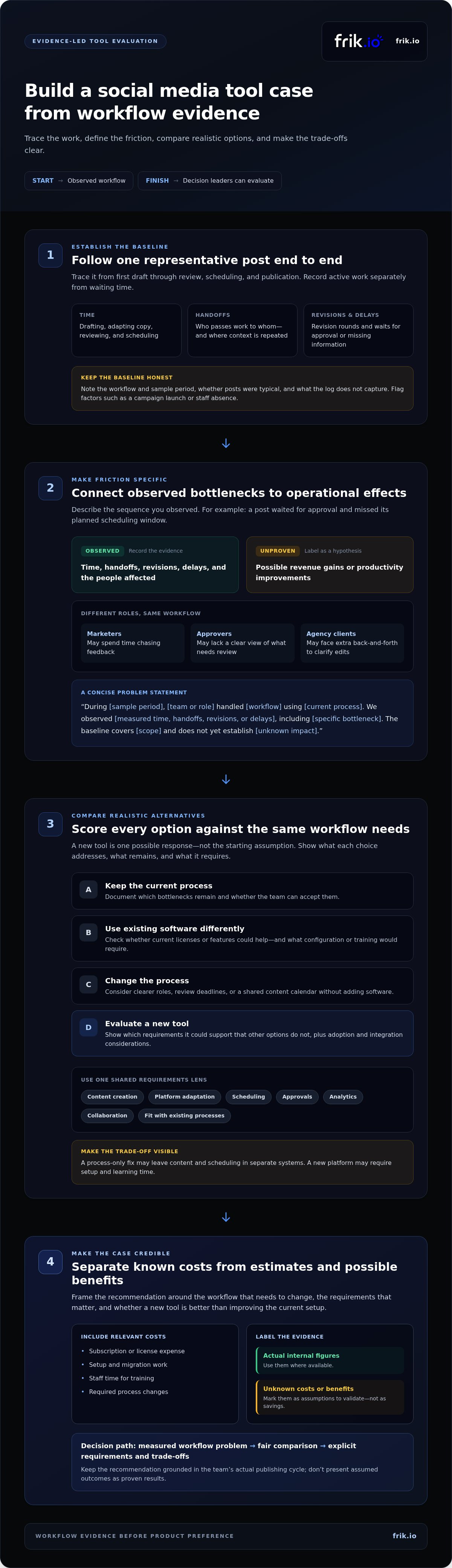
Follow a representative post from the first draft through review, scheduling, and publication. Record active work time separately from waiting time, and note each handoff, revision round, and recurring bottleneck. A simple log or shared spreadsheet is enough, as long as everyone records the same details consistently.
- Time: Track time spent drafting, adapting copy, reviewing, and scheduling.
- Handoffs: Note who passes work to whom and where context must be repeated.
- Revisions and delays: Record revision rounds and how long approvals or missing information hold up a post.
Explain the limits of the baseline. State which workflow and sample period you observed, whether the posts were typical, and what the log doesn’t capture. If a campaign launch or staff absence affected the sample, note it. This keeps a small set of observations useful without presenting it as a universal measure.
Translate team friction into business impact
Connect a bottleneck to an operational effect only when the evidence supports it. If a post waited for approval and missed its planned scheduling window, record that sequence. If late reporting is a recurring concern, trace the delay to a specific handoff or data-gathering step before claiming the workflow caused it. Keep possible revenue gains or productivity improvements separate as hypotheses to test.
Show who experiences the friction. Marketers may spend time chasing feedback; approvers may lack a clear view of what needs review; agency clients may face extra back-and-forth to clarify edits. These are different points in the same workflow, and each can help define what a solution must address.
Problem statement: “During [sample period], [team or role] handled [workflow] using [current process]. We observed [measured time, handoffs, revisions, or delays], including [specific bottleneck]. The baseline covers [scope] and does not yet establish [unknown impact].”
Keep the statement crisp and quotable. It gives the proposal a clear target: improve a documented workflow, then measure whether the change addresses the problem.
Build a Social Media Tool Business Case Leaders Can Evaluate
A measured problem is the starting point, not the recommendation. Frame the request around a decision: what workflow needs to change, which requirements matter, and whether a new tool is better than improving the current setup. This keeps the proposal focused on the team’s needs rather than making it sound like a purchase decision has already been made.
When comparing options, consider the capabilities tied to your workflow, such as content creation, platform adaptation, scheduling, approvals, and reporting. Use your baseline to decide which capabilities are essential and which would simply be useful additions.
Compare the new tool with realistic alternatives
Compare the proposed tool with approaches the organization could actually take. Assess each option against the same requirements, such as content creation, platform adaptation, scheduling, approvals, analytics, collaboration, and fit with existing processes. A fair comparison shows leaders what a new tool changes and what it doesn’t.
- Keep the current process: Document which bottlenecks remain and whether the team can accept them.
- Use existing software differently: Identify whether current licenses or features could address the workflow need, and what configuration or training that would require.
- Change the process: Consider whether clearer roles, review deadlines, or a shared content calendar could reduce friction without adding software.
- Evaluate a new tool: Show which requirements it could support that the other options do not, along with adoption and integration considerations.
For example, if approval handoffs are the main issue, compare process changes that clarify who reviews posts with software that provides a shared review workflow. Don’t assume a tool is necessary simply because the current process is inconvenient. State the trade-off: a process-only fix may leave content and scheduling in separate systems, while a new platform may require setup and learning time.
Make the business case concise and credible
Separate known costs from estimates and possible benefits. Include the relevant subscription or license expense, setup and migration work, staff time for training, and any process changes required. Use actual internal figures where available. If a cost or benefit is unknown, label it as an assumption to validate rather than presenting it as a saving.
Build potential benefits from the baseline: time spent on repeated tasks, approval delays, revision rounds, or missed scheduling windows. Explain which measures might improve and how you’ll track them. Don’t convert time released into revenue unless your organization has a defensible method for doing so. A new workflow may help, but the case should distinguish potential benefits from demonstrated results.
A one-page summary can give decision-makers the essentials:
- Need: The affected workflow and observed baseline.
- Options: The alternatives considered and their trade-offs.
- Request: The decision needed, plus costs, assumptions, and risks.
- Evidence: The measures that would show whether the approach is working.
This structure makes how to get buy-in for a new social media tool a practical evaluation, not a sales pitch. If a unified workspace is among the options, frik.io’s social media platform brings content creation, scheduling, publishing, and collaboration into one workspace for your team to assess against its requirements.
Compare Social Media Tools Against Workflow and Adoption Criteria
A feature checklist can make every platform look capable. A useful comparison shows whether each option supports the work your team actually does and what adoption would require. Set must-haves from the documented workflow, then separate them from attractive extras. If the main bottleneck is client approval, advanced content-generation features may be interesting, but they shouldn’t outweigh a workable review process.
Choose criteria that reflect the team's real work
Assess each option against the platforms your team publishes to, the roles involved, and the steps between draft and publication. Include client review and reporting if they’re part of the workflow. Consider usability and change effort alongside feature coverage: a capability only helps if the people responsible can use it within the process.
Use a compact matrix to make trade-offs visible. Decide what counts as evidence before comparing options, such as a sample workflow walkthrough, observed task completion, or a documented review of permissions and integrations.
| Requirement | Must-have | Trade-off or risk | Evidence to record |
|---|---|---|---|
| Content creation and platform adaptation | Draft and tailor content for required channels | Review the editing effort and brand consistency | Compare outputs against a real brief |
| Scheduling and publishing | Support the team’s publishing workflow | Account for setup and any changes to current steps | Walk through a representative publishing task |
| Approvals and collaboration | Give each reviewer a clear role in the process | Check whether the workflow adds or removes handoffs | Test a draft through review and approval |
| Analytics and reporting | Provide the reporting needed for team decisions | A broad dashboard may not answer the right questions | Match reports to defined measures |
Reporting criteria should reflect the decisions your team needs to make, not the number of charts a platform displays. Define the questions your reports must answer, then assess whether each option provides the information your team needs to act on those measures.
Address security, access, and adoption concerns
List the people who need access, the tasks each person performs, and the permission questions your organization needs answered. Document data handling, integration, and transition considerations through your normal review process. Make adoption part of the evaluation too: identify who will learn the workflow, how they’ll practise it, and how the team will capture usability issues.
Keep the comparison tied to the original need. Frik.io provides brand-voice content generation, platform-tailored posts, scheduling, client review portals, collaboration, and multi-platform analytics. Assess these capabilities against the same requirements and record what the team observes, rather than assuming a feature will improve results. That’s a practical step in how to get buy-in for a new social media tool: make workflow fit and adoption visible. For a hands-on evaluation, frik.io’s social media workspace brings these tasks together for your team to assess against its criteria.
Propose a Low-Risk Social Media Tool Pilot With Clear Success Measures
A pilot turns a software request into a bounded test. Define one workflow, the people involved, and an evaluation period that fits the work. For example, test drafting, review, and scheduling for one content stream rather than moving every channel and team process at once. Keep the existing process available where needed, and document how the pilot will avoid disrupting scheduled publishing.
Assign an owner to coordinate the test and maintain the measurement log. Name the participants, including the people creating content and those who approve it. Set a review cadence and decision date in advance, so the pilot has a clear endpoint instead of becoming an open-ended trial.
Set measurable pilot criteria before launch
Choose a small set of measures tied directly to the original workflow issue. If approval delays were the problem, track draft-to-approval cycle time and revision rounds. If scheduling handoffs caused friction, record how often a post needs clarification or manual follow-up. Use the same definitions and tracking method for the baseline and pilot; otherwise, apparent changes may reflect different measurement rather than a different workflow.
Pair the numbers with brief feedback. Ask participants whether roles were clear, review felt manageable, and the workflow was easy to use. If AI-generated content is in scope, evaluate whether drafts reflect the brand’s style and how much editing they need. Use your own brand standards to judge the results.
Prepare stakeholders for a useful decision
Bring each stakeholder in according to their role. Marketing can assess workflow fit; finance can review cost assumptions; IT can address integration and access questions; approvers can judge the review flow. Share the scope, responsibilities, known risks, evaluation timeline, and decision criteria before the pilot starts. This gives people a chance to raise constraints early, before the team has invested time in the test.
Agree on three possible outcomes before launch:
- Stop: A must-have requirement fails, a material risk can’t be resolved, or the workflow creates unacceptable disruption.
- Adjust: The tool appears relevant, but training, configuration, roles, or scope need to change before results can be judged.
- Scale: The pilot meets the agreed measures, participants can use the workflow, and decision-makers accept the remaining costs and risks.
These conditions make the pilot a test of fit, not a promise of savings. Frik.io supports brand-voice drafting, platform-tailored posts, scheduling, and review in a shared workspace. Evaluate Frik.io in a focused social media pilot using your team’s baseline and success criteria.
Show How Frik.io Fits the Social Media Tool Case
Once the team has documented its workflow needs and pilot measures, assess Frik.io against that case. Don’t assume the platform will solve every bottleneck. Identify which steps its capabilities support, then observe how they fit the team’s actual process. This keeps the recommendation specific and grounded in evidence.
Connect platform capabilities to the proposed workflow
Frik.io brings social content creation, adaptation, scheduling, and publishing into one workspace. During a pilot, the team can draft a post, tailor it for different social platforms, and schedule it as part of the agreed publishing workflow. Track the steps involved and compare them with the baseline using the same definitions. A shared workspace brings these activities together, while the pilot shows whether that changes handoffs or cycle time for your team.
For content creation, teams can train the AI on their style guide and generate captions in the brand’s voice. Evaluate a sample against your brand standards, then record how much editing it needs and whether reviewers find the draft usable. Treat those observations as evidence about fit, not proof of a guaranteed reduction in revisions.
If approval handoffs are part of the documented problem, include Frik.io’s collaborative client review portals and approval workflows in the test. Have the relevant approvers review real draft content, and note whether they can complete their usual review steps in the workflow. Keep the test focused: adding capabilities unrelated to the original problem can make results harder to interpret.
Turn the decision into a practical next step
Translate the evaluation into a short recommendation a decision-maker can act on. State the workflow being tested, who owns and participates in the pilot, which measures will be reviewed, and when the team will decide. Include unresolved questions or risks so leaders can distinguish what the pilot has shown from what still needs evaluation.
If reporting is a stated requirement, include Frik.io’s multi-platform analytics in the evaluation. Define what the team needs to see and which decisions the reporting should support before reviewing the analytics. Then assess whether the available view answers those questions. The presence of analytics alone does not demonstrate business impact.
This final step brings how to get buy-in for a new social media tool back to a clear decision: connect the platform to a documented need, test it against agreed criteria, and use the results to recommend whether to stop, adjust, or expand the workflow. Explore Frik.io as a platform to evaluate against your team’s requirements, or start exploring the social media workspace with your pilot criteria in hand.
Turn Your Evidence Into a Confident Next Step
Make the decision easy to act on. Bring your recommendation, pilot owner, measures, and decision date into one brief, then invite stakeholders to respond to the evidence rather than a promise of what a tool might deliver. That’s how to get buy-in for a new social media tool while keeping the conversation focused on what your team can verify.
Use the evaluation to test details that matter in real work. Do AI-generated captions reflect your brand’s voice? Can posts be adapted for the platforms your team uses? Do collaborative client review portals support the approval workflow you need? Clear answers help your team judge fit and decide what to do next.
Explore Frik.io and evaluate it against your team’s workflow. Take your criteria into the review and move forward with confidence in the decision your evidence supports.
Frequently Asked Questions
How do you get executive buy-in for a new social media tool?
Make the request easy to decide by connecting the tool to a business priority executives recognize, such as consistent publishing or clear approval accountability. For how to get buy-in for a new social media tool, identify the decision you need now, who will own the outcome, and what evidence would change your recommendation. Explain why the issue matters now, not just why the tool is appealing.
What should a social media tool business case include?
A strong case gives leaders enough information to assess fit, risk, and the requested commitment. Include the affected team and workflow, why current arrangements fall short, options considered, expected costs, and assumptions that still need validation. Add the decision requested and what would trigger a review. For example, distinguish permission to evaluate a platform from approval to adopt it across the organization.
Is a pilot the best way to get approval for social media software?
A pilot is useful when leaders need evidence about usability, adoption, or workflow fit before making a broader commitment. It isn’t the only path: if existing software already meets the need, changing the process may be simpler. A pilot is most informative when it tests a real publishing task with the people who will use or approve the work, rather than relying only on a product demonstration.
How can you demonstrate the ROI of a social media tool without overpromising?
Separate operational evidence from financial attribution. Report observed changes in time spent, approval delays, or rework, and explain how those measures were recorded. Don’t label released time as cash savings unless the organization can show how it was redeployed or reduced costs. Likewise, connect social activity to revenue only when your attribution method supports that conclusion. Report limitations alongside results.
Who should be involved in approving a new social media platform?
Involve people who use, approve, fund, and govern the workflow. That often means the social media lead and content creators, the approvers who review posts, a budget owner, and IT or security staff if access or integration questions apply. Give each person a defined role: users assess usability, approvers test review steps, and budget holders evaluate the commitment. Keep the decision group focused enough to reach a clear outcome.
What if leadership says the current social media process is good enough?
Ask what “good enough” means in practice. Leaders may prioritize reliable publishing, while the team may be concerned about recurring rework or approval delays. Rather than arguing from frustration, identify a specific exception or recurring task and show its effect using documented evidence. If the issue doesn’t outweigh the cost or change effort, keep the current process and agree on what future signal would justify reviewing it again.


