
Adding clients shouldn’t mean adding approval threads, duplicated content work, and more manual coordination. The right scalable social media tools for agencies help standardize the workflow without making every brand sound the same.
As client lists grow, teams have more posts to move across networks, more revisions to track, and more context to keep straight. A tool can help, but scale comes from connecting the steps, not simply scheduling more content.
This guide shows you how to build a repeatable workflow for multiple client accounts, with clear reviews and more efficient content production. Learn what to look for in agency tools, how brand-voice AI can support distinct client identities, and how to connect content creation, approvals, publishing, and analytics. frik.io brings these capabilities together in one workspace, helping teams reduce repetitive work while keeping human judgment in the loop.
Key Takeaways
- Scale client work by connecting each production step in a shared workflow, rather than adding scattered calendars and message threads.
- Use a consistent process to organize brand context, draft posts, collect approvals, publish content, and measure results, while keeping strategic decisions in human hands.
- Compare scalable social media tools for agencies by how well client organization, brand voice, approvals, publishing, and analytics work together.
- Pilot a manageable client workflow, document what works, and refine the process before rolling it out across the agency.
- Explore how Frik.io combines style-guide-trained AI, platform-tailored drafts, client approvals, scheduling, publishing, and analytics in one workflow.
Why scalable social media tools matter when your agency adds clients
Scattered calendars, message threads, and spreadsheets can work when an agency has only a few accounts. As the client list grows, the same information starts living in too many places. Teams spend time finding the latest caption, confirming who owns a revision, and checking whether a post is ready to publish. A shared workflow makes that work easier to track.
Scalable agency social media operations increase client and content volume without multiplying the coordination effort required for every post. That takes repeatable processes, clear ownership, and connected workflow stages. Scheduling more posts alone won’t solve the operational problem. Social media marketing spans content, channels, and audience engagement, as the overview of Social Media Marketing illustrates. Agency systems need to support that work while preserving each client’s priorities and voice.
What changes when an agency takes on more client accounts?
Hypothetical scenario: An agency adds a local retailer to its client roster. The team needs to organize the retailer’s brand details, draft and adapt content for its channels, collect feedback, schedule approved posts, and prepare reporting. If each step lives in a separate document or inbox, every handoff requires someone to piece together the post’s status and context.
That coordination adds up across accounts. Each client has its own brand guidelines, reviewers, publishing needs, and reporting expectations. A repeatable workflow makes ownership visible: the team can see what needs drafting, what awaits client review, and what is ready to publish. Standardize the process, not the brand. Consistent steps should make it easier to apply each client’s context, not flatten every account into the same content.
Which bottlenecks should a tool remove first?
Start with recurring work that follows a clear process. Rebuilding similar content workflows, chasing routine feedback, and adapting approved ideas for different channels can create avoidable friction. A shared system can help teams manage these steps without losing context or track of status.
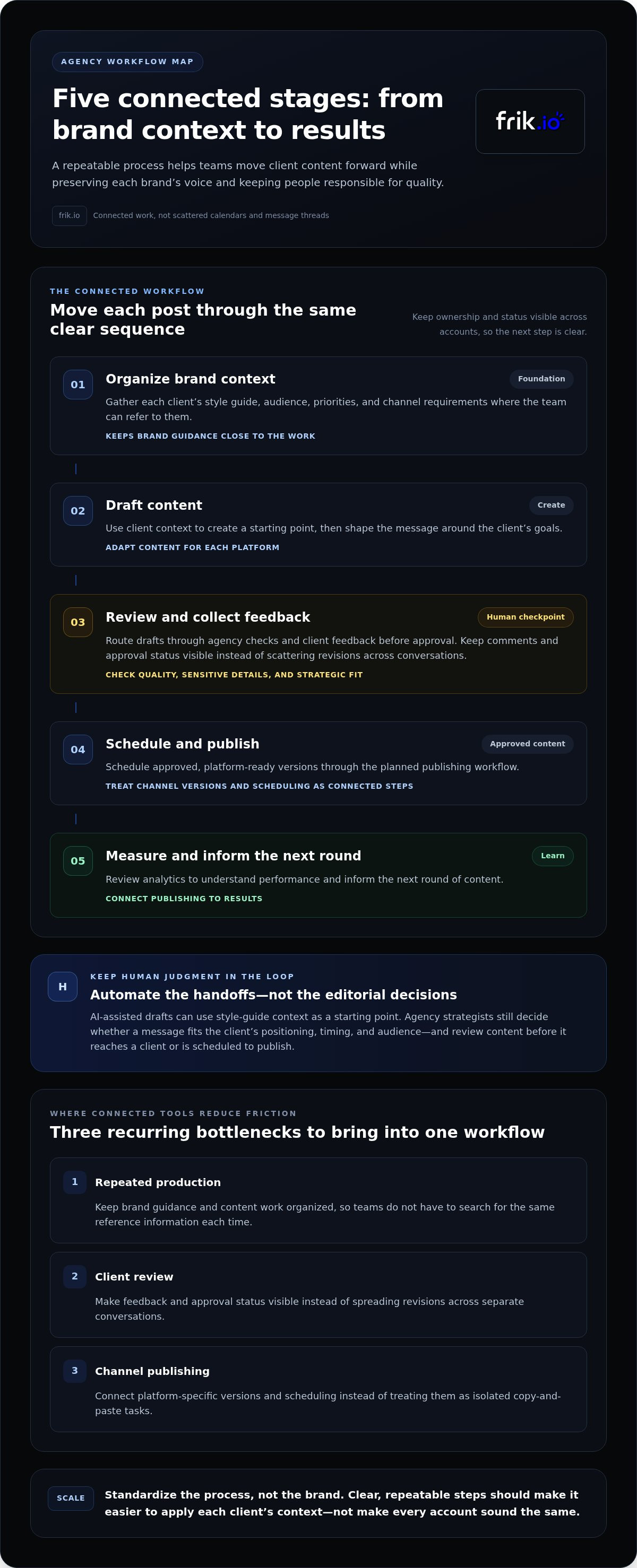
- Repeated production: Keep brand guidance and content work organized so the team doesn’t have to search for the same reference information each time.
- Client review: Keep feedback and approval status visible instead of scattering revisions across separate conversations.
- Channel publishing: Treat platform-specific versions and scheduling as connected steps, not isolated copy-and-paste tasks.
Not every task should be automated. Choosing the message, checking sensitive details, and deciding whether a draft fits the client’s strategy still call for human judgment. Tools should reduce repetitive coordination and protect time for those decisions. Agencies evaluating AI social media management platforms can start with this distinction: streamline repeatable execution while keeping people responsible for quality and direction.
How scalable social media tools connect agency workflows
A connected workflow moves each client’s content from context to results, with fewer gaps between creation, approval, and publishing. The goal isn’t to automate every decision. It’s to make the next step clear, keep work visible across accounts, and give the team more room to focus on strategy and quality.
Build the process in this order:
- Organize brand context. Gather each client’s style guide, audience, priorities, and channel requirements where the team can refer to them.
- Draft content. Use that context to create a starting point, then shape the message around the client’s goals.
- Review. Route drafts for agency checks and client feedback before approval.
- Publish. Schedule approved, platform-ready content through the planned publishing workflow.
- Measure. Review analytics to understand performance and inform the next round of content.
A shared workspace helps teams coordinate these stages across clients. Rather than piecing together a post’s status from separate messages and files, staff can see where work stands and what needs attention. That visibility matters when several people contribute to different accounts. It also helps teams spot recurring delays, such as drafts waiting for review, and improve the process without relying on memory. Brandwatch's Guide to Social Media Management Tools for Agencies discusses the role of agency tools. The workflow here connects their capabilities from setup through measurement.
From brand guidelines to platform-ready drafts
A client’s style guide gives AI-assisted drafting useful context, including preferred language and brand voice. Treat it as a starting point, not a substitute for editorial review. A post prepared for one platform may need a different format, emphasis, or length on another. Copying one caption everywhere can overlook those differences. For more on preserving a distinct voice as production scales, explore this AI brand voice strategy.
Workflow automation moves content forward; it doesn’t replace editorial judgment. Agency strategists still decide whether a message fits the client’s positioning, timing, and audience. Keep human review in the process, especially before content reaches a client or is scheduled to publish.
From client review to scheduled publishing
Once the agency has checked a draft, send it to the client for feedback. A client approval portal can centralize comments and approvals, helping the team distinguish a revision request from a post that’s ready to publish. After approval, schedule the content according to the plan. Autopilot scheduling can support that planned cadence while the team retains oversight of content and timing.
Close the loop by reviewing analytics and carrying relevant insights into future briefs. This create-review-publish-measure cycle keeps each stage connected rather than treating reporting as a separate task. Agencies assessing scalable social media tools for agencies should look for that continuity. A platform such as frik.io's social media workflow tools brings brand-voice AI, approvals, scheduling, publishing, and analytics into one workspace.
How to compare scalable social media tools for agencies
Compare tools against the work your agency needs to move, not a feature checklist in isolation. A platform may offer approvals, scheduling, and analytics, but still create extra admin if those features don’t connect. Use the criteria below to assess whether each capability moves work forward or leaves the team to bridge another gap.
| Capability | What to evaluate | Signs of workflow continuity |
|---|---|---|
| Multi-client organization | Can your team keep each client’s accounts and content distinct? | Work is easy to find by client, with ownership and status visible. |
| Brand context | Can the tool store or apply each client’s guidance to content creation? | AI-assisted drafts can draw on the relevant style guide, rather than a generic voice. |
| Client approvals | Can clients review drafts and give feedback in a clear process? | Comments and approval status stay connected to the work. |
| Publishing | Can approved content move into scheduling and publishing? | Teams don’t need to re-enter or manually track the same post across stages. |
| Analytics | Can the team review results after publishing? | Performance insights can inform future content planning. |
A unified platform should simplify work, not introduce another layer of process. During evaluation, trace one typical post from client context through reporting. Note where someone must copy information, switch tools, or chase a status update. Some handoffs are valuable, especially strategic review or client sign-off. The problem is repetitive admin that exists only because two workflow stages don’t connect.
Can the tool keep client work distinct and consistent?
Check whether the team can tell which client, channel, and content item they’re handling. Then assess how brand guidance informs drafts. AI-assisted content should reflect each client’s style guide while leaving room for the agency to refine the message. Compare that with generic cross-posting: platform-specific adaptation should give each version a fit-for-channel treatment, not simply duplicate one caption. For deeper guidance on preserving distinct voices, use this AI brand voice strategy.
Can clients review work without creating more admin?
Evaluate whether clients can give clear feedback and whether the team can see what’s awaiting review, approved, or ready for scheduling. A review process should clarify the next action, not create separate status-tracking work. Also trace how scheduling and publishing connect to analytics. If results sit apart from the content workflow, the agency may need an extra step to carry insights into planning. This social media analytics guide for agencies can help frame what to measure and how to use it.
Finally, review subscription terms to understand how the tool fits your agency’s changing needs. Focus on what’s included and how the subscription is organized. A smooth workflow depends on how capabilities work together, not on one feature alone. The best fit is the tool that connects your essential stages with the least unnecessary coordination.
How agencies can roll out social media tools without disrupting delivery
A platform rollout works best when it improves a real workflow without putting active client delivery at risk. Avoid moving every account at once. Map how work currently moves, test the new process with one manageable client, and use what the team learns to create a repeatable approach.
Use this four-step rollout:
- Map current work. Record how content is drafted, reviewed, approved, published, and assessed. Note where ownership becomes unclear or work gets repeated.
- Choose a pilot account. Pick a client with accessible brand guidelines and a straightforward content workflow, rather than starting with the most complex account.
- Document the workflow. Define who drafts content, who checks it, who manages client review, who schedules and publishes, and who reviews performance.
- Review results. Gather team and client feedback, identify friction, and adjust the process before extending it to other accounts.
Keep responsibilities explicit during the pilot. Give each draft a clear owner, make sure client feedback has a visible destination, and define the publishing handoff for approved content. The person reviewing performance should know which results need to inform future planning. Clear ownership helps the platform support delivery instead of creating another layer of coordination.
How should an agency pilot a new platform?
Run one complete content cycle for the chosen client: organize its brand context, draft and review content, schedule approved posts, then examine the workflow and reporting. Ask the team where information was easy to find and where it had to be re-entered or chased. Collect client feedback on the review experience. Use both perspectives to document a process the team can repeat.
How can teams scale the workflow across clients?
Turn the tested process into a reusable template, then adapt account-specific details such as brand voice, reviewers, and approval needs. Train the team on responsibilities and shared workspace conventions, including how content is organized and how its status is recorded. Standardize the operating steps, not the client’s identity.
Before onboarding more accounts, use a short scorecard to check workflow fit:
- Handoffs: Are there fewer avoidable transfers or repeated data entry?
- Approval clarity: Can the team tell what needs client input and what’s approved?
- Content consistency: Does each account retain its own brand context across drafts?
- Team adoption: Can staff follow the process and find the information they need?
If one area remains unclear, refine the workflow before making it the agency standard. A measured rollout helps agencies get more value from scalable social media tools for agencies without forcing every client into an identical process. To put a connected multi-client workflow into practice, explore frik.io's social media management platform.
How Frik.io supports scalable social media workflows for agencies
The best tool depends on how your agency works. Use the workflow criteria from the previous section to judge whether a platform keeps client context, content, approvals, publishing, and measurement connected. Frik.io is a subscription social media management platform for agencies and growing teams. It brings social media workflow tools together so your team can manage strategy, editorial decisions, and client relationships alongside content production.
Where Frik.io fits in a multi-client workflow
Frik.io brings multi-network content creation, scheduling, and publishing into one workspace. For agencies, that supports a repeatable process across accounts while keeping each client’s brand context in view. Its AI can be trained on a user’s style guide, and posts can be tailored for each social platform. Teams get a starting point for client-specific drafts without relying on one generic caption for every channel.
Collaborative client approval portals support review before publishing. Teams can move drafts through client feedback and approval, then schedule and publish content in the same platform. Analytics connect published work to the next stage of performance review. Assess whether these capabilities help reduce avoidable handoffs while preserving the checks your agency needs.
- Before drafting: Bring the relevant style-guide context into AI-assisted content creation.
- Before publishing: Use client review to gather feedback and approval on drafts.
- After approval: Schedule and publish content, then use available analytics to inform future work.
What an agency can evaluate in a Frik.io workflow
Start with one client’s style guide and a typical content cycle. Assess whether AI-assisted drafts reflect the guidance your team provides, and whether platform-tailored posts meet your editorial standards. Then follow a draft through the approval portal. Check whether the client and team can collaborate clearly, and whether the next action is easy to identify after feedback arrives.
Next, examine scheduling and publishing in relation to your planned workflow. Autopilot scheduling supports planned publishing while your team oversees content and timing. Review how the platform’s analytics fit into your reporting and planning process. Consider whether the information helps your team evaluate content and shape subsequent work, rather than creating another disconnected task.
These checks help you decide whether Frik.io fits your requirements for scalable social media tools for agencies. Evaluate the workflow against your client mix and team responsibilities, not an assumed universal standard. If the connected process aligns with how you want to create, review, publish, and measure, explore Frik.io as a next step.
Build a workflow that grows with your agency
Your next step doesn’t need to be a full-scale process change. Choose one client workflow, identify where coordination slows the work, and decide what a more connected process should make easier. That gives your team a practical way to evaluate scalable social media tools for agencies against real needs, while keeping client voice and human review at the center.
Frik.io brings together AI drafting informed by your style guide, collaborative client approval portals, scheduling, publishing, and analytics. Explore how those capabilities could fit the workflow you’ve defined and support your team as its client mix evolves.
Explore Frik.io's social media workflow and take the next step toward a more manageable agency process. Build a system that scales without losing the thoughtful, client-specific work that makes your service valuable.
Frequently Asked Questions
What makes a social media tool scalable for an agency?
A scalable tool helps an agency add clients without requiring the same increase in manual coordination. It supports clear client organization, repeatable approvals, brand-specific content, publishing, and measurement. When a new client joins, the team should be able to apply that client’s guidance and route posts through a familiar process, rather than inventing a new system of spreadsheets and reminders. More scheduled posts alone don’t equal scalability.
How many social media management tools does an agency need?
There’s no universal number. The right setup depends on your workflow, team, client requirements, and integrations. List the tasks your tools cover, then look for duplicated functions and handoffs, such as copying approved content from one system into another to schedule it. A connected workspace may reduce fragmentation, but it doesn’t need to replace every specialist tool. Keep tools that serve a distinct need and fit smoothly into the process.
Can AI create social media content in each client’s brand voice?
AI can help draft client-specific content when it has useful style-guide context, but the agency should review every draft before approval. Check whether terminology is accurate, the tone suits the client, and the message fits the intended audience. Then adapt the content for its platform instead of assuming one version works everywhere. Treat AI output as a starting draft, not a guarantee of perfect voice or strong performance.
How can agencies simplify social media approvals for multiple clients?
Set a clear review sequence, identify who can approve each client’s content, and keep feedback attached to the draft it refers to. A client approval portal can support collaborative review by giving the agency and client a shared place to discuss work and track its status. For example, a specific revision can stay linked to the post, reducing confusion about which caption or creative the feedback concerns.
What should agencies compare when choosing social media tools?
Compare how tools separate client accounts, use style-guide context, adapt content by platform, support approvals, publish posts, and provide analytics. Then test a typical post from draft to performance review. Note each handoff and any detail your team must enter twice. This gives a more useful picture of fit than comparing feature counts alone. The scalable social media tools for agencies worth considering are those that support your actual process.
Do social media management tools publish to every social network?
No. Supported networks and publishing capabilities vary by tool, and options may differ across content formats. List the channels and post types your clients rely on, then compare them with each tool’s current product information. If a client’s workflow depends on a particular format, include that format in your evaluation rather than assuming that support for a network covers every publishing need.
How can an agency measure whether a new social media workflow is working?
Track workflow indicators such as handoff frequency, clarity of approval status, team adoption, brand consistency, and how long content takes to move through review. These show how the process is functioning, while audience engagement and other performance metrics show how published content is received. Compare both sets with your agency’s own baseline. That helps identify whether the workflow is improving without relying on invented industry benchmarks.


