
A clear social media content sign-off process gives every post an owner, a defined review path, and a deadline. Aim to move drafts through review and final approval within 24 to 48 hours, with extra review for content that needs specialist input. That structure turns approval from a last-minute scramble into a repeatable workflow.
It’s easy to assume that adding more reviewers will catch more problems. But without clear roles and response times, reviews can stall drafts and push publishing deadlines back. A strong social media content sign-off process makes clear who creates, edits, reviews, approves, and schedules each post.
This guide explains how to map each stage, assign accountability, set practical turnaround times, and decide what happens when feedback is late. You’ll also learn how to spot bottlenecks and improve the workflow, so your team can publish with more confidence and less back-and-forth.
Key Takeaways
- Map each post from idea to publication, and assign a clear owner to every review stage.
- Choose a sequential, parallel, conditional, or hybrid workflow based on the content and who needs to review it.
- Set deadlines, send reminders, and define who steps in when feedback is late.
- Track where posts get delayed and use those patterns to refine your approval process.
- Use a shared platform to bring content creation, review, and scheduling into a more coordinated workflow.
How do you measure whether your approval workflow is working?
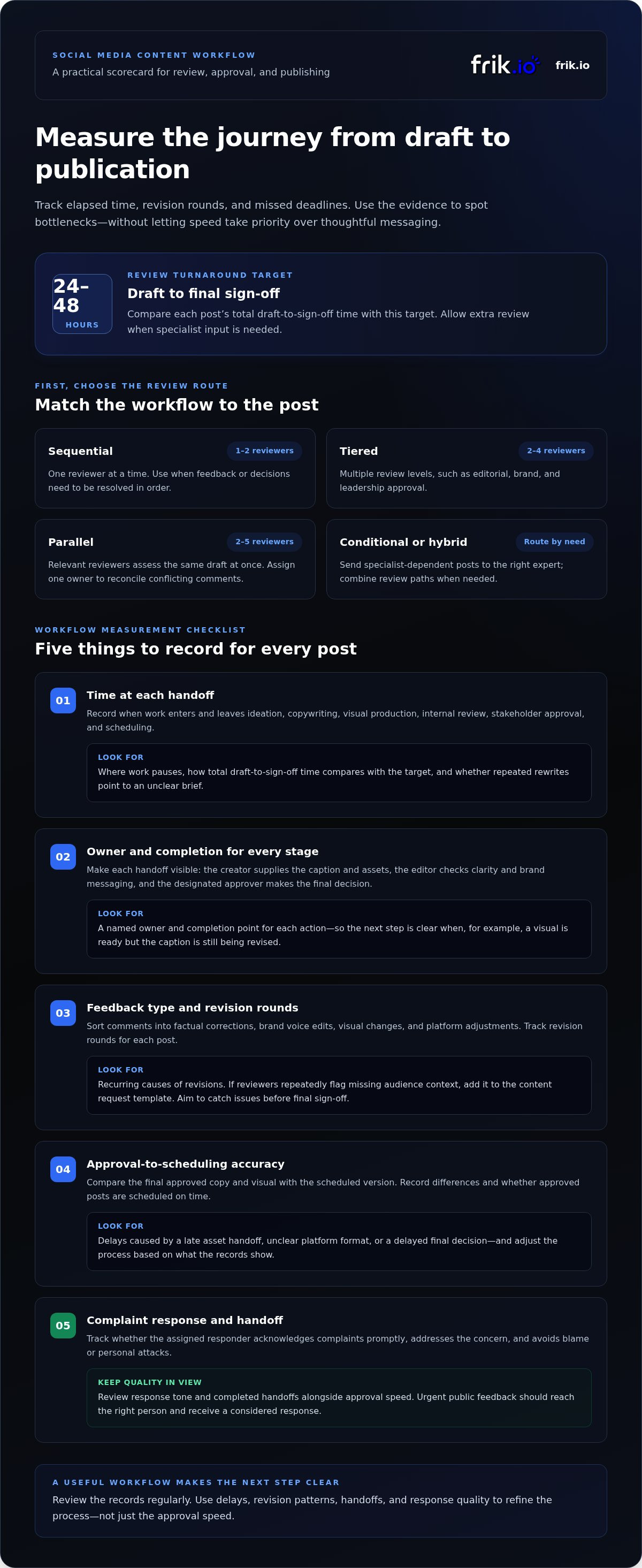
Track each post from request to publication, then compare elapsed time, revision rounds, and missed deadlines. Review complaint responses separately to make sure speed never takes priority over thoughtful messaging.
- Record the time each post enters and leaves every stage. Include ideation, copywriting, visual production, internal review, stakeholder approval, and scheduling. A shared content calendar can show where work pauses, such as drafts waiting for an editor. Compare total draft-to-sign-off time with the 24-to-48-hour target, then identify which stage causes delays. Track revisions too: repeated rewrites may point to unclear briefs, not slow reviewers.
- Assign one accountable owner to each stage, then track whether handoffs happen as planned. The creator supplies the caption and assets, the editor checks clarity and brand messaging, and the designated approver makes the final decision. Record who owns each action and when it is completed. If the visual is ready but the caption is still being revised, the workflow should show who acts next instead of leaving the team guessing.
- Measure review quality by recording the type of feedback and whether it addresses a specific issue. Separate factual corrections, brand voice edits, visual changes, and platform adjustments. For example, if reviewers repeatedly flag missing audience context, add that detail to the content request template. Track revision rounds for each post and look for recurring causes. An effective workflow catches problems early, before final sign-off, rather than sending the same concern through every review stage.
- Check that approved posts reach scheduling without unauthorized changes or missed publishing dates. Compare the final approved copy and visual with the scheduled version, and record any differences. Track how many approved posts are scheduled on time, then investigate each delay. A late asset handoff, unclear platform format, or delayed final decision may call for a different fix. Review these records regularly and adjust the workflow where the evidence shows friction.
- Include complaints and negative reviews in your measurement plan. Track whether the assigned responder acknowledges each complaint promptly, addresses the customer’s concern, and avoids blame or personal attacks. For example, recognizing a delivery issue and offering a clear next step is more constructive than arguing publicly. Review response tone and completed handoffs alongside approval speed. A workflow is effective only when urgent public feedback reaches the right person and receives a considered response.
What is a Social Media Content Workflow?
A social media content workflow moves a post from request to publication through defined tasks and approvals. Map every handoff so the draft, visual, and final decision each have a clear owner.
- Choose an approval model that matches the post’s risk and review needs. A linear workflow sends each draft through one reviewer at a time; it suits a small team needing a clear sequence. A tiered model adds review levels, such as editorial, brand, and leadership approval. Linear workflows typically use 1-2 reviewers, while tiered workflows commonly use 2-4.
-
Set Timelines and Feedback Rounds
Set a deadline for each reviewer and define how feedback returns to the creator. A practical target is 24 to 48 hours from draft to final sign-off, with one person consolidating comments before revisions begin. Specify what “approved” means, such as signed-off copy, visual, and platform format. Avoid open-ended feedback rounds; ask reviewers to flag essential changes in one pass.
-
Identify Workflow Breakdowns and Benefits
Look for stalled handoffs, conflicting edits, missing assets, and unclear decision rights. For example, two reviewers may suggest different calls to action, leaving the creator unsure which version to use. A defined approval process records decisions, catches issues before publication, and helps teams coordinate messaging across networks. It also makes the next action visible instead of burying feedback in scattered messages.
- Match the review path to the content. In a parallel workflow, relevant reviewers assess the same draft at once; this can speed routine checks, though one owner must resolve conflicting feedback. Parallel workflows typically involve 2-5 reviewers. A conditional model routes posts only to specialists when needed, such as sending a product claim for factual review. A hybrid combines paths, for example, parallel brand and editorial checks followed by sequential final approval.
- Set up approval tools around clear permissions and a single source of truth. Give creators editing access, reviewers commenting access, and one approver the authority to publish or return a draft. Use templates to capture the audience, network, caption, visual asset, and scheduled date. Keep the approved version separate from drafts, and lock approved copy if the tool allows it. Apply the same review path to AI-generated and human-written content.
Sequential, parallel, conditional, and hybrid workflows
- Choose the review route by asking whether each decision depends on the previous one. In a sequential workflow, an editor checks copy before a brand lead reviews visuals and messaging. Use this structure when feedback must be resolved in order. For independent checks, send a draft to relevant reviewers at once. Parallel workflows commonly use 2-5 simultaneous reviewers, but assign one owner to reconcile conflicting comments before approval.
- Use conditional routing when only certain content needs specialist review. For example, send a product announcement to the product team while routine engagement posts follow the standard editorial path. A hybrid workflow can combine fast, parallel checks with a final decision-maker when needed. For sensitive content, such as a hospital network’s public messaging, the review may proceed in sequence through a supervisor, communications lead, and privacy officer.
- Document the workflow from idea to publication, including each owner, handoff, decision, and revision point. List ideation, copywriting, design, internal review, stakeholder approval, scheduling, and publishing. Add the audience, network, assets, and platform-specific requirements to each content request. Then include status, owner, reviewer, deadline, and scheduled date in a shared calendar. This gives contributors one view of what is ready, waiting, or blocked.
- Scale the structure as contributors and channels increase. A single reviewer may work for a small team, but a group with 200 content contributors can overwhelm that model. Separate routine posts from sensitive or high-impact content, then assign reviewers by expertise instead of sending every draft to everyone. Keep the documented workflow current when an editor changes roles or a new channel adds different formats. A calendar should show those route changes clearly.
- Test the documented workflow for two to four weeks, then review where drafts pause or loop back. Track time in each stage, missed deadlines, revision rounds, and posts awaiting decisions. Compare patterns by workflow type and content category. If parallel reviews produce conflicting edits, add a consolidating editor. If sequential reviews stall, clarify the next owner and due date. Adjust one part at a time, then measure again to see whether the change removes the bottleneck.
Reminders, due dates, and accountability
- Put every post and deadline on a shared calendar, then work backward from its publish date. For example, teams can submit content by the 20th, receive feedback by the 25th, and finish scheduling by month-end. For an individual post, set the draft deadline at least 48 hours before publication. Add the channel, assigned owner, reviewer, and current status so each contributor can see the next action.
- Schedule reminders around the handoffs, not just the final deadline. A reminder when a draft enters review gives the reviewer a clear starting point. Set an escalation rule for no response after 24 hours, such as notifying the team lead and assigning a backup reviewer. For editorial review, flag a task if work hasn’t started within 12 hours. Keep reminders tied to a defined owner and due time.
- Create an audit trail for each post by recording its submission date, feedback, approval decision, and publication status. Keep the approved copy and visual together, with a clear version label such as “final-approved” and the approver’s name. If a caption changes after sign-off, record who edited it and route it for approval again. These records make it easier to trace decisions if a post is questioned later.
- Limit social account access to people who need it for their assigned work. Give contributors permissions that match their roles, and review access when someone changes teams or leaves. Avoid sharing one password across the team. Use individual accounts and multifactor authentication where available. Keep publishing access with designated staff, and document who can approve, schedule, or publish on each channel.
- Review reminder and deadline records to find recurring delays. Compare planned dates with actual approvals, then note whether late feedback stemmed from an unclear brief, an overloaded reviewer, or a missing asset. After two to four weeks, adjust reminder timing or backup assignments and track the same measures again. If several channels miss deadlines for the same reason, update the shared schedule or ownership rules instead of adding more reminders.
The approval template recommends submitting a content idea 2-3 days before the draft deadline. Treat that step as an early checkpoint, giving the assigned owner time to clarify the brief before drafting begins. Record whether the idea is ready, needs revision, or is waiting on input so the handoff stays visible.
Review turnaround times and escalation paths
Set review deadlines in relation to the publishing date, then define who steps in when feedback is late. A clear route keeps brand checks, specialist input, and final approval moving.
- Document brand guidelines before assigning reviewers. Specify approved messaging, audience, tone, visual standards, and platform requirements for each channel. For example, tell reviewers whether a campaign caption must include a product detail or a specific call to action. Assign an editor to check clarity and consistency, then name the person responsible for final sign-off. A clear checklist keeps feedback focused on relevant changes rather than personal preference.
-
Define Review Deadlines and Escalation Rules
Set a deadline for every review stage and connect it to the scheduled publishing date. A social media approval process should generally move from draft to final sign-off within 24 to 48 hours. For a staged review, allow 24 hours for editorial feedback, then 24 hours for compliance review, followed by 12 hours for final approval. If a reviewer hasn’t acted within 24 hours, notify the designated team lead and assign a backup. Don’t treat silence as approval.
-
Coordinate Internal and External Reviews
Separate internal review from client or stakeholder approval, and make clear what each reviewer needs to decide. An internal editor can assess tone, accuracy, and platform fit before the draft reaches an external approver. Send one consolidated draft with focused questions instead of forwarding a long thread of comments. For a campaign visual, ask the stakeholder to review the image and caption together, so feedback covers the complete post.
- Apply the same review path to AI-generated content as to human-created content. Check every caption for factual accuracy, brand voice, audience fit, and platform-specific wording before approval. If an AI draft includes a claim that needs substantiation, route it to the appropriate internal reviewer. Keep edits in the working draft, then compare the final copy with the approved version before scheduling. AI can speed up drafting, but the assigned approver remains accountable for publication.
- Make escalation visible in the workflow, not just in a policy document. Record the overdue stage, reviewer, next owner, and revised deadline where the team tracks publishing. If the team lead cannot resolve a delay, route the decision to the person with final authority. After publishing, note whether escalation prevented a missed deadline or exposed an unrealistic review window. A client approval portal can centralize stakeholder comments and approval decisions in one review flow.
Frik.io: AI Social Media Management Platform
frik.io brings social content creation, review, and scheduling together in one workspace. Use it when separate tools make it harder to keep drafts, feedback, and publishing plans aligned. Brand-True AI Content Generation drafts captions in your brand’s voice and tailors posts for different platforms. The Client Approval Portal gives clients a dedicated place to review content and share feedback. These tools support the workflow you define, while your team remains responsible for reviewing and approving posts before publication.
Explore frik.io to see how the platform can support your content workflow.
Make Your Approval Workflow a Working Advantage
A social media content sign-off process should evolve as your team, channels, and priorities change. Treat it as a working agreement, not a document to file away. When a campaign leads to extra review rounds or a new stakeholder joins, use what you’ve learned to update ownership and expectations. That keeps the process useful without adding steps just for the sake of control.
The right workspace can help put that agreement into practice. frik.io combines an AI Social Media Management Platform, Brand-True AI Content Generation, and a Client Approval Portal. Use these tools to support content creation and review while your team retains responsibility for approval decisions.
If scattered drafts or feedback are making your workflow harder to manage, contact frik.io to discuss your workflow. Start with the bottleneck you want to solve, then build a clearer path from draft to publication. A focused next step can make a complex process easier to manage.
Frequently Asked Questions
Who Should Be Involved in the Approval Process?
Involve the people who create the post, protect the brand, and know its subject matter. A content creator drafts the caption and selects assets, an editor checks clarity and consistency, and a subject expert verifies product details. Include a final approver who can decide when reviewers disagree. For a customer story, for example, assign one person to verify the quote and another to approve the brand presentation.
How do you handle social media approvals in regulated industries?
Build the review path around the organization’s applicable compliance and recordkeeping requirements. In financial services, for example, FINRA-related rules may require published social media content to be archived and retrievable for a set period. Route claims and customer-facing messages to the appropriate compliance reviewer, and retain the approved version and decision record. Apply the same controls to AI-generated drafts as to content written by staff.
What Are the Best Practices for a Smooth Approval Workflow?
Start each request with a clear brief covering the audience, goal, platform, key message, asset, and publish date. Define what reviewers should assess, such as factual accuracy or brand voice, to keep feedback focused. Ask one person to consolidate comments before revisions. For a product launch post, distinguish essential corrections from optional wording preferences in the brief. This clarity helps creators act on feedback without reopening settled decisions.
What features should you look for in a social media approval tool?
Look for a shared review space that keeps each post’s draft, comments, status, and approved version together. Role-based permissions help separate editing from approval, while a calendar makes upcoming content visible. A useful audit trail shows who changed or approved an item. If external stakeholders review posts, a dedicated client portal keeps their feedback attached to the right draft instead of scattered across email threads.
What is a social media content sign-off process?
A social media content sign-off process is the agreed route a post follows before publication, from draft creation to authorized approval. It identifies who reviews the copy and assets, what each person checks, and how the final decision is recorded. For example, a team might ask an editor to check a caption and a product lead to verify the details before clearing the post for scheduling.
Who should approve social media posts before publication?
The final approver should be accountable for the post’s purpose and potential impact. A marketing lead may approve a routine brand update, while a product expert verifies technical claims. Add a compliance reviewer when the subject or organization requires that oversight. Keep final authority distinct from general feedback: many people can comment, but one designated person should resolve conflicts and make the release decision.
What are the steps in a social media content approval workflow?
Move each post through a deliberate sequence: submit a brief, create the copy and assets, review for accuracy and brand fit, resolve requested edits, record approval, then schedule and publish. Add a subject expert when the post contains specialized claims. Before scheduling, compare the approved draft with the publishing version. This final check can catch accidental changes to a caption, image, link, or platform-specific detail.
How long should social media content approval take?
A practical target is 24 to 48 hours from draft to final sign-off. The time depends on the number of reviewers, the complexity of the content, and whether specialist checks are needed. A routine event reminder may move quickly; a post with technical or compliance-sensitive claims needs room for proper review. Set the deadline backward from the planned publishing date and allow time to resolve requested changes.


