
What if faster social approvals came from fewer opinions, not faster reviewers? When drafts, comments, and sign-offs are scattered across email, chat, and documents, teams can lose track of the latest version and spend time chasing decisions. To streamline social media approval process, start by making ownership and feedback clear, then give every post one shared path from draft to publication.
It’s frustrating when a vague comment triggers another revision round or a last-minute edit puts the publishing schedule at risk. A repeatable workflow can reduce that friction while keeping the human quality check that protects your brand.
This guide shows you how to assign reviewer roles, set deadlines, and ask for specific, actionable feedback. You’ll also learn how a shared client review portal can centralize comments and how brand-voice drafting can help reviewers assess content against agreed guidelines. Frik.io supports these steps, but a clear process and human approval remain essential. The result is fewer avoidable loops and a more predictable route to publishing.
Key Takeaways
- Identify where approval friction comes from, and separate avoidable delays from essential quality checks.
- Define who prepares, reviews, and approves each post so every decision has a clear owner.
- Choose a sequential, parallel, or risk-based review pattern that fits the content and team.
- Use a five-step workflow to streamline social media approval process, from brief to scheduled post.
- Define the process first, then use a shared workspace to keep feedback and approval status organized.
Why the Social Media Approval Process Gets Stuck, and What to Fix First
A post is drafted, comments arrive in email and chat, and someone makes another edit in a shared document. Who owns the next move? When reviewers aren’t sure who decides, revisions multiply and publication slips. The problem isn’t always that people take too long to review. Often, the process hasn’t made clear who should respond, what they should assess, or which version is current.
Quality review still matters. A human check can catch errors, tone mismatches, or details that need context. Friction arises when reviewers have to guess at the brief, duplicate one another’s work, or reopen decisions without a clear reason. Social media optimization includes creating and distributing content across platforms, as outlined in Social Media Optimization. A dependable approval path helps teams coordinate that work without turning every post into an open-ended discussion.
Which approval bottlenecks are slowing your team down?
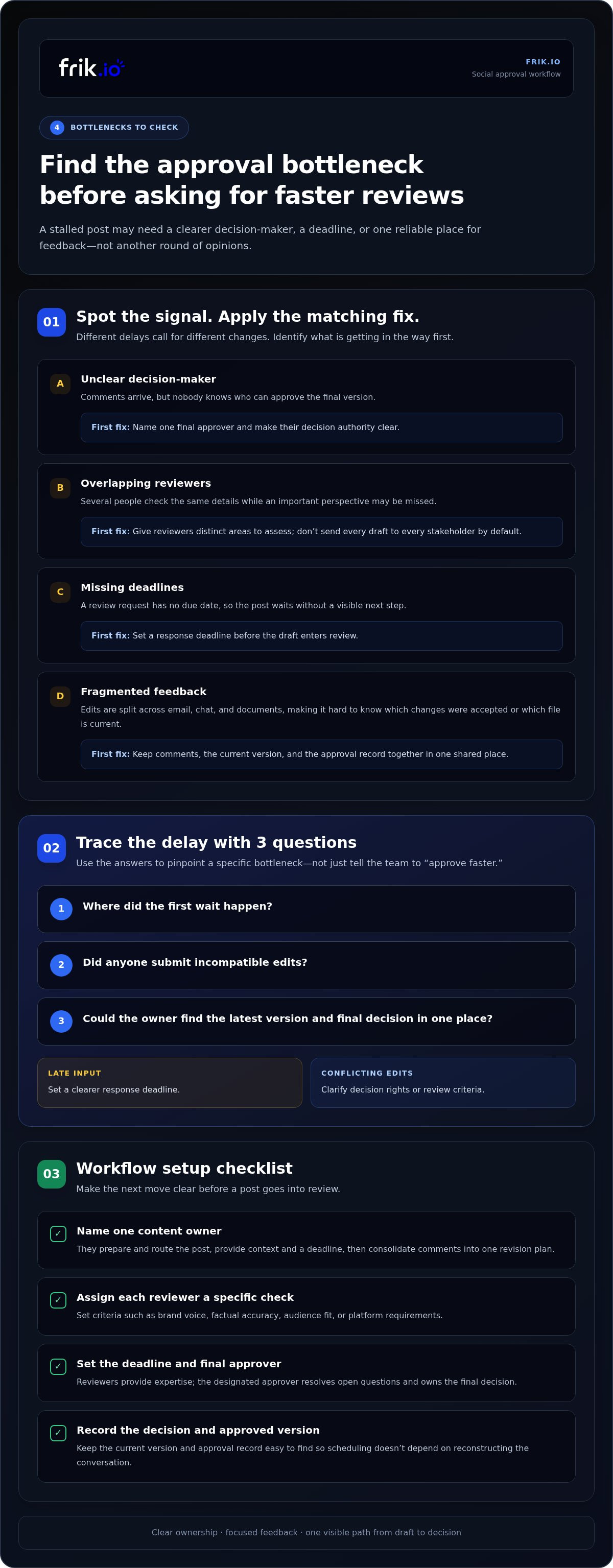
Start by identifying the kind of delay. Late input means a reviewer hasn’t responded by the time the team needs a decision. Conflicting edits mean reviewers respond but disagree or repeatedly revise the same element. These problems call for different fixes: set clearer deadlines for the first, and clarify decision rights or review criteria for the second.
Look for these common signals:
- Unclear decision-maker: Reviewers leave comments, but nobody knows who can approve the final version.
- Overlapping reviewers: Several people check the same details while an important perspective is missed.
- Missing deadlines: Review requests have no due date, so a post waits without a visible next step.
- Fragmented feedback: One reviewer emails a caption edit, another comments in chat, and a third marks up a document. The team can’t easily tell which changes were accepted or which file is authoritative.
Diagnose a delayed post by asking three questions: Where did the first wait happen? Did anyone submit incompatible edits? Could the owner find the latest version and final decision in one place? The answers point to a specific bottleneck, rather than a vague instruction to “approve faster.”
What a streamlined approval workflow should achieve
To streamline social media approval process, set expectations before the next draft enters review. Name one content owner to prepare and route the post, define what each reviewer checks, set a response deadline, and identify the person with final approval authority. Record the decision and approved version so scheduling doesn’t depend on someone reconstructing the conversation.
An efficient approval process creates a clear path from draft to decision, with the right people reviewing the right details at the right time. Efficiency means fewer avoidable loops, not rushed or automatic sign-off. Reviewers should be able to flag substantive issues, but they shouldn’t have to request changes because the goal or audience was never explained.
Fit the workflow to the content. A routine post may need a content owner and one approver. A higher-risk post may warrant additional subject-matter review. Add checks when they address a real risk, not by default. Before redesigning the process, use this checklist to find the first fix:
- Is one person accountable for moving the post forward?
- Does each reviewer know what to assess?
- Is there a clear deadline and a final approver?
- Can the team find the current version and approval record?
Design a Social Media Approval Workflow with Clear Roles and Review Criteria
An approval workflow defines the people, checks, and decisions that move a post from draft to publish-ready. Keep the path visible: the content owner prepares the post and brief, reviewers assess their assigned criteria, and one designated approver gives final sign-off. This makes clear who acts next and prevents review comments from becoming an informal vote.
Set review criteria before a post enters the workflow. Reviewers should know whether they’re checking brand voice, factual accuracy, audience fit, or platform requirements such as format and caption conventions. A brief that states the goal and intended audience gives them context to evaluate the post, rather than simply react to personal preference.
- Content owner: Supplies the draft, relevant context, and review deadline, then consolidates comments into a single revision plan.
- Reviewers: Check specific areas, such as subject accuracy or brand alignment, and explain any requested changes.
- Final approver: Resolves open questions, confirms the post meets the criteria, and records the decision.
Reviewers provide expertise; the designated approver owns the final approval decision. That distinction keeps useful input in the process without giving every comment equal decision-making weight.
How to assign approvers without creating review-by-committee
Name one person accountable for advancing each post, even when several people contribute. Give reviewers distinct areas of responsibility: a subject-matter expert checks accuracy, a brand lead checks voice, and a client contact confirms business fit. In agency-client workflows, state whether the agency approver or client approver gives final sign-off. Avoid sending every draft to every stakeholder by default.
How to make approval feedback specific and usable
Ask reviewers to describe the issue, why it matters, and the change they recommend. “The opening sounds too formal for this audience; use a more conversational hook” gives the content owner a clear next action. “I don’t like it” doesn’t. A shared style guide and content brief help reviewers ground feedback in agreed standards. For teams shaping consistent voice guidance, the AI brand voice tool guide offers related direction.
Classify feedback before revising. A factual correction addresses an error and should be resolved before approval. Strategic feedback challenges the post’s message, audience, or goal and may require the approver to make a decision. Preference-based edits reflect taste. Apply them when they improve the post or align with the brief, not automatically. This prevents subjective tweaks from reopening settled decisions.
- Approved: Meets the agreed criteria and can move forward.
- Needs revision: Has specific changes to make before another review.
- Blocked: Depends on a missing fact, decision, or asset, with an owner assigned to resolve it.
Document these definitions alongside the brief so every reviewer uses the same standard. Teams that want to bring review and brand-voice drafting into a shared workflow can explore frik.io’s social media management platform. It supports the process, while people remain responsible for meaningful review and final approval.
Choose the Right Social Media Approval Model for Your Team
The right approval model depends on who needs to weigh in, how much content moves through the workflow, and what could go wrong if a post is inaccurate or off-brand. Treat sequential, parallel, and risk-based review as flexible patterns, not fixed product features. A team can use one model for routine content and another when a post needs closer attention.
There’s no universally fastest option. Sequential review creates an orderly handoff but can stall if one person is unavailable. Parallel review gathers input at the same time but can produce conflicting edits. Risk-based review directs attention where it matters most, though the team needs clear criteria for judging risk.
Sequential, parallel, or risk-based review: what changes?
Use sequential review when each check depends on the previous one. For example, a subject-matter reviewer may confirm a claim before a brand lead reviews the final wording. Choose parallel review when reviewers can assess the same draft independently, such as checking factual accuracy and visual consistency at once. Risk-based review adjusts the number and depth of checks to a post’s sensitivity and potential impact.
| Model | Best-fit situation | Benefit | Main trade-off |
|---|---|---|---|
| Sequential | Reviews must happen in a specific order | Clear handoffs and decision points | A delayed reviewer can hold up later checks |
| Parallel | Several specialists can assess one draft independently | Feedback arrives together | Comments may conflict or overlap |
| Risk-based | Content varies in sensitivity or potential impact | Review effort matches the content | Requires shared rules for assigning review depth |
How to match the approval model to team and client needs
Start with four questions: How many stakeholders need input? How much account and content volume does the team manage? How sensitive is the subject matter? How often do posts return for revision? The answers point to a practical level of structure. A small team publishing routine updates may only need one content owner and one approver. An agency coordinating multiple client accounts may need documented handoffs and a visible decision owner so each post doesn’t depend on informal follow-ups.
Don’t send every post through the same review depth. A low-risk, recurring post can follow a light path. A sensitive announcement or a post with claims that need subject expertise may require additional checks. That’s the value of risk-based review: add scrutiny where it serves a purpose, not as a default for every caption.
For agency-client work, name one person to consolidate feedback and resolve conflicting requests. Reviewers can contribute from both teams, but one designated approver should make the final decision. That prevents a client comment and an agency edit from sending the same post in opposite directions. Choose the model that fits your workflow today, then adjust it as stakeholder count, account volume, or content risk changes. This helps streamline social media approval process steps without adding unnecessary review layers.
How to Streamline Social Media Approvals in Five Practical Steps
A repeatable workflow turns review into a sequence of clear handoffs. Use these five steps to move each post from brief to scheduled content, with a human decision-maker in control.
A repeatable path from content brief to approval
- Brief the post. Owner: content owner. Input: audience, platform, objective, draft direction, required assets, and review deadline. Complete when: reviewers understand what the post needs to achieve and what they’re being asked to assess.
- Prepare the draft. Owner: writer or content creator. Input: approved brief, brand guidance, and platform requirements. Complete when: the draft and supporting assets are ready for review together, with any claims or details needing verification clearly identified.
- Route it to reviewers. Owner: content owner. Input: draft, brief, named reviewers, review criteria, and deadline. Complete when: each reviewer has the context to check their assigned area, rather than being asked to approve everything.
- Consolidate feedback. Owner: content owner. Input: reviewer comments submitted by the deadline. Complete when: comments are gathered into one revision request that separates required corrections from suggestions and resolves duplicates. If reviewers disagree, send the conflict to the decision owner instead of forwarding competing edits to the writer.
- Record the decision and schedule. Owner: designated approver, then publishing owner. Input: revised draft and any outstanding decision. Complete when: approval, approved version, and decision date are recorded, and the post is handed to the publishing workflow. If it isn’t approved, note the remaining blocker and who owns it.
What to do when feedback is late or contradictory
Set the review deadline when you route the post. If it passes without a response, notify the reviewer and content owner of the next planned step, such as holding the post or asking the decision owner to assess the schedule impact. Don’t treat silence as approval unless your team has explicitly agreed to that rule.
For contradictory feedback, have the designated decision owner compare each request with the brief and review criteria. Escalate only when the disagreement affects accuracy, brand risk, or the publishing plan. This keeps ordinary preferences from becoming approval emergencies. For teams considering how a platform can support these handoffs, the AI social media management platform guide explores the broader workflow context.
Track approval time, revision rounds, and on-time publishing as diagnostic indicators. Review them over time to spot whether delays come from late input, repeated edits, or unclear ownership. Use the pattern to adjust the workflow, not as a promise of a particular time saving. Use frik.io to support a more organized social approval workflow with collaborative client review portals, brand-voice drafting, and scheduling and publishing tools.
Put a More Efficient Social Media Approval Process into One Shared Workspace
Choose the workflow before you choose the software. A platform can bring drafts and comments together, but it can’t decide who owns a post, what reviewers should assess, or who has final authority. Define those expectations first. Then select a workspace that supports your review path instead of adding unnecessary steps or forcing the team back into separate spreadsheets and message threads.
A shared workspace is useful when it keeps each post’s review connected to its content and publishing handoff. Reviewers should be able to find the draft, relevant context, and their next action without searching across several channels. For teams working with clients, a shared review experience can bring feedback together and show whether a post is still in review or ready to move forward.
What to look for in a social media approval workspace
Prioritize capabilities that make the agreed workflow easier to follow, not features that promise to replace it. A useful workspace can support:
- Shared client review: Clients and internal teams can assess the same content in a collaborative review portal rather than passing edits through email and spreadsheets.
- Connected content work: Drafting, review, and scheduling sit within a coordinated workflow, reducing handoffs between disconnected tools.
- Visible status: The team can identify whether content is awaiting review, needs changes, or has been approved for the next step.
These capabilities help keep comments and decisions tied to the relevant post. They don’t remove the need for clear roles or criteria. People still need to give useful feedback, resolve disagreements, and confirm the approved version before it moves to publishing.
How Frik.io can support a more connected review flow
Frik.io brings collaborative client review portals together with social content drafting, scheduling, and publishing. Teams and clients can review posts in a shared place while keeping content work connected to the publishing workflow. Instead of treating feedback as a separate email trail, reviewers can collaborate around the content being prepared.
Brand-true AI drafting can provide a more aligned starting point. Frik.io can be trained on a user-provided style guide, helping teams draft content with agreed voice guidance in mind. Its AI-generated captions can also be tailored for each platform, so reviewers assess copy intended for the relevant network rather than a generic version. These drafts are a starting point, not an approval decision. Reviewers still check accuracy, audience fit, brand alignment, and platform-specific requirements; a designated person remains responsible for resolving feedback and approving the post.
To streamline social media approval process, use software to support a workflow your team has already defined. If a connected review and publishing workspace fits your process, explore Frik.io’s social media workflow as a next step.
Make Your Next Approval Cycle More Predictable
Your next step doesn’t need to be a full process overhaul. Choose one upcoming content cycle and test a clearer path from brief to decision. Notice where ownership, review expectations, or handoffs still create uncertainty, then adjust one part of the workflow before the next batch begins. Small, deliberate refinements can help your team streamline social media approval process without sacrificing thoughtful review.
As your workflow evolves, the right workspace can support collaboration with client review portals, AI drafting trained on your style guide, and platform-tailored content connected to scheduling. These capabilities can make the process more connected while your team stays responsible for reviewing content and making approval decisions.
Ready to put that approach into practice? Explore Frik.io’s connected social media workflow and take the next step toward moving content to publication with more clarity and less friction.
Frequently Asked Questions
How many people should approve a social media post?
Assign only the people needed to check the post’s actual risks. Routine updates often need a content owner and one final approver. Add a specialist when the post includes details they’re responsible for, such as product specifications or a public announcement. For example, a campaign announcement might need a marketing lead and a communications approver, while a recurring tip may not. Keep the final decision with one person, even when several people contribute.
How long should a social media approval deadline be?
Set the deadline based on the post’s complexity and planned publishing date, leaving time for revisions. A routine post might allow reviewers one business day, while a post needing fact-checking or input from several stakeholders may need longer. Include the exact date, time, and time zone in the request. If the deadline is missed, follow the agreed next step rather than quietly assuming the post is approved.
What should a team do when a client does not respond to an approval request?
Send a concise reminder that includes the post, the outstanding decision, and the deadline’s time zone. State what happens next, such as holding the scheduled post or moving it to a later publishing slot. Don’t treat silence as approval unless that rule was agreed in advance. If a client’s decision is essential to accuracy or brand risk, keep the post on hold and notify the designated account owner.
How can teams keep an audit trail of social media approvals?
Keep a record tied to each post that shows the version reviewed, reviewer comments, changes made, approver, decision, and date. For example, note that a claim was corrected after review and identify which version received sign-off. Store the record in the team’s shared workspace or another consistent location, not only in an individual inbox. This makes it easier to resolve questions later and distinguish approved content from drafts.
Can a social media approval workflow work across different time zones?
Yes. Make deadlines unambiguous by including the date, time, and time zone in a format everyone can interpret. Build the review sequence around overlapping working hours where possible. If they don’t overlap, assign handoffs so the next person knows when to act. For a client in another time zone, agree on a practical response window and avoid scheduling critical reviews at the end of someone’s workday.
How should a team handle an urgent social media post?
Use a predefined fast-track path rather than skipping review entirely. Identify who can approve urgent posts, which checks remain essential, and how the team will document the decision afterward. For example, a time-sensitive service update may need a quick accuracy check by its owner and sign-off from the communications lead. If the required reviewer isn’t available, delay or revise the post rather than publish uncertain information.
Is a formal social media approval process necessary for a small team?
A small team can keep its process lightweight, but it still benefits from agreeing on who checks content and who gives the final go-ahead. A shared checklist or calendar note may be enough for a few people publishing routine posts. As responsibilities or client work expand, a consistent system helps the team streamline social media approval process without relying on memory. Formality should match the work, not the team’s headcount.


