
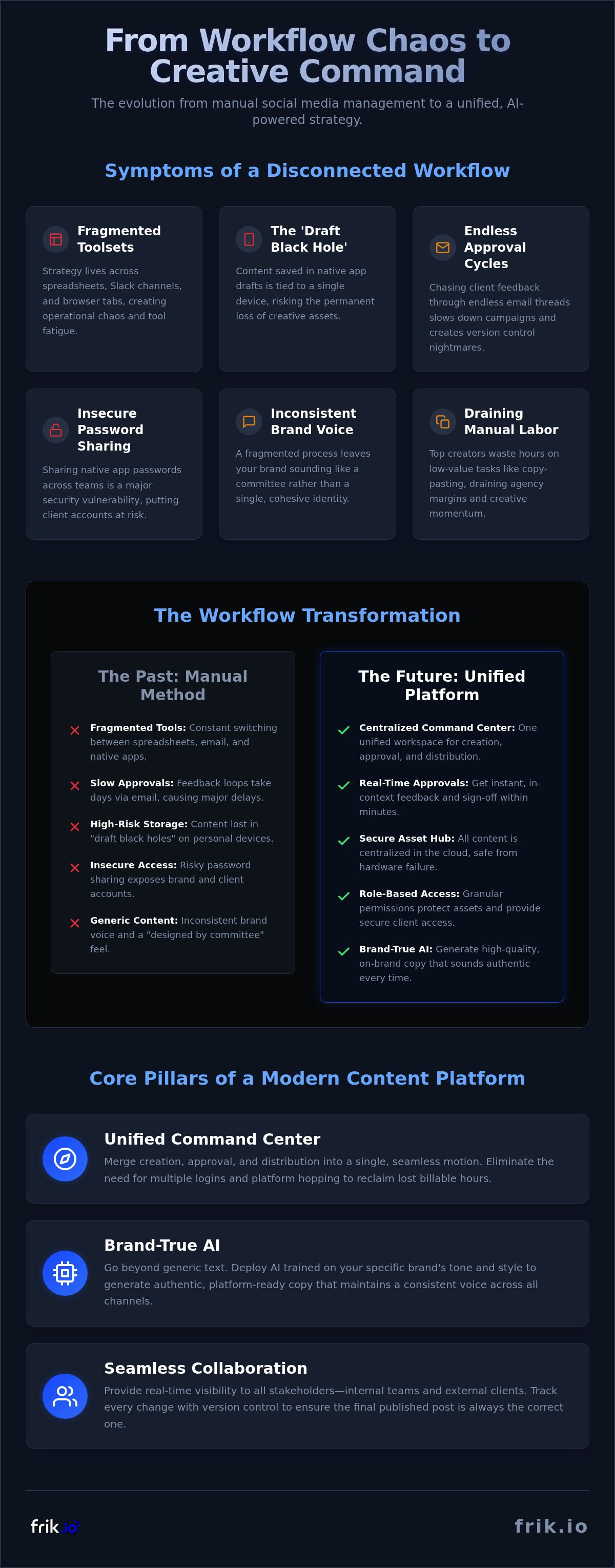
Spreadsheets and native app drafts aren't just slowing your team down; they're actively draining your creative ROI. You've likely felt the friction of chasing client approvals through endless email threads or hunting for a lost post idea buried in a platform's "Drafts" folder. It's a fragmented way to work that leaves your brand voice sounding like a committee rather than a cohesive identity. Managing multiple platforms through manual copy-pasting is no longer a sustainable strategy for high-growth teams.
You deserve a workflow that moves as fast as the 2026 social landscape. This guide shows you how to deploy a modern social media content collaboration tool to centralize your entire strategy into a single, AI-powered command center. We will explore how to eliminate operational bottlenecks, slash approval turnaround times, and ensure your AI-generated content actually sounds like your brand. It's time to move from operational chaos to streamlined productivity with a unified workspace built for precision and scale.
Key Takeaways
- Replace manual spreadsheets with a centralized workspace to eliminate fragmented workflows and reclaim lost billable hours.
- Discover why a professional social media content collaboration tool is essential for providing real-time visibility to both internal teams and external clients.
- Protect your brand assets by moving away from native app password-sharing toward secure, role-based access controls.
- Audit your current "content leaks" to identify where drafts go missing and establish a clear hierarchy for creation and final approval.
- Deploy Brand-True AI to generate platform-ready copy that maintains a consistent voice across every digital channel effortlessly.
Beyond the Spreadsheet: Why Teams are Outgrowing Manual Collaboration
Modern marketing departments are hitting a wall. It isn't a lack of talent; it's the friction of tool fatigue. When your strategy lives across three spreadsheets, two Slack channels, and a dozen browser tabs, you aren't managing social media. You're managing chaos. This fragmentation is the primary reason agencies are outgrowing manual collaboration methods in 2026. Static documents can't preview a video, notify you of a client's specific feedback, or automate the transition from draft to published post.
Relying on manual updates creates a massive how to scale social media management for multiple clients bottleneck. Your best creators shouldn't spend their hours copy-pasting text from a document into a scheduler. This is a low-value task that drains agency margins and kills creative momentum. Shifting to a dedicated social media content collaboration tool allows your team to move from simple "posting" to high-level strategic content operations.
The 'Draft Black Hole' Phenomenon
Saving content in native app "draft" folders is a high-risk gamble. These drafts are often tied to specific devices. If a team member's phone breaks or an account gets locked, that content is gone. It creates a "black hole" where expensive creative assets disappear before they ever reach the audience. A professional social media content collaboration tool solves this by centralizing every asset in a cloud-based workspace. This ensures your monthly ROI isn't compromised by hardware failure or fragmented storage. Centralization equals security.
Collaboration as a Growth Lever
True efficiency happens when you move from individual silos to a shared creative environment. This transition reduces the feedback loop from days of back-and-forth emails to minutes of real-time adjustments. Speed is your ultimate competitive advantage. When your team has immediate access to a centralized hub, they can focus on executing a what is a content pillar strategy with absolute precision.
- Unified Workspace: Eliminate the need for multiple logins and platform hopping.
- Real-Time Approvals: Get client sign-off inside the post preview, not in a separate email.
- Scalable Infrastructure: Add new clients and team members without breaking your existing workflow.
Establishing this foundation allows you to treat social media as a scalable business asset rather than a daily chore. It turns your operation into an efficient command center where every post serves a documented strategic purpose.
What Defines a Social Media Content Collaboration Tool in 2026?
In 2026, a professional social media collaboration tool is defined by its ability to merge creation, approval, and distribution into a single motion. It isn't just a place to store files; it's an active environment where work happens. Real-time visibility for all stakeholders is the baseline requirement. Managers need to see progress without asking for status updates, and clients need a clear portal to review work. This transparency builds trust and eliminates the friction of manual reporting.
Version control is now a non-negotiable standard for multi-brand agencies. When multiple editors touch a single post, the risk of using an outdated caption or an unapproved image is too high. A sophisticated workspace tracks every change, ensuring that the final published version is exactly what the client approved. This level of precision is what separates high-end operations from those still struggling with manual methods. It's about moving from "getting things done" to "getting things right" every single time.
The Role of Brand-True AI in Team Workflows
AI-integrated drafting has moved from a luxury to a core requirement. However, the standard has shifted away from generic text generation. Modern teams demand tools that understand nuance. Brand-True AI is the capability to generate content that matches a specific brand's historical tone and vocabulary. This ensures that every caption sounds authentic, regardless of which team member initiated the draft. By training models on your specific style guides, you eliminate the "generic bot" feel that plagues lower-tier tools. This technology acts as a force multiplier, allowing your team to produce high-volume, high-quality content without sacrificing the brand's unique identity.
Unified Workspaces vs. Fragmented Toolsets
Efficiency thrives in simplicity. The modern preference has shifted toward unified workspaces that offer a 360-degree view of the content calendar. Having one login for every social network eliminates the administrative burden of managing dozens of credentials. It also removes the "copy-paste" workflow that traditionally existed between design tools and schedulers. When your creation tools live inside your distribution hub, your speed to market increases significantly. If you want to see how this looks in practice, consider how an AI Social Media Management Platform can consolidate your entire tech stack into one sleek interface. You no longer need to connect disparate apps; you simply need a single, powerful foundation for your operations.
Native Apps vs. Professional Collaboration Platforms
Native apps are technically free, but the hidden "time tax" of manual management is massive. When you manage content across Instagram, TikTok, and LinkedIn individually, you're trading your team's billable hours for a zero-dollar software budget. It's a poor trade. Professional agencies understand that efficiency requires a centralized command center. Relying on native tools forces your team into a fragmented workflow where context is lost between every login and logout.
Security is another critical liability. Sharing passwords for native app access puts your brand presence at risk. If an employee leaves or a device is compromised, your accounts are vulnerable. A professional social media content collaboration tool uses secure, role-based access instead. You grant permissions without ever handing over master credentials. This keeps your brand safe while allowing your team to move at high velocity.
Native drafts are notoriously volatile. App updates or device migrations frequently wipe "Drafts" folders without warning. Because these files are often stored locally, they're invisible to the rest of the team. Professional platforms store every asset in a secure, cloud-based workspace. This ensures your creative work is protected, searchable, and accessible from any device at any time. Centralization isn't just about convenience; it's about asset protection.
The Client Approval Barrier
Screen-recording a draft on a mobile device just to get client feedback is a clunky, amateur process. It creates friction and slows down the entire production cycle. A dedicated client portal replaces this chaos with a white-label, professional experience. Clients can view platform-accurate previews and leave comments directly on the post. This eliminates the risk of "Approved" messages in Slack or email that never actually reach the content scheduler. You get faster turnarounds and a single source of truth for every revision.
Cross-Platform Scalability
Tailoring a single campaign for five different networks natively is a repetitive nightmare. Each platform requires specific aspect ratios, character counts, and tagging conventions. A social media content collaboration tool automates the "tailoring" process for you. You can create a core concept and then refine it for every channel within a single interface. Seeing all cross-platform drafts in one unified feed allows for better strategic alignment. It ensures your brand voice remains consistent even as you scale your presence across the digital landscape.
How to Transition Your Team to a Collaborative Workflow
Transitioning to a professional social media content collaboration tool isn't just a software change; it's a cultural shift toward operational excellence. Start by auditing your current "content leak" points. These are the specific gaps in your workflow where drafts disappear, feedback stalls, or assets are lost in personal folders. Identifying these friction points allows you to build a system that actively prevents them from recurring. Efficiency is the byproduct of discipline.
Define your internal hierarchy immediately to ensure accountability. Clearly establish who is responsible for creation, who handles the editorial review, and who grants the final "go" for publication. By defining these roles, you eliminate the ambiguity that leads to missed deadlines and inconsistent quality. Centralize all your foundational assets, including your strategy for how to write a bio for instagram, into your central hub. This provides your team with a single source of truth for every brand standard.
Setting Up Your AI Brand Voice
Integrate your brand voice profile into your drafting tool as the first step of onboarding. Feed the system your best-performing historical posts to train the AI on your specific tone, vocabulary, and cadence. This allows the AI to handle the "first 80%" of every post, generating platform-ready drafts in seconds. Human oversight remains essential for the final 20% of the creative process. Your team's role shifts from manual drafting to high-level refining, ensuring every post has the emotional resonance and strategic alignment required for growth.
Onboarding Clients to the Approval Portal
Position the Client Approval Portal as a premium benefit rather than a new requirement. Frame it as a tool for speed and clarity that respects their time. Set up automated notifications so approvals never stall in a busy inbox. When clients can see platform-accurate mockups and leave feedback directly on the post, the entire feedback loop accelerates. This transparency builds confidence and eliminates the need for endless status meetings. It turns the approval process into a streamlined, one-click experience that keeps your production calendar moving forward.
Ready to eliminate the chaos? You can centralize your team's content strategy in one AI-powered command center today.
Frik.io: The Efficient Command Center for Modern Teams
frik.io is the foundational layer for your digital presence. It functions as a sophisticated social media content collaboration tool that handles the heavy lifting so your creative team can focus on high-level strategy. Every stage of the social media lifecycle happens within one secure, sleek interface. We replace the administrative burden of fragmented toolsets with a single, AI-powered system designed for precision and scale. Efficiency is self-evident when your entire workflow is centralized.
Brand-True AI content generation is the cornerstone of this efficiency. It doesn't just write generic text; it produces platform-ready captions and assets that mirror your brand's unique DNA in seconds. This capability eliminates the creative block that often stalls production cycles. By centralizing your drafts in a persistent, cloud-based workspace, we effectively close the "Draft Black Hole" for good. Your work is saved and synced across the entire team, ensuring that hardware failures or app updates never compromise your output.
For agencies, the Client Approval Portal is a definitive secret weapon. It replaces clunky email chains and screen recordings with a professional, branded experience. Clients can review platform-accurate previews and provide feedback with a single click. Faster approvals mean faster scaling. This transparency builds the quiet authority your agency needs to retain high-value clients and manage complex portfolios with ease. It is a high-end solution for teams that have outgrown manual methods.
Features Built for High-Velocity Content
Our platform is engineered for teams that demand speed without sacrificing quality. We provide the tools necessary to move from operational chaos to streamlined productivity without adding unnecessary complexity to your day.
- Autopilot Scheduling: Deploy your content across every network automatically. Our "set-it-and-forget-it" logic ensures your brand remains active even when your team is offline.
- Multi-Platform Analytics: Access a 360-degree view of your performance across all channels. Use data-driven insights to prove ROI to stakeholders and refine your content pillars in real time.
- Scalable Workspace: Add new brands, team members, and clients effortlessly. The collaborative environment is built to expand alongside your agency's ambition.
Getting Started with frik.io
Moving your first brand into the frik.io workspace is a straightforward process that yields immediate results. Experience the relief of a professional workflow where every asset has a designated place. You will notice the difference in your team's velocity and your client's satisfaction within the first week of implementation. It is time to reclaim your billable hours and focus on the work that actually moves the needle for your brand.
Experience the Command Center - Start your frik.io trial today
Deploy Your 2026 Content Command Center
The era of managing social strategy through fragmented spreadsheets and native app drafts is over. To scale in 2026, your agency needs a unified workspace that bridges the gap between creative ideation and final distribution. By implementing a professional social media content collaboration tool, you eliminate the operational friction that stalls growth and drains your team's creative energy. You've learned how to audit your workflow, define clear roles, and leverage AI to maintain a consistent brand voice across every platform.
Transitioning to a centralized system provides the quiet authority needed to manage complex client portfolios with absolute precision. It's about moving from a state of chaos to a state of streamlined productivity. Frik.io offers the high-end features your team deserves: Brand-True AI trained on your unique voice, centralized client approval portals, and autopilot scheduling for multi-platform growth.
Stop the chaos and scale your agency with frik.io. Your team is ready for a professional upgrade.
Frequently Asked Questions
What is a social media content collaboration tool?
A social media content collaboration tool is a centralized workspace where teams create, schedule, and publish content from a single dashboard. It replaces the fragmented workflows of spreadsheets and Slack threads with a unified system. This technology provides real-time visibility for all stakeholders, including managers and clients. By integrating creation and distribution, it allows your team to move from individual silos to a shared environment built for strategic content operations.
How do collaboration tools solve the problem of lost drafts?
These tools solve the problem by moving drafts from local device storage to persistent, cloud-based workspaces. Native app drafts are often tied to specific phones and can be wiped during app updates or device migrations. A professional platform ensures that every creative asset is saved and accessible to the entire team. This centralization eliminates the "Draft Black Hole" and protects your creative ROI from hardware failures or account lockdowns.
Can I use AI to draft content that actually sounds like my brand?
You can achieve this by using Brand-True AI content generation trained on your unique voice and historical performance. Unlike generic bots, this technology analyzes your specific style guide and vocabulary to produce platform-ready copy. It allows the AI to handle the first 80% of the drafting process while maintaining your brand's unique identity. This ensures consistency across every channel even when multiple team members are contributing to the same campaign.
How do client approval portals work in 2026?
Modern portals provide a white-label, professional interface where clients can view platform-accurate mockups of their posts. They can leave feedback directly on the creative assets instead of using clunky email threads or screen recordings. This transparency builds trust and significantly reduces approval turnaround times. Once a client grants the final "go" within the portal, the post can automatically move into the distribution queue through autopilot scheduling.
Is it safe to share social media access with a collaboration platform?
It is much safer than sharing native app passwords because these platforms use secure, role-based access controls. You grant specific permissions to team members without ever handing over your master credentials. This reduces the risk of account compromise if an employee leaves or a device is lost. Professional tools act as a secure foundational layer for your operations, ensuring your brand presence remains protected while your team works at high velocity.
What is the best collaboration tool for small agencies?
Small agencies benefit most from a tool that democratizes high-level professional capabilities, such as frik.io. You need an "Efficient Command Center" that handles manual labor through automation and AI drafting. This allows a smaller, agile team to manage a volume of clients that was previously reserved for large-scale operations. Look for a platform that offers a unified workspace and scalable features that grow alongside your agency's portfolio.
How does a unified workspace improve social media ROI?
A unified workspace improves ROI by eliminating the "time tax" associated with manual management and fragmented toolsets. By reducing the time spent on copy-pasting, status meetings, and chasing approvals, your team can focus on high-value strategic work. Faster production cycles and AI-driven efficiency allow you to scale your operations without a proportional increase in headcount. This streamlined logic protects your agency margins and maximizes the impact of every creative asset.
Can I schedule posts to multiple platforms at once with these tools?
You can definitely schedule to multiple networks simultaneously using a professional social media content collaboration tool. These platforms allow you to create a core campaign concept and then use AI to automatically tailor the copy and specs for each network. This eliminates the need to log into five different apps to post a single update. It ensures your brand voice remains consistent while respecting the unique requirements of every digital platform.


