
Posting daily without a foundation isn't a strategy; it's a recipe for creative burnout that leaves your brand voice fragmented and your audience confused. You've likely felt the anxiety of the morning "what do I post?" scramble while trying to maintain a cohesive presence across 6.5 different platforms. It's frustrating to work this hard without seeing the topical authority that commands attention. You're searching for a way to stop the chaos, and that starts with understanding exactly what is a content pillar.
Mastering this strategic framework transforms your fragmented social media efforts into a unified, high-velocity engine. We'll show you how to build a repeatable system that eliminates guesswork and speeds up client approval cycles. You'll learn to move beyond simple volume toward a model of semantic authority that drives real ROI. We'll also look at how frik.io acts as your command center, training AI on your specific pillars to ensure every caption remains brand-true and professional. This guide provides the foundation you need to move from operational chaos to streamlined productivity.
Key Takeaways
- Define what is a content pillar to establish 3-5 core themes that anchor your brand expertise and eliminate daily posting anxiety.
- Move beyond tactical content buckets toward a strategic topic cluster model to build the deep topical authority that modern algorithms prioritize.
- Implement a repeatable 5-step framework to audit your high-performing assets and map new content directly to customer pain points.
- Utilize frik.io to train AI on your unique pillar strategy, ensuring every generated caption remains brand-true and professional at scale.
- Streamline your workflow with a unified command center approach that accelerates client approval cycles and improves overall social media ROI.
Defining the Content Pillar: Your Social Strategy’s North Star
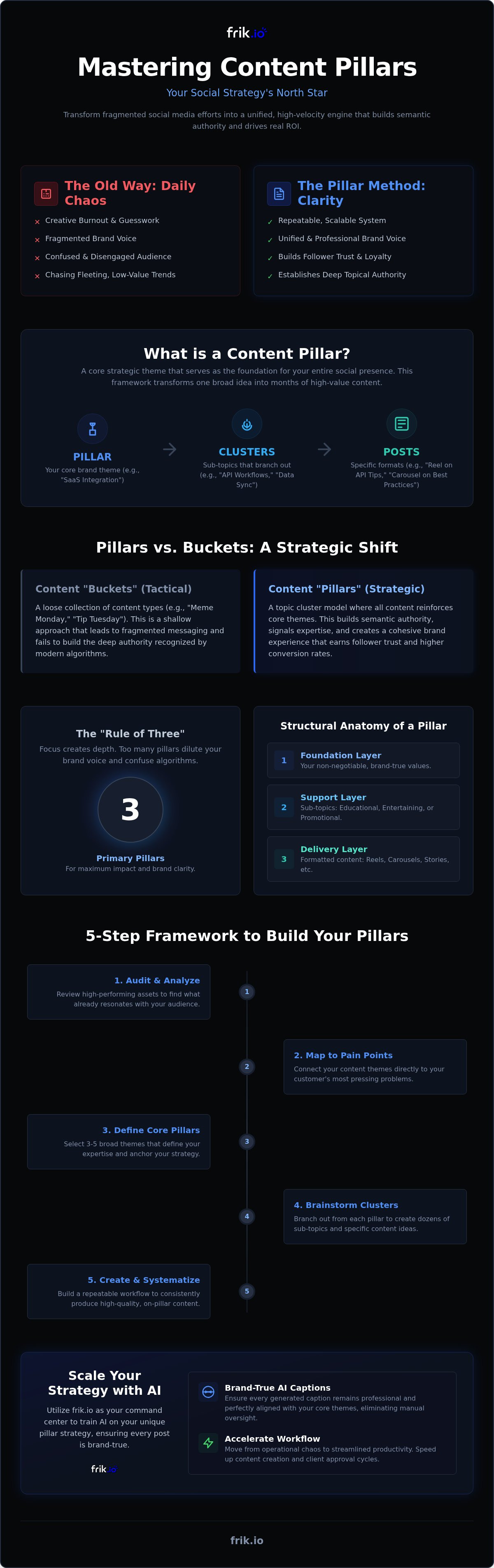
Stop guessing what to post. A content pillar is a strategic theme that serves as the foundation for your entire social presence. Instead of chasing fleeting trends, you build around 3-5 core topics that define your brand's expertise. Understanding what is a content pillar is the first step toward moving away from "random acts of posting" and toward a system where every piece of content reinforces your market position. This framework allows you to scale your output while maintaining a razor-sharp focus.
Visualize your pillar as the trunk of a tree. From this central topic, dozens of sub-topics or "clusters" branch out into specific posts. This model ensures you never run out of ideas because one broad theme can generate months of sub-topics. This structural logic is heavily used in search engine optimization (SEO), where deep topical coverage signals authority to both users and algorithms. In the crowded feeds of 2026, this instant topical authority is what separates industry leaders from background noise.
Why Pillars are Essential for Modern Social Media Teams
Creative block usually stems from having too many choices. Pillars solve this by providing a pre-approved decision framework for your team. When you know your core themes, you don't ask "What should I post today?" but rather "How do I express our core pillar through this specific platform's lens?" This clarity ensures consistency across Instagram, LinkedIn, and TikTok without needing constant manual oversight. It acts as a guardrail that prevents strategy drift, ensuring that as your team grows, your brand voice remains unified and professional.
The ROI of Thematic Consistency
Algorithms now prioritize semantic authority over simple engagement metrics. When you consistently group related content, you send high-value signals that tell the platform exactly who you are and which audience segments will find your content genuinely useful. This depth builds follower trust significantly faster than generic, fragmented posts. Higher trust directly correlates to improved conversion rates because users view your brand as a reliable source of information. Agencies can monitor these trends and refine their approach by utilizing social media analytics for agencies to track which specific pillars are moving the needle.
The Structural Anatomy of Effective Social Media Pillars
Building a high-velocity social strategy requires more than just picking topics. You need a structural anatomy that supports consistent growth. When agencies ask what is a content pillar in a social context, they're looking for a framework that translates abstract brand values into daily deliverables. This hierarchy ensures that every post serves a specific purpose in your broader marketing ecosystem.
The structure follows a logical path. At the base sits your foundation: the brand-true values that never change. These are your non-negotiables. Above this, you build the support layer, which consists of educational, entertaining, or promotional sub-topics. These provide the variety needed to keep your feed fresh. Finally, you have the delivery layer, where these sub-topics are formatted into Reels, carousels, or single-image posts. This tiered approach turns a static strategy into a dynamic content engine.
To keep your operations lean, follow the "Rule of Three." Select only three primary pillars. This prevents over-complication and ensures your team can maintain high quality across every platform. Too many pillars dilute your brand voice and make it harder for the algorithm to categorize your content accurately. Focus creates the depth necessary for true authority.
Educational Pillars: Building Authority
Educational pillars establish you as a leader by providing "How-to" content and deep industry insights. For a B2B brand, this might look like "Advanced SaaS integration tips" or "Data-driven marketing reports." For a B2C brand, it could be "Professional styling guides for home decor" or "Skincare ingredient deep-dives."
The challenge is maintaining a human expert voice at scale. You can utilize frik.io to draft educational captions that sound authentic, moving beyond generic AI outputs. By training the system on your specific industry knowledge, you generate weeks of authoritative content in minutes. This allows your team to focus on high-level strategy while the platform handles the heavy lifting of drafting brand-true captions.
Community Pillars: Driving Engagement
Engagement doesn't happen by accident. Community pillars focus on shared values, behind-the-scenes glimpses, and user-generated content (UGC). These elements humanize your brand and spark genuine conversations in the comments. Instead of just talking at your audience, you're building a space for them to participate. The Engagement Pillar acts as the bridge between brand and buyer, turning passive followers into active advocates.
Use these pillars to ask provocative questions or share "day-in-the-life" content that resonates with your audience's daily experiences. This approach moves your strategy from a broadcast model to a community-first ecosystem. It creates a repeatable loop where your audience feels seen and heard, driving long-term loyalty and higher social ROI.
Pillars vs. Buckets: Why Your Current Strategy Is Stalling
Many marketers use "buckets" and "pillars" as synonyms. They aren't. Buckets are tactical labels like "Meme Monday" or "Client Spotlight." They describe what you're posting in the short term. A content pillar is strategic. It defines why you're posting and how that topic supports your business goals. If you don't know what is a content pillar, you're likely stuck in a cycle of shallow engagement that fails to drive revenue. High-velocity brands don't just fill slots on a calendar; they build authority through consistent thematic depth.
Agencies often fall into the "Agency Trap" by creating 10 or more categories to show variety to a client. This over-complication creates operational chaos and dilutes the brand voice. Stick to the Rule of Three. This focus allows for the deep topical authority that 2026 algorithms demand. Don't fear repetition. Pillars don't make your feed look repetitive; they make it recognizable. Users need consistent themes to remember your brand among the noise of 6.5 different platforms. Understanding what is a content pillar versus a bucket is the difference between a fragmented feed and a unified command center.
Moving Beyond Tactical Posting
Transitioning from a post-to-post mindset to a theme-to-theme workflow requires a unified workspace. You need to visualize how your pillars distribute across the month to ensure no core value is neglected. Using an AI social media management platform helps you maintain this balance without manual tracking. This shift allows your team to spend less time on "what to post" and more time on high-level strategy. It transforms your daily output into a cohesive brand narrative that scales effortlessly.
The Problem with 'Empty' Content Buckets
Empty buckets like "National Holiday" posts or generic engagement bait might get likes, but they often hurt long-term brand authority. This "shallow" content fails to convert because it doesn't solve a problem or showcase expertise. Audit your current feed to identify which posts drive leads and which simply fill space. If a post doesn't map back to a core pillar, it's just noise. Eliminate the noise to make room for content that builds trust. A pillar-based audit reveals exactly where your strategy is stalling and where you need to double down on depth.
A 5-Step Framework for Building High-Performance Content Pillars
Success in social media isn't accidental; it's engineered. Transitioning from a chaotic posting schedule to a streamlined system requires a repeatable framework. When you understand what is a content pillar, you can build a strategy that scales without increasing your workload. This five-step process moves you from abstract ideas to a high-velocity content engine.
Auditing for Authority
Step 1: Audit your existing top-performing content. Look beyond surface-level likes. Focus on high-value signals like saves and direct message shares. These metrics indicate that your audience finds the content genuinely useful and trustworthy. Use this data to identify natural themes that already resonate with your followers. Simultaneously, look for 'White Space' in your industry. Identify the specific pain points your competitors are ignoring and position your brand as the primary solution in those areas. This ensures your pillars are built on a foundation of proven demand and unique value.
Mapping Pillars to the Buyer’s Journey
Step 2: Map pillars to specific customer pain points and desired outcomes. Your strategy must serve the entire funnel to be effective. TOFU pillars provide broad awareness and education to attract new followers. MOFU and BOFU pillars transition into specific problem-solving and social proof to drive conversions. A healthy weekly calendar balances these frequencies. It typically favors 60 percent educational content and 40 percent community or promotional content. This balance ensures you build authority while still moving prospects toward a purchase.
Step 3: Define the Brand Voice for each pillar. Consistency is non-negotiable for growing teams. You can train frik.io's AI content generation on your custom style guides to ensure every pillar maintains its unique tonal edge. This eliminates the risk of strategy drift and ensures that AI-drafted captions sound like human experts. It provides a "set-it-and-forget-it" level of convenience for maintaining professional standards.
Step 4: Create a Content Matrix. Diversify your formats within each pillar. A single theme can be a Reel for reach, a carousel for depth, and a poll for engagement. This format variety keeps your feed dynamic while the core message remains unified across all 6.5 platforms the average user visits monthly. Finally, Step 5: Load your pillars into an autopilot scheduler. Automating the execution phase ensures your strategy remains active without manual daily intervention. This moves your operations from creative block to a state of streamlined productivity.
Scaling Content Pillars with AI-Powered Brand Voice Integration
Strategy is only as good as its execution. Many teams struggle to maintain the thematic depth required for true authority because manual content creation is slow and prone to drift. Once you define what is a content pillar for your brand, the next step is automating the output without losing your unique edge. frik.io serves as your strategic command center, training AI on your specific brand voice and pillar strategy to generate "Brand-True" content at scale. Move from operational chaos to streamlined productivity by turning high-level concepts into daily deliverables in seconds.
Training Your AI on Your Pillars
Precision starts with the right inputs. You can upload custom style guides and detailed pillar descriptions directly into frik.io to anchor the AI's logic. This ensures that every generated post aligns with your core strategic mission. The platform doesn't just create generic text; it understands the nuances of your industry. From a single pillar, you can generate platform-specific variants that respect the unique culture of each feed:
- Convert a technical pillar into an authoritative LinkedIn article.
- Transform the same pillar into a punchy, high-energy TikTok script.
- Draft educational carousels for Instagram that maintain your human expert tone.
This multi-platform scalability ensures your brand remains unified across 6.5 different social platforms. It eliminates the friction of manual drafting while reinforcing what is a content pillar at the tactical level. You maintain total control over the narrative while the AI handles the heavy lifting of format optimization.
Streamlining the Approval Workflow
Automation shouldn't mean a loss of quality control. Utilize the Client Approval Portal to maintain a professional review process. This feature allows agencies to present entire pillar batches to clients at once, significantly reducing approval cycles. Clients can see how daily posts map back to the long-term strategy, improving trust and retention. It bridges the gap between high-level strategy and daily execution, ensuring that nothing goes live without a final human check.
The future of social management is "agentic." We're moving toward systems that don't just draft content but suggest pillar shifts based on live engagement data. This allows you to pivot your strategy in real-time as audience interests evolve. You're no longer just managing a calendar; you're leading a dynamic, data-driven ecosystem. Start building your pillars with frik.io's AI Command Center today.
Establish Your Strategic Command Center
Transitioning from fragmented social posting to a unified strategy requires a shift in perspective. You've learned that understanding what is a content pillar is about more than just categorizing topics; it's about building a foundational logic that sustains long-term growth. By moving away from empty buckets and toward thematic clusters, you establish the topical authority required to win in 2026. This strategic depth ensures your brand remains recognizable and trustworthy across every platform your audience visits.
Now is the time to turn this framework into a high-velocity operation. frik.io provides the infrastructure to execute your pillars with precision. Generate AI drafts that sound exactly like your brand, manage feedback through streamlined approval portals, and deploy content with one-click multi-platform scheduling. You can finally replace messy spreadsheets with a sleek, tech-forward workspace that simplifies complex workflows.
Scale your social media strategy with frik.io's AI Command Center and reclaim your creative focus today. Your path from operational chaos to streamlined productivity starts here.
Frequently Asked Questions
How many content pillars should a brand have?
Most successful brands maintain 3 to 5 core pillars to ensure variety without over-complication. Following a "Rule of Three" allows your team to develop the deep topical authority that 2026 algorithms prioritize. Having too many pillars leads to strategy drift and operational chaos. By focusing on a limited set, you ensure your brand voice remains consistent and recognizable across multiple platforms while keeping your content creation workflow lean and manageable.
Can content pillars change over time?
Your pillars should evolve as your audience needs and market trends shift. While the foundation of what is a content pillar is rooted in brand-true values, the specific themes can be refined through performance data. Reviewing your strategy quarterly allows you to identify which topics are driving high-value signals like saves and shares. If a pillar consistently underperforms, pivot toward new "White Space" opportunities where competitors aren't providing value.
What is the difference between a content pillar and a content cluster?
A content pillar is a broad, strategic theme that anchors your brand expertise. In contrast, a content cluster consists of the specific sub-topics and individual posts that branch off from that pillar. Think of the pillar as the trunk of a tree and the clusters as the branches. This hierarchy ensures every post reinforces a core mission, moving your strategy from "random acts of posting" to a unified, high-velocity system.
How do I know if my content pillars are working?
Success is measured through high-value engagement signals rather than surface-level likes. Track metrics such as saves, direct message shares, and comment depth to gauge topical authority. If your pillars are working, you'll see faster client approval cycles and improved conversion rates over time. Using frik.io's integrated analytics allows you to monitor pillar performance across platforms, providing the data needed to refine your strategy and maximize your social media ROI.
Do I need different pillars for different social media platforms?
Your core pillars should remain consistent across all platforms to maintain a unified brand voice. However, the delivery and format must be tailored to each specific algorithm's goals. For example, an educational pillar might become a technical LinkedIn article, a high-energy TikTok script, or an engaging Instagram carousel. This approach ensures your strategic foundation remains strong while you optimize for the unique user behaviors and content preferences of each social network.
How can AI help me come up with content pillar ideas?
AI excels at analyzing vast amounts of engagement data to identify natural themes and "White Space" in your industry. You can use frik.io to input your existing top-performing content and let the system suggest potential pillars based on audience demand. This eliminates creative block by providing a data-driven starting point. AI also helps generate weeks of sub-topic ideas from a single pillar, ensuring your content calendar remains full and strategically aligned.
Is a content pillar the same as a brand's value proposition?
They are related but distinct. A value proposition defines the unique benefit your product or service provides. A content pillar is the strategic theme you use to communicate and prove that value through social content. For instance, if your value proposition is "the most efficient workflow tool," your pillars might focus on automation, scalability, and time-management. Pillars act as the delivery mechanism that turns your abstract brand promise into tangible, authoritative content.
How often should I review my content pillar strategy?
High-velocity teams should conduct a deep-dive review of their content pillars every quarter. This frequency provides enough data to spot meaningful trends without over-reacting to short-term fluctuations. Monthly audits are also beneficial for tracking tactical performance and ensuring your content matrix remains balanced. Regular reviews allow you to pivot quickly based on live engagement data, ensuring your "Efficient Command Center" approach stays ahead of algorithm shifts and evolving audience interests.


