
What if your style guide could do more than describe your brand? Social media style guide enforcement works when voice, terminology, and platform rules become clear checks contributors can apply before a post goes live. If every writer interprets “on-brand” differently, manual reviews can slow publishing and still miss inconsistencies. The problem isn’t a lack of guidelines. It’s the gap between broad principles and everyday decisions.
This guide shows you how to close that gap. You’ll learn to turn brand values into specific rules for captions, visuals, terminology, and platform-specific edits, then build those checks into drafting and approval workflows. You’ll also learn how to focus reviews, make feedback more consistent across contributors and clients, and use AI trained on your style guide to carry brand rules into content creation. The result is a repeatable system for managing content across channels without sending every post through an open-ended review.
Key Takeaways
- Make social media style guide enforcement practical by turning broad brand principles into rules contributors can check in a draft.
- Use examples and counterexamples to clarify voice, terminology, formatting, and content boundaries.
- Choose the right balance of manual reviews, workflow checks, and AI assistance for your team’s needs.
- Assign clear ownership for maintaining standards, drafting posts, reviewing changes, and making final decisions.
- Connect style guidance to content creation and shared approvals to support consistency across contributors and platforms.
Why Social Media Style Guide Enforcement Breaks Down as Teams Grow
A style guide can explain how a brand should sound, but it can’t ensure every contributor applies the rules the same way. As teams grow, more writers, reviewers, clients, and channels create more room for interpretation to drift. The differences may be subtle: a caption uses a different product term, a graphic introduces unapproved formatting, or a platform edit shifts the tone from helpful to overly promotional.
That’s why social media style guide enforcement needs to be a process, not just a document. Wikipedia offers a familiar example of a shared standard in practice: Wikipedia's Manual of Style sets guidance for content contributors. For a brand team, the goal is similar: make expectations clear enough to apply consistently while leaving room to adapt messages to the audience and platform.
What Does Social Media Style Guide Enforcement Mean?
Social media style guide enforcement is the consistent application of documented brand rules during content drafting, review, and publishing. The style guide holds the rules; enforcement is the workflow that puts them to use. Teams can check adherence as a post is drafted, during review and approval, and before it’s published. Each stage gives contributors a chance to catch issues before they reach the audience.
That doesn’t mean every post should sound identical. Consistency means keeping recognizable standards, such as voice, terminology, and visual conventions, while adapting the message to the format. A short caption may be more direct than a longer post, for example, while both still sound like the same brand.
Why Do Social Posts Drift Away from Brand Guidelines?
Broad adjectives leave room for personal judgment. “Confident” might mean concise and assured to one writer, but bold and full of superlatives to another. “Friendly” could mean conversational, or slip into slang the brand wouldn’t normally use. Without observable examples, each contributor fills in the gaps with their own instincts.
Small differences can compound. Inconsistent terminology may confuse audiences about what a product or feature is called. Uneven formatting can make a feed feel disconnected. When writers adapt content for different platforms, they may change more than length or structure: a measured brand voice can become abrupt, or a clear message can lose important context.
Time pressure makes the gap wider. A writer rushing to meet a publishing deadline may skip a terminology check. A reviewer may leave feedback in a document, chat, or email, while the person editing the post sees only some of it. Without a shared process, a draft can be approved before anyone checks every relevant rule.
The fix starts with treating the guide as a standard people can apply, not a reference they’re expected to interpret from scratch. Clear examples help contributors distinguish a brand rule from a personal preference. That way, teams can maintain a consistent identity without flattening every post into the same voice.
Turn Your Social Media Style Guide into Clear, Testable Rules
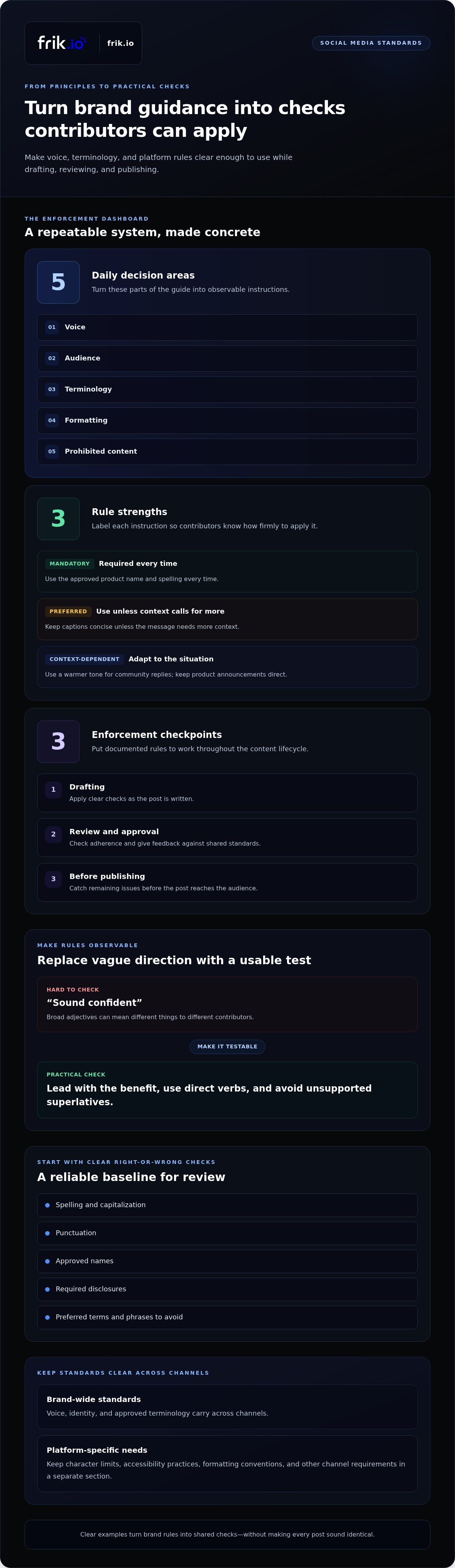
Start with the parts of your guide that shape daily decisions: voice, audience, terminology, formatting, and prohibited content. Rewrite each broad principle as something a writer or reviewer can observe. “Sound confident” is hard to check. “Lead with the benefit, use direct verbs, and avoid unsupported superlatives” gives the team a practical test.
Label each rule so contributors know how firmly to apply it:
- Mandatory: Use the approved product name and spelling every time.
- Preferred: Keep captions concise unless the message needs more context.
- Context-dependent: Use a warmer tone for community replies, while keeping product announcements direct.
Keep brand-wide standards separate from platform requirements. Voice, identity, and approved terminology should carry across channels. Character limits, accessibility practices, formatting conventions, and other channel-specific needs belong in a separate section. Resources such as HHS Social Media Policies show how social media guidance can cover practical areas beyond tone, including accessibility and comment moderation.
Which Style Guide Rules Are Easiest to Enforce?
Begin with rules that have a clear right or wrong answer: spelling, capitalization, punctuation, approved names, and required disclosures. Add a preferred-terms list and note phrases to avoid. For example, specify the approved name for a feature and flag vague alternatives that could confuse readers. These checks give reviewers a reliable baseline before they assess more subjective choices.
How Do You Make Subjective Voice Guidance Actionable?
Pair each voice attribute with a behavior and a sample. “Helpful” might mean explaining the next step before introducing a feature. “Authoritative” might mean stating a recommendation plainly without exaggerated claims. Add a counterexample to show the boundary, but don’t turn one sample caption into a template every writer must copy.
Context matters, too. A customer response may call for warmth and empathy; a product update may need a sharper, more informative opening. In both cases, the same underlying brand traits should come through. For teams developing this kind of guidance for AI-assisted writing, the AI brand voice tool guide offers a related framework.
Make each rule reviewable by asking: could two people look at the same post and agree on whether it meets this instruction? If not, add a sample, clarify the context, or narrow the wording. Then test the rules against real drafts. With frik.io, teams can train AI on their style guide and generate brand-voice captions, bringing documented standards into the drafting process.
Clear rules are easier to carry into a shared workflow. Explore how frik.io’s social media workspace can support style-guided content creation and review.
Compare Manual Reviews, Workflow Checks, and AI-Assisted Enforcement
Each enforcement method solves a different problem. A checklist helps reviewers remember the rules. An approval workflow makes review stages and ownership visible. AI can help carry style guidance into a draft. For reliable social media style guide enforcement, match the method to the decision being made, then combine approaches where they complement each other.
- Manual checklist: Easy to start and useful for applying human judgment, but consistency depends on reviewers remembering and interpreting each check. Review effort rises with content volume.
- Structured workflow: Makes handoffs, feedback, and approval responsibility clearer. It can reduce scattered comments, though people still need to assess the content and resolve conflicting feedback.
- AI-assisted drafting or review: Can help apply explicit guidance, such as suggesting an approved term or preferred format. It can support repeatable checks across more drafts, but still needs human oversight for context and nuance.
Consider four dimensions: consistency, review effort, scalability, and judgment. A checklist requires little setup but relies heavily on reviewer attention. A workflow adds structure and makes ownership easier to track. AI can support recurring checks across more drafts, while people decide whether a joke fits the audience or a sensitive response strikes the right tone. No single approach removes the need for clear rules and accountable review.
When Is a Manual Style Guide Checklist Enough?
A shared checklist can work well when a small group creates a manageable stream of posts and the same people understand the brand. Keep it short and specific so reviewers can use it without rereading the full guide. Watch for repeated corrections, missed details, or uncertainty about who approves changes. As contributors, channels, or approval steps increase, reassess whether memory and manual coordination still provide dependable coverage.
What Can AI and Approval Workflows Enforce Reliably?
AI is best suited to clearly stated, repeatable guidance, such as terminology, capitalization, and formatting. It can also support drafting when trained on a team’s style guide. Approval workflows clarify who reviews, who resolves edits, and who makes the final decision. For a broader look at how these systems fit together, see this AI social media management platform guide.
Keep people responsible for decisions that depend on meaning. A tool may flag a phrase, but it can’t reliably determine whether that phrase feels empathetic in a customer reply, suits a specific moment, or reflects the brand’s intent. Use automation to surface likely issues, not replace judgment. A hybrid system lets checks handle predictable details while reviewers focus on voice, context, and exceptions.
That balance can also protect review time. Route drafts through defined approval stages, gather feedback in a shared place, and assign one person to resolve conflicting edits. The result is a process that can scale without asking every reviewer to inspect every detail from scratch.
Build a Repeatable Social Media Style Guide Enforcement Workflow
A reliable workflow makes brand rules part of production, not a last-minute cleanup task. Assign an owner to maintain the guide, a creator to draft each post, and a named approver to make the final decision. For client work, clarify who consolidates feedback so the writer isn’t left resolving conflicting comments alone.
Use this sequence to make social media style guide enforcement repeatable:
- Set the rules. Keep the current guide accessible and identify which requirements apply to every post and which apply only to particular platforms or situations.
- Draft against the brief. Before writing, the content owner checks the audience, purpose, channel, and relevant rules.
- Review the draft. The reviewer checks mandatory requirements first, then evaluates voice, clarity, and platform fit.
- Correct and resolve. The creator addresses feedback tied to a specific rule. The approver resolves disagreements and records any approved exception.
- Publish and learn. Confirm the final version is the approved one, then capture recurring issues for the next guide review.
Keep the review checklist short enough to use on every post:
- Does the copy reflect the intended brand voice and audience?
- Are names, claims, and key details accurate?
- Do spelling, terminology, and formatting follow the guide?
- Does the post fit the platform without losing the brand’s meaning?
How Should Teams Review and Correct a Post?
Start with mandatory rules, such as approved terminology and required content, then assess tone and audience fit. Make feedback actionable: cite the relevant rule and suggest a correction instead of saying a line simply “doesn’t feel right.” If an exception is approved, record its context and rationale so the next contributor can apply the same judgment rather than reopen the debate.
How Do You Keep the Guide Useful Over Time?
Choose a review cadence that fits your publishing process, and revisit the guide when brand strategy or channel needs change. Look for recurring comments: if reviewers keep correcting the same issue, the rule may need a clearer example. Maintain a visible change log that records what changed and why, so contributors know which guidance is current.
Use recurring exceptions as signals. One unusual post may need a one-time decision; repeated exceptions may reveal a missing rule or an overly rigid instruction. A shared workspace can help keep drafts, feedback, and approvals connected. With frik.io, teams can use client review workflows to centralize approval feedback and keep decisions visible across contributors.
Bring drafting, review, and publishing into a more connected process with frik.io’s social media management platform.
Scale Style Guide Enforcement with Shared AI and Approval Workflows
A growing team needs brand guidance where content work happens. If writers have to search through separate documents, approval threads, and publishing tools, a rule can easily get missed. Connecting guidance to drafting and review makes social media style guide enforcement part of the content workflow while keeping final decisions with people.
Before choosing a tool, assess whether it can support the work your team needs to coordinate:
- Reusable brand guidance: Can contributors bring shared voice and terminology rules into content creation?
- Clear review ownership: Can the team see who needs to review content and who makes the final decision?
- Visible approval status: Can contributors distinguish a draft from content that has been approved?
- Platform-specific tailoring: Can posts adapt to different networks without losing the brand’s core voice?
- Connected coordination: Can drafting, feedback, and publishing preparation happen within a coherent workflow?
These criteria matter most when multiple contributors or clients need to review content, or when one idea must be adapted for several platforms. A useful system should make the shared standard easier to apply, not force every channel into identical copy. Platform edits can change structure and emphasis while preserving the brand’s recognizable voice.
What Should a Style Guide Enforcement Tool Support?
Prioritize a shared source for brand guidance, visible review ownership, and an approval status everyone can understand. Check that the workflow accommodates both brand-wide rules and channel-specific requirements. The right fit should help contributors move from a draft to review and publishing coordination without scattering context across disconnected conversations.
How Can frik.io Fit into Your Enforcement Process?
frik.io lets teams train its AI on their own style guide and generate captions that reflect their brand voice. Treat those captions as a strong starting point, not a final verdict. A human reviewer still needs to confirm accuracy, audience fit, and alignment with the intended guidance.
Teams can then tailor posts for different social platforms and use collaborative client review portals to support approval. This connects brand-guided drafting with feedback and sign-off, while giving each post room to fit its channel. Reviewers can focus on decisions that require context instead of rebuilding the brand standard from scratch for every caption.
Start by mapping your current content path, then identify where rules, feedback, or approvals get lost. Compare those gaps with the tool-fit criteria above. If a shared workspace aligns with your needs, explore frik.io as a unified social content workspace for creating, tailoring, reviewing, and scheduling content.
Make Your Next Campaign Easier to Govern
Your next step doesn’t have to be a complete workflow overhaul. Start with an upcoming campaign: choose one recurring brand rule, make it easy to apply during drafting, and decide who owns the final review. This small test can show where guidance needs clarification and where your team is losing time.
As your process grows, the goal is to make social media style guide enforcement part of the work itself, not another layer of manual checking. Frik.io gives teams a place to bring their guidance into content creation: train its AI on your style guide, generate brand-voice captions, tailor posts for different platforms, and support approvals through collaborative client review portals. Human review still matters, but the workflow gives contributors a consistent starting point.
Ready to connect brand guidance with the way your team creates and approves content? Explore Frik.io and bring your brand guidance into your social workflow. Build the process one clear rule at a time, and give your team room to publish with confidence.
Frequently Asked Questions
What is social media style guide enforcement?
Social media style guide enforcement is the practical system a team uses to apply brand standards to social content. It turns guidance into decisions contributors can make, such as using an approved product name or choosing a tone suited to the audience. A useful process also records who approved an exception and why, so similar situations are handled consistently rather than decided from scratch each time.
How do you enforce brand voice across multiple social media platforms?
Define the brand traits that must stay consistent, then document how each platform changes the delivery. For a product announcement, the central message and approved terminology might remain the same, while one channel uses a concise caption and another includes more context. Give writers platform-specific examples and review each adapted post for meaning as well as tone. This helps keep channel edits from changing the brand’s intent.
Can AI enforce a social media style guide?
AI can help apply explicit rules, but it shouldn’t make every final brand judgment. For example, it may assist with drafting from approved terminology or identifying a phrase that conflicts with written guidance. A person should still review nuance, factual accuracy, and audience context. Teams can train Frik.io’s AI on their own style guide and use brand-voice caption generation as a starting point for human review.
How do you measure whether a social media style guide is being followed?
Review a recurring sample of published posts and record which rules they meet, which need correction, and what exceptions were approved. Group issues by type, such as terminology, tone, formatting, or platform adaptation. If the same issue keeps appearing, the cause may be unclear guidance rather than careless writing. Compare review comments across channels, too, to see whether contributors are applying standards consistently.
Who should be responsible for enforcing a social media style guide?
Assign one owner to maintain the guide, content creators to apply it while drafting, and a designated approver to make final decisions. In a client workflow, identify who gathers and reconciles feedback before it reaches the writer. This prevents reviewers from issuing contradictory edits. Tie responsibility to roles rather than individuals’ informal habits, so the process remains clear when team members change.
How often should a social media style guide be updated?
Review it on a regular schedule that fits your publishing cycle, and update it sooner when a brand, product, audience, or channel strategy changes. Use recurring comments and approved exceptions as evidence of what needs clarification. For example, repeated questions about a product name may signal that the guide needs an explicit spelling example. Record edits in a change log and share updates with contributors.
What should a social media style guide checklist include?
A practical checklist should cover decisions a reviewer can verify quickly: correct names and terminology, spelling and formatting, factual accuracy, voice and audience fit, and suitability for the platform. Include any required disclosures or accessibility considerations relevant to the post. Phrase checks as clear questions, such as “Does the caption use the approved feature name?” That makes reviews easier to complete and feedback easier to act on.


