
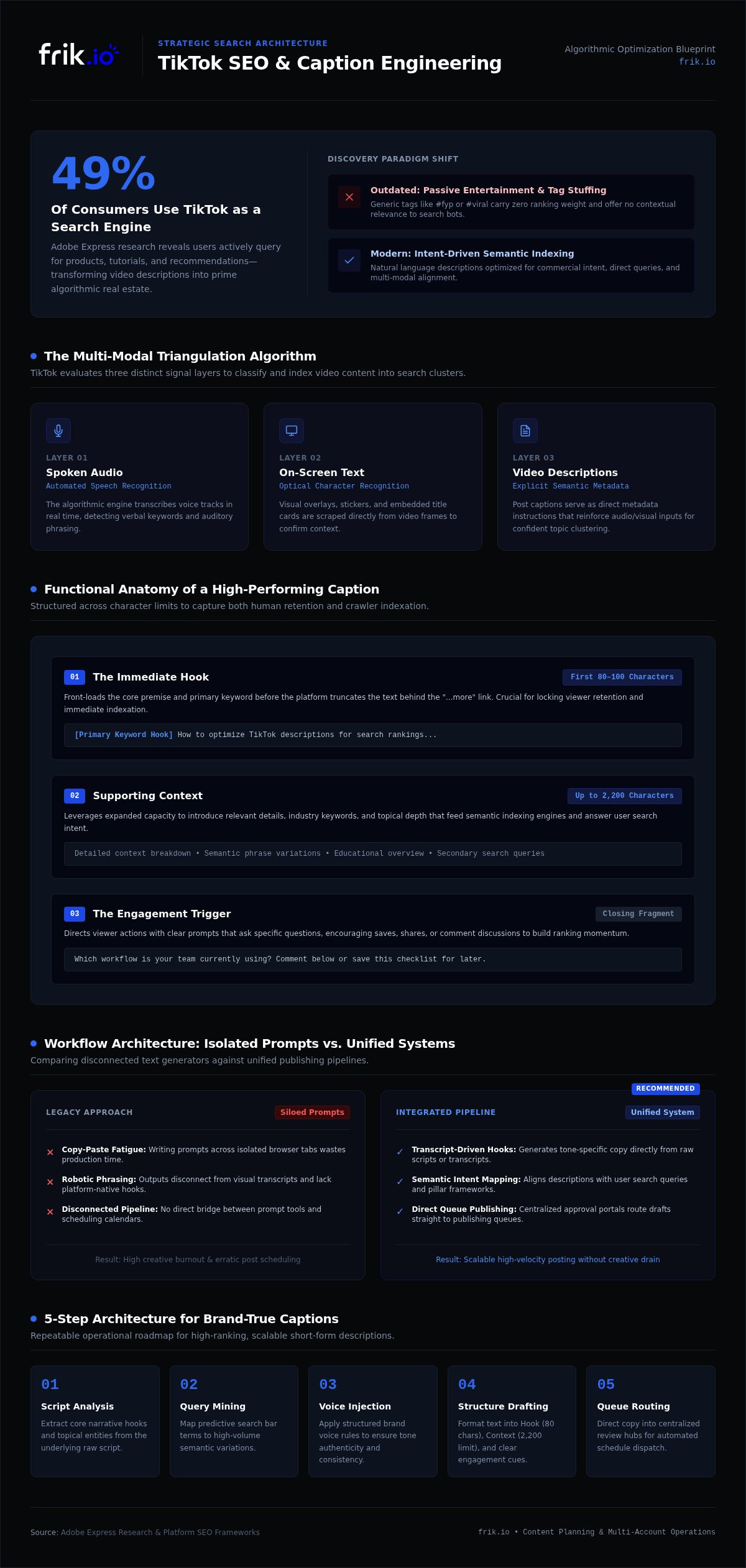
According to research from Adobe Express, 49% of consumers now treat TikTok as a search engine to find products, tutorials, and recommendations. That shift turns your video description from an afterthought into prime algorithmic real estate. Deploying an ai tiktok caption generator isn't about generating generic filler; it's about engineering platform-native hooks that stop the scroll and index your content the second it goes live.
You already know the exhaustion of writing dozens of platform-specific descriptions every week, only for standard text prompts to spit out robotic lines disconnected from your actual scheduling pipeline. Missing key search terms or hiding your value behind clumsy phrasing guarantees your videos get buried before viewers ever hit the cutoff button.
This guide reveals how an AI TikTok caption generator drives search discoverability, captures viewer attention within the critical first 80 characters, and integrates seamlessly into scalable publishing workflows. From multi-modal ranking signals to brand-true prompt architectures, here is your roadmap to transforming short-form descriptions into dependable growth engines.
Key Takeaways
- Deploy an ai tiktok caption generator to capture search intent and lock in critical hooks before the in-feed truncation cutoff.
- Drive algorithmic discoverability by structuring descriptions around semantic search queries instead of relying on outdated hashtag stuffing.
- Eliminate copy-paste fatigue by transitioning away from siloed browser prompts toward unified platforms that combine generation with direct publishing.
- Implement a repeatable prompt framework that embeds brand voice parameters, context, and clear viewer actions into every draft.
- Scale multi-account operations efficiently by routing AI-drafted copy directly through centralized approval portals into automated publishing queues.
What Is an AI TikTok Caption Generator and Why Do Creators Need One?
An ai tiktok caption generator is software that uses natural language processing to produce contextual, hook-driven descriptions for short-form video. While basic utilities confuse post descriptions with speech-to-text video subtitles, actual performance lies in the written copy directly beneath your clip. TikTok is no longer just a passive entertainment feed; it operates as an active search engine. Captions provide the indexable metadata that algorithmic crawlers read to categorize your media and match it with user queries.
Writing dozens of high-energy hooks every week drains marketing teams quickly. Creative fatigue leads to rushed, uninspired copy that ignores algorithmic search intent and tanks retention. A dedicated caption engine solves this bottleneck by turning core video concepts into platform-native copy in seconds, protecting team bandwidth while maintaining publishing cadence.
The Functional Anatomy of High-Performing TikTok Video Captions
High-converting descriptions rely on three distinct structural layers to capture users and search bots alike:
- The Immediate Hook (First 80-100 Characters): Front-loads the core premise and primary keyword before the platform truncates the text behind the "...more" link.
- Supporting Context: Leverages the expanded 2,200-character video limit to provide relevant details, industry keywords, and topical depth that feed semantic indexing.
- The Engagement Trigger: Directs viewer actions with clear prompts that ask specific questions, encouraging saves, shares, or comment discussions.
Generic descriptions like "Wait till the end!" offer zero search relevance and give viewers no reason to engage. Structural clarity earns rankings.
Overcoming the Creative Bottleneck in High-Velocity Publishing
Sustaining daily posting schedules across multiple accounts quickly depletes creative resources. High-velocity operations cannot afford writer's block when algorithm momentum requires continuous output. Modern short-form teams apply established prompt engineering techniques to extract dozens of tone-specific caption variations from a single video script or rough transcript. Instead of starting from scratch, strategists map these generated hooks back to organized content planning frameworks to balance product education, social proof, and trending discussions. This operational shift lets your team focus on narrative direction and video production while an ai tiktok caption generator systematically handles description drafting.
How TikTok SEO and AI Captions Drive Video Discoverability in 2026
TikTok discovers and ranks content through multi-modal triangulation. The platform's algorithm evaluates spoken audio via automated speech recognition, screen text via optical character recognition, and written descriptions as explicit metadata. When these three layers reinforce the same topic, the recommendation system assigns your video to specific search clusters. Relying on an ai tiktok caption generator ensures your written descriptions match what search crawlers look for across every release.
Modern short-form discovery rewards semantic clarity over hashtag volume. Overloading posts with generic tags like #fyp or #viral provides zero ranking weight. Instead, TikTok analyzes natural language syntax to determine context, pushing videos directly into user search results and suggested search bars at the top of comment feeds.
Decoding the Modern TikTok Search Engine Algorithm
Predictive search bars reveal exactly how the platform interprets user intent. When a viewer begins typing, TikTok surfaces complete queries based on popular demand and indexed content. High-intent commercial users rely heavily on these queries to evaluate products and compare services. Rather than guessing which phrases move the needle, top teams are moving beyond basic prompt engineering by feeding structured video concepts into specialized systems that extract high-volume semantic variations automatically.
Strategic Keyword Placement Inside Video Descriptions
Algorithmic crawlers index the entire 2,200-character description field, but human viewers only see the opening fragment during initial playback. Your keyword strategy must cater to both audiences simultaneously:
- The Critical Visible Window: Insert your primary target query within the opening 80 to 100 characters so users immediately understand the video's premise before truncation occurs.
- Semantic Body Context: Use the remaining characters to weave in secondary search phrases, core talking points, and related terms naturally without resorting to robotic keyword stuffing.
- Targeted Tag Selection: Limit tags to 3 to 5 niche-specific phrases that reinforce your primary keyword cluster rather than broad discovery tags.
Balancing search density with natural readability requires precision. Teams seeking consistent algorithmic indexing across multiple brand profiles often run their copy workflows through a centralized AI social media management platform to generate, optimize, and organize video metadata at scale.
Evaluating AI TikTok Tools: Single-Prompt Toys vs. Unified Workflows
Standalone AI chat interfaces feel fast until you map the complete publishing cycle. Pasting rough video concepts into isolated browser windows yields clever lines, but it creates operational friction downstream. An enterprise social strategy cannot scale on disconnected utilities. Professional operations require an ai tiktok caption generator connected directly to scheduling queues, team approval chains, and multi-profile workspaces.
Industry coverage on TikTok's evolution into a search engine highlights why modern teams need systematic execution. When captions function as indexable search metadata, drafting in isolation invites errors, misses critical keyword targets, and fractures brand tone across campaigns.
The Operational Hidden Costs of Standalone Caption Generators
Treating copy generation as an isolated task introduces severe operational friction across creative teams:
- Context Switching: Shuffling text between prompt tools, spreadsheets, review documents, and native uploaders squanders hours every week.
- Version Drift: Edits made during client or internal reviews fail to sync back to master drafts, resulting in unapproved or outdated copy going live.
- Security Exposure: Unvetted third-party text tools lack centralized role permissions, risking leaks of unreleased product messaging and proprietary brand assets.
Single-prompt utilities create organizational debt. Integrated pipelines eliminate it entirely.
The Power of Built-In Brand Voice Customization
Generic AI tools default to enthusiastic clichés, robotic punctuation, and cringey buzzwords that alienate TikTok communities. Captions must reflect authentic human personality to earn watch time. Deploying purpose-built AI brand voice generators solves this by enforcing specific tonal parameters across every draft. Modern engines ingest vocabulary preferences, banned phrases, and distinct audience personas. For agencies running multiple accounts, this capability ensures that an edgy streetwear label and a conservative B2B software firm maintain distinct linguistic identities within the same software ecosystem. Built-in tone governance transforms an ai tiktok caption generator from a novelty writer into an indispensable operational command center.
Five Steps to Prompting AI for Viral, Brand-True TikTok Captions
Vague inputs yield bland, generic descriptions. To get scroll-stopping copy from an ai tiktok caption generator, feed the engine precise constraints rather than open-ended requests. High-performing creators treat prompts as structured creative briefs, guiding the model through context, persona calibration, search targeting, hook divergence, and behavioral triggers.
Step 1 to 3: Setting Context, Audience Persona, and Search Intent
Establish the narrative foundation before demanding finished lines. Follow these initial setup steps:
- Step 1: State the Video Core Thesis: Open by defining the single specific problem your video addresses. Provide a two-sentence summary of the clip's visual narrative or paste a rough script outline.
- Step 2: Calibrate Voice and Persona: Outline the exact communication register. Specify whether the tone is deadpan, authoritative, punchy, or conversational, and list words your target demographic uses or avoids.
- Step 3: Define Explicit Search Terms: Dictate your primary and secondary keywords. Instruct the engine to weave these terms into natural conversational syntax rather than dumping them as raw tags.
Clear constraints eliminate robotic jargon immediately.
Step 4 and 5: Generating Hook Variations and Behavioral CTAs
Execution hinges on capturing attention within the opening line and driving immediate action before the viewer scrolls away.
- Step 4: Request Distinct Hook Angles: Command the engine to draft three specific opening variants within the first 80 characters: a curiosity-gap hook, a contrarian challenge, and a direct benefit promise. Comparing diverse angles lets you test what resonates best with your audience.
- Step 5: Enforce Action-Oriented Closers: Demand a closing call to action that sparks engagement in the comments. Avoid limp questions like "What do you think?" Instruct the AI to ask divisive, binary, or specific preference questions, such as "Which of these two workflows would you implement first?"
Always review the final draft to confirm character limits stay within platform thresholds. Teams looking to eliminate manual prompt engineering across daily campaigns can automate this process using brand-true AI content generation to build consistent, search-ready drafts directly inside their publishing calendar.
Scaling TikTok Video Operations with an Integrated AI Management Platform
Drafting punchy copy solves only half of the production equation. Scaling social performance requires operational continuity. When creative teams finish generating descriptions, manual handoffs often stall execution. An ai tiktok caption generator delivers maximum value when it lives directly inside your publishing engine rather than in an isolated tab.
Modern agencies juggle multiple brand accounts with divergent style guides, publication cadences, and review hierarchies. Unifying production under an AI social media management platform eliminates friction, connecting automated copy generation straight to client reviews and live feeds.
Streamlining Review Cycles with Dedicated Client Approval Portals
External review bottlenecks kill social momentum. Sending video attachments and draft captions through disjointed email threads or shared spreadsheets invites miscommunication and delays publication. Dedicated client approval portals replace these fragmented methods with clean, centralized review dashboards:
- Interactive Preview Workspaces: Present video assets and draft captions exactly as they appear in the mobile feed, giving stakeholders full visual context.
- One-Click Sign-Offs: Allow clients and internal directors to approve, reject, or request line edits instantly without navigating third-party spreadsheets.
- Strict Tone Governance: Protect brand equity by locking pre-approved voice rules, ensuring unvetted revisions cannot bypass established guidelines before scheduling.
Connecting Generation to Autopilot Scheduling
Once a description receives sign-off, manual copy-pasting should end. Re-entering text across disconnected scheduling tools introduces transcription errors, breaks hashtag formatting, and drains valuable team hours. Unified workflows bridge this divide through autopilot scheduling.
Approved video assets and descriptions transition directly from the review portal into the queue, automatically deploying to live feeds during targeted viewing windows. Platforms like frik.io unify brand-true AI drafting, interactive approvals, and autopilot scheduling into a single command center. This closed-loop setup turns your ai tiktok caption generator into an end-to-end operational engine, letting agile teams maintain high-velocity publishing schedules without creative burnout or operational chaos.
Transform Short-Form Descriptions into an Automated Growth Engine
TikTok captions are no longer afterthoughts; they represent high-value search metadata that connects your videos directly to high-intent audiences. Maximizing reach requires pairing front-loaded hooks inside the initial truncation cutoff with structured semantic keywords. Upgrading from isolated web prompts to a dedicated ai tiktok caption generator protects your voice and eliminates writer's block across high-velocity production cycles.
Scaling creative output shouldn't create operational chaos. Pairing brand-true AI content generation tailored to your exact voice with interactive client approval portals replaces messy spreadsheets with clean, one-click sign-offs. When approved copy feeds directly into autopilot scheduling across all your social channels, consistent short-form growth becomes your baseline. Streamline your social workflow with frik.io and take complete command of your publishing pipeline today.
Frequently Asked Questions
How does an AI TikTok caption generator improve video reach?
An ai tiktok caption generator expands video reach by structuring natural language descriptions around high-volume search queries. TikTok crawls post descriptions as explicit metadata to index content alongside spoken audio and on-screen text. Placing targeted keywords and compelling hooks within the description signals relevance to the recommendation engine, pushing your clips into top search results and recommended inquiry bars.
Can an AI TikTok caption generator match my specific brand tone?
Yes, advanced platforms allow you to train content models on custom style guides, target audience personas, and distinct vocabulary rules. Rather than delivering generic, overly hyped text, trained systems adapt their cadence to match witty, educational, or corporate tones. This ensures consistent brand positioning across hundreds of video releases without sounding robotic.
What is the ideal caption length for TikTok videos in 2026?
The ideal strategy combines a front-loaded opening hook of under 80 characters with an informative body of 150 to 300 words. While TikTok supports up to 2,200 characters for video uploads, viewers only see the opening line before in-feed truncation. Pack your primary hook up front, then use the remaining character allowance to add semantic keyword context for search bots.
Do AI-generated TikTok captions hurt engagement or algorithmic reach?
No, AI-assisted text descriptions do not incur algorithmic penalties or shadowbans on TikTok. Mandatory platform disclosures apply strictly to photorealistic synthetic media, deepfake video, and cloned audio. Written descriptions, script concepts, and hashtag groupings generated by AI remain entirely exempt from labeling requirements and perform based on user engagement signals.
How do I optimize TikTok captions for the platform search engine?
Optimize descriptions by front-loading your primary query within the first line of text, followed by 3 to 5 niche-specific hashtags. Avoid broad tags like #fyp that carry zero indexable weight. Instead, write clear contextual sentences explaining the clip's solution so algorithmic crawlers can easily match the video to viewer search queries.
Can I schedule TikTok videos directly after generating captions?
Yes, when you use a unified AI social media management platform rather than a standalone text prompt window. Platforms like frik.io route AI-drafted captions directly through collaborative client approval portals and into autopilot scheduling queues. This closed-loop process publishes approved videos and metadata to live feeds automatically, completely removing manual copy-pasting from your publishing pipeline.


