
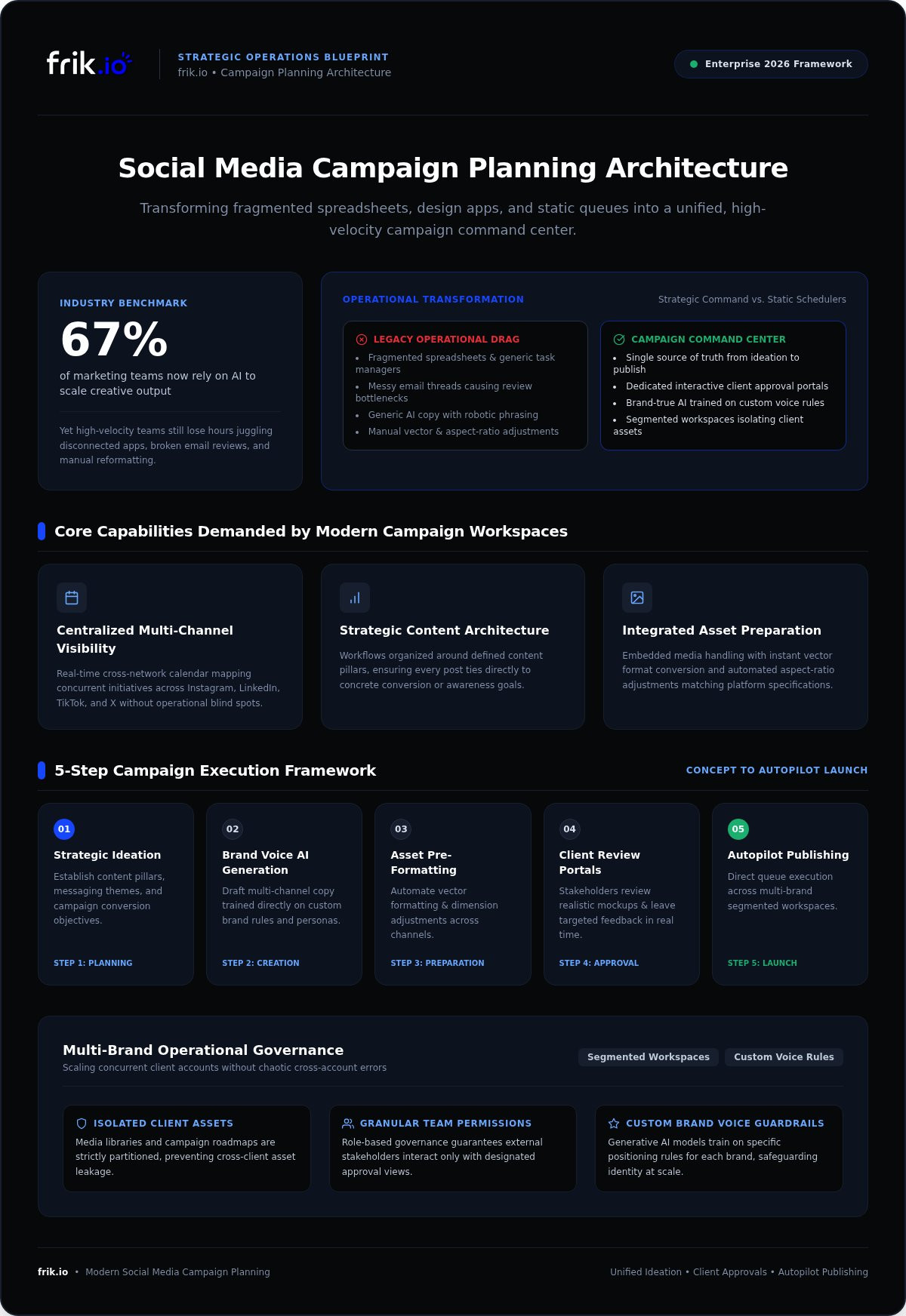
While 67% of marketing teams now rely on AI to scale their output, most high-velocity teams still lose hours juggling fragmented spreadsheets, design apps, and basic schedulers. When reviews stall in messy email threads and creative assets require tedious manual reformatting, operational drag kills momentum. A static calendar simply isn't enough to run high-impact launches. To maintain speed without sacrificing quality, you need a dedicated social media campaign planning tool that bridges the gap between strategic ideation and automated publishing.
You already know that orchestrating multi-channel campaigns shouldn't require jumping across disconnected apps. In this guide, you'll discover how top campaign planning tools streamline complex workflows from initial concept to client sign-off. We evaluate the leading platforms for 2026, examining how they centralize roadmaps, protect custom brand voice, and eliminate approval bottlenecks so your team can execute at scale.
Key Takeaways
- Move beyond static schedulers by choosing a dedicated social media campaign planning tool that unifies strategic ideation, content creation, and publishing in one workspace.
- Protect brand consistency across high-volume campaigns using AI generation trained directly on your custom brand guidelines.
- Eliminate spreadsheet review bottlenecks and accelerate sign-offs with dedicated, interactive client approval portals.
- Deploy a structured five-step roadmap to streamline multi-channel execution from concept development to autopilot scheduling.
- Isolate client assets, permissions, and style rules using segmented workspaces to scale multi-brand operations without chaotic cross-account errors.
What Is a Social Media Campaign Planning Tool?
A social media campaign planning tool is an integrated command center that unites strategic ideation, asset management, client approvals, and direct publishing into a single operational workspace. It replaces the fragmented patchwork of spreadsheets, generic task managers, and basic schedulers that high-velocity marketing teams frequently outgrow.
Basic post schedulers merely push finalized text and images to an API queue. In contrast, true campaign planning software orchestrates the entire operational lifecycle, turning strategic intent into live posts without manual handoffs. Managing multi-week launches inside static spreadsheets inevitably breeds version-control errors, broken copy links, and missed deadlines. Modern teams rely on active production engines where AI assistance and structured governance transform static calendar grids into automated workflows.
"A social media campaign planning tool is not a digital calendar; it is the strategic engine that aligns messaging themes, accelerates creative review, and executes cross-network distribution from a unified source of truth."
The Shift from Simple Schedulers to Campaign Command Centers
Simple schedulers handle tactical queue management, but they break down under the weight of high-stakes product launches. Multi-week initiatives require strict alignment with broader social media marketing principles, demanding message pacing, synchronized channel delivery, and strict asset versioning. When copy lives in Google Docs, creative assets hide in cloud storage folders, and dates sit in standalone schedulers, teams suffer immense operational drag. Modern campaign hubs eliminate this friction by anchoring all conversations, approvals, and media files directly to the scheduled deliverables.
Core Capabilities Every Modern Campaign Workspace Demands
High-velocity teams cannot afford disconnected point solutions. To maintain high output across multiple brands, modern campaign workspaces must deliver three foundational capabilities:
- Centralized Multi-Channel Visibility: Real-time cross-network calendar views mapping concurrent initiatives across Instagram, LinkedIn, TikTok, and X without blind spots.
- Strategic Content Architecture: Workflows organized around an established framework, making it simple to evaluate what is a content pillar so that every scheduled post serves a clear conversion or awareness objective.
- Integrated Asset Preparation: Embedded media handling, such as vector format conversion and automated aspect-ratio adjustments, ensuring visuals match distinct platform specifications instantly.
Connecting strategic planning directly to automated execution stops operational chaos before it starts. This foundation guarantees that marketing teams spend less time managing files and more time driving commercial growth.
Essential Features to Look for in Social Campaign Software
High-velocity marketing teams cannot rely on generic task software to orchestrate rapid multi-channel launches. While basic project management platforms organize static deadlines, a specialized social media campaign planning tool must unite generative speed with strict publishing controls. Modern campaign software requires integrated capabilities that accelerate production while safeguarding the brand across every social touchpoint.
AI Generation Grounded in Brand Voice Guidelines
Generic generative AI often defaults to robotic phrasing, repetitive vocabulary, and superficial insights. Deploying generic copy across dozens of campaign posts dilutes market authority and damages trust. High-performing teams rely on Brand-True AI Content Generation that trains directly on custom brand parameters, target personas, and positioning rules. Implementing a dedicated AI brand voice tool ensures that drafted captions automatically reflect approved messaging tone, eliminating hours of repetitive editorial rewrites.
Collaborative Workflows and Dedicated Client Approval Portals
Approval bottlenecks routinely derail time-sensitive marketing pushes. Routing creative drafts through shared spreadsheets or disjointed email threads leads to conflicting feedback, delayed launch dates, and missed engagement windows. Modern campaign platforms eliminate this friction through interactive review environments:
- Interactive Review Spaces: External stakeholders review realistic post mockups within dedicated Client Approval Portals, leaving targeted feedback in real time without creating separate platform logins.
- Granular Permission Safeguards: Role-based access controls separate drafting teams from decision-makers, guaranteeing unapproved creative assets never deploy prematurely.
- Audit-Ready Activity Trails: Centralized version logs record every revision, ensuring total transparency across agency teams and brand managers.
Dynamic Scheduling and Cross-Platform Formatting
A comprehensive social media content plan requires adapting creative assets to distinct network requirements without manual reformatting. Modern platforms automate this tedious asset prep. Integrated utilities like an SVG Converter Tool instantly optimize vector graphics into platform-compliant images, saving valuable design hours. Simultaneously, Autopilot Scheduling engines analyze optimal engagement windows to release campaign assets across networks without manual intervention.
Agile teams seeking to unify strategy, asset prep, and automated distribution can deploy an all-in-one workspace like frik.io to eliminate operational drag and protect brand consistency from day one.
Comparing the Best Social Media Campaign Planning Tools for 2026
Selecting the right social media campaign planning tool requires evaluating how effectively software balances planning depth, creative automation, and everyday usability. Teams often find themselves caught between rigid enterprise suites and disconnected generic task boards. A modern command center must bridge this operational divide, translating high-level strategy directly into published assets without manual friction.
| Tool Category | Planning Depth | Content & Asset Automation | Client Approvals | Native Publishing |
|---|---|---|---|---|
| Specialized AI Command Centers (frik.io) | High (Integrated roadmaps & pillars) | High (Brand-true generation & SVG conversion) | Native client portals (No login needed) | Direct API cross-network execution |
| Generic PM Software (Asana, Monday) | High (Kanban & Gantt boards) | None (Manual external creation) | Requires paid guest seats or exports | None (Requires third-party sync) |
| Legacy Enterprise Suites | Moderate to High (Complex workflows) | Basic to Moderate (Generic AI assists) | Multi-tier internal approval paths | Direct API publishing |
Frik.io: The AI-Powered Command Center for Agile Teams
Agile teams and agencies frequently outgrow basic schedulers yet find legacy suites too bloated. Built specifically as an ai social media management platform, frik.io merges drafting, brand-aligned generation, and direct publishing into one smooth flow. Dedicated Client Approval Portals let external stakeholders review realistic mockups and sign off instantly, while Autopilot Scheduling handles time-optimized distribution across accounts.
Generic Project Management Platforms: Strengths and Limitations
Generic project tools like Asana, Monday.com, and Teamwork excel at tracking operational deadlines, team capacity, and overall deliverables. Yet they fall short as complete campaign solutions because they lack direct connections to social media networks. Teams must manually copy approved captions, export media files, and paste everything into a secondary scheduler. This disconnect creates double data entry and increases the risk of publishing outdated creative revisions.
Enterprise Social Suites vs. Modern Lightweight Workspaces
Traditional corporate platforms provide robust governance for massive organizations with hundreds of stakeholders. However, these platforms often saddle smaller, fast-moving teams with multi-month rollouts, rigid per-seat billing, and excessive interface complexity. Modern agile workspaces prioritize velocity. They replace steep learning curves and heavy administrative overhead with intuitive visual workflows, automated asset handling, and responsive scheduling that matches how modern social teams actually work.
How to Build and Execute a Campaign Roadmap: 5-Step Framework
Executing high-impact launches requires a repeatable operating framework. Without structured execution, even bold creative concepts stall in endless revisions. A dedicated social media campaign planning tool brings discipline to your process, transforming abstract ideas into live assets through five clear stages:
- Define Core Strategy: Establish campaign themes, commercial goals, and primary channel allocations.
- Generate Aligned Copy: Produce platform-tailored post variations using brand-governed AI assistance.
- Centralize and Convert Visuals: Consolidate brand assets and format them across target dimensions.
- Gather Frictionless Approvals: Collect stakeholder sign-offs via interactive client portals.
- Automate Cross-Network Distribution: Trigger scheduled publishing queues using automated calendar controls.
Phase 1: Concept Ideation and Content Pillars
Begin by anchoring every deliverable to verified audience challenges rather than guesswork. Map your overarching campaign message across your primary content pillars, establishing why each post exists. Next, determine your channel distribution. Professional B2B angles belong on LinkedIn, while high-velocity hooks, vertical videos, and behind-the-scenes content perform best on Instagram and TikTok. Set realistic publishing milestones, establish delivery cadences, and define strict production deadlines before drafting begins.
Phase 2: High-Velocity Asset Production and Approval
Speed defines competitive content teams. Once your roadmap is set, draft native post hooks tailored to the conversational culture of each network. Brand-governed AI generation speeds up this phase dramatically, generating multiple caption angles that adhere strictly to your pre-configured tone rules.
Graphic workflows require equal precision. Instead of manually exporting multiple image variations from external design software, teams can use an integrated SVG Converter Tool to process vector graphics directly inside the workspace. This tool instantly formats vector files for clean rendering across standard square, portrait, and landscape ratios.
Once assets are ready, bypass chaotic email threads completely. High-velocity teams send live preview links via dedicated Client Approval Portals. Clients see exact post mockups, leave targeted feedback, and approve scheduled deliverables with a single click. Finally, Autopilot Scheduling queues the approved content for automated delivery at peak engagement windows.
Ready to streamline your production roadmap? Start building your campaign roadmap with frik.io and launch multi-channel initiatives in record time.
Scaling Multi-Brand Campaigns Without Operational Chaos
Agencies and multi-brand marketing teams face severe operational risks as their client portfolios grow. Managing distinct brand identities across disconnected accounts often results in cross-posting blunders, lost creative assets, and communication breakdowns. A modern social media campaign planning tool solves this friction through strict workspace segmentation. Isolating brand guidelines, tone parameters, and media assets into dedicated environments ensures complete account security while allowing unified teams to execute campaigns at high velocity.
Eliminating the Client Approval Bottleneck
Shared master spreadsheets create massive liability during external review phases. Stakeholders frequently overlook tracked changes, accidentally edit locked copy formulas, or struggle to visualize final mobile feed layouts. Dedicated Client Approval Portals replace these fragile sheets with self-serve, interactive review environments:
- Interactive Post Simulations: Clients preview pixel-perfect mockups reflecting actual feed appearances across mobile and desktop interfaces.
- Frictionless Feedback Loops: Stakeholders approve drafts or request specific copy adjustments with one click, requiring zero software logins or onboarding.
- Compressed Review Windows: Real-time notifications shrink review cycles from multiple business days down to minutes, ensuring scheduled launch windows are never missed.
Unifying Strategy, Drafting, and Execution in One Command Hub
Tool fatigue drains team efficiency. Jumping between separate applications for copywriting, asset conversion, project tracking, and publishing drains creative momentum and invites human error. Consolidating these fragmented stages into a single command hub transforms daily operations.
Automated queue management guarantees that concurrent brand launches never collide or suffer erratic delivery gaps. Instead of managing manual spreadsheets and checking upload links, marketing teams can focus on strategic positioning and conversion metrics. Deploying a dedicated social media campaign planning tool establishes the operational foundation needed to scale client rosters effortlessly without sacrificing creative quality.
Take Command of Your Campaign Execution
Scaling multi-channel marketing no longer requires sacrificing operational sanity. High-velocity teams quickly outgrow manual spreadsheets and disconnected point tools because they create bottlenecks right when speed matters most. Adopting a dedicated social media campaign planning tool bridges this divide, transforming chaotic launch roadmaps into predictable, synchronized production engines. You can now align strategic pillars, gather feedback, and execute cross-network distribution from a single source of truth.
Trained Brand-True AI Content Generation keeps every campaign post strictly on-brand, eliminating hours of repetitive revisions. Zero-friction Client Approval Portals eliminate spreadsheet review chaos by letting external stakeholders sign off on realistic post previews with a single click. Combined with hands-off Autopilot Scheduling that delivers cross-platform posts at optimal engagement windows, your team gains the freedom to focus on commercial impact. Streamline your campaigns with frik.io today and equip your marketing team with the ultimate command center for modern growth.
Frequently Asked Questions
What makes a social media campaign planning tool different from a regular scheduler?
A dedicated social media campaign planning tool orchestrates strategy, content drafting, visual asset management, and approvals before publishing, whereas a regular scheduler simply queues pre-finished posts. Schedulers function merely as tactical timers. Modern campaign platforms connect overarching messaging themes directly to publishing APIs, letting agile teams collaborate on roadmaps, optimize graphics, and manage stakeholder feedback in one workspace without jumping across disconnected apps.
How does an AI brand voice generator keep campaign messaging consistent?
An AI brand voice generator enforces tone consistency by training directly on your custom brand guidelines, positioning rules, and audience personas. Rather than producing generic, repetitive copy, it generates multi-channel variations that reflect your established voice. Whether you are drafting a technical thought-leadership post for LinkedIn or a punchy caption for Instagram, every update maintains recognizable brand integrity without requiring hours of manual editing.
Can marketing agencies manage multiple clients within a single planning platform?
Yes, modern platforms provide dedicated workspace segmentation designed specifically for multi-brand management. Each client workspace operates as an isolated environment housing unique brand voice profiles, asset libraries, connected social accounts, and approval settings. Team members can switch between client accounts smoothly while role-based permissions ensure internal drafts and communications stay strictly separated, preventing accidental cross-posting and protecting client confidentiality.
Why should teams stop using spreadsheets for social media campaign planning?
Spreadsheets create severe operational friction because they lack live post previews, direct publishing connections, and automated version control. Relying on static sheets forces teams to manually copy text into external schedulers, which introduces version errors and broken links. Upgrading to an active social media campaign planning tool eliminates redundant data entry, centralizes creative assets alongside copy, and allows instant updates across entire multi-week roadmaps.
How do client approval portals protect agencies from unauthorized post publishing?
Client approval portals create a secure, gated workflow that blocks scheduled content from publishing until stakeholders grant explicit sign-off. External clients review realistic post mockups via dedicated links without needing platform logins or complex onboarding. Drafts remain locked in review status until approved, protecting your agency from publishing unvetted creative revisions, incorrect client links, or unfinished promotional assets prematurely.
What social networks should our campaign planning software support in 2026?
Your platform should support YouTube, Facebook, Instagram, LinkedIn, TikTok, and X to cover the full spectrum of modern digital reach. High-velocity campaigns require synchronized multi-channel delivery across both video-heavy discovery platforms and text-focused professional feeds. Look for tools that not only connect to these major networks via official APIs but also provide tailored caption formatting and aspect-ratio tools for each channel.


