
More social posts won’t fix a strategy that has no clear link to your business goals. If your content feels disconnected, or you’re unsure which platforms deserve your limited time, learning how to create a social media marketing plan starts with focus, not a fuller calendar.
A useful plan turns what you know about your audience into content and measurable action. It clarifies what you’re working toward, where you’ll show up, and how you’ll keep publishing without rebuilding the process every week.
This guide walks you through setting goals, understanding your audience, choosing platforms, and defining content priorities. You’ll also build a repeatable workflow for drafting, reviewing, scheduling, and publishing posts, then choose measures that help you decide what to adjust. Tools can keep the work organized: brand-voice AI can support first drafts, while human review keeps content accurate and aligned with your brand. The result is a social media marketing plan you can put to work and improve over time.
Key Takeaways
- Learn how to create a social media marketing plan that connects each social objective to a business outcome and a clear audience action.
- Use audience needs and team capacity to decide which channels deserve priority.
- Shape recurring themes and campaign priorities into platform-appropriate content that gives each post a purpose.
- Assign owners, reviewers, and deadlines so content can move from brief to publication without workflow gaps.
- Use performance insights to refine your plan, while a centralized workspace can support drafting, approvals, scheduling, and publishing.
What a social media marketing plan does, and what yours needs to accomplish
Reactive posting is easy to fall into. Someone spots a timely idea, publishes it, and moves on. Without a clear purpose or process, those posts can become disconnected from the business priorities social media is meant to support. A practical plan replaces guesswork with decisions your team can use, review, and adjust.
Social media marketing is the use of social platforms to connect with audiences and support marketing goals. For a foundational overview, see Social Media Marketing on Wikipedia. A working plan makes that broad idea operational by recording the decisions, actions, owners, and measures that guide your social activity.
Strategy sets the direction; the plan defines the channels, content, cadence, responsibilities, and review cycle that put it into practice. You don’t need a lengthy document. You need a reference that helps people decide what to publish, why it matters, who moves it forward, and how to learn from the results.
What belongs in a useful social media marketing plan?
Start with six elements. Each answers a practical question your team will face:
- Business objectives: What priority should social activity support?
- Audience: Whom are you trying to reach, and what do they need?
- Selected channels: Where can you reach that audience in a way your team can sustain?
- Content themes: What relevant subjects will you return to?
- Workflow: Who drafts, reviews, schedules, and publishes each post?
- Success measures: What signals will show whether the activity is helping?
Keep the plan proportionate to your capacity. A small team may give one person several responsibilities, while a larger team may distribute them across roles. Either way, name an owner and set a workable cadence instead of planning more content than you can maintain. Treat the plan as a living tool: review the evidence, then update priorities, content, or workflow as you learn.
How a plan connects social activity to business priorities
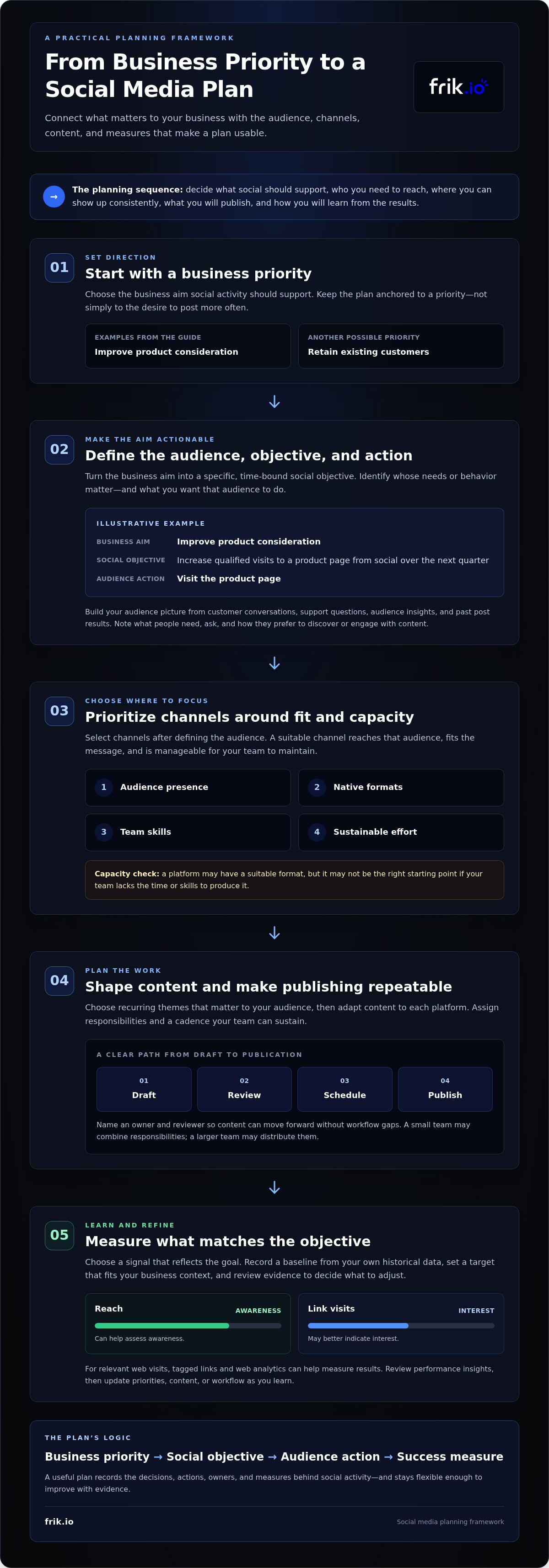
Build a clear chain: business priority → social objective → audience action → success measure. This makes each activity easier to evaluate and prevents a common mistake: treating frequent publishing as proof of progress.
Illustrative example: If a business priority is to increase awareness of a new service, the social objective might be to help more relevant prospects understand what it does. The audience action could be watching an explainer or visiting a service page. Track relevant views or visits alongside the publishing schedule to see whether the content is reaching its intended audience. These measures provide a more useful signal than post count alone.
Posting more often doesn’t show whether the intended audience saw, understood, or acted on your message. Use the connection between priorities and audience actions as the foundation for how to create a social media marketing plan that guides decisions instead of simply filling a calendar.
Set social media goals, define your audience, and prioritize channels
Make these decisions in order: choose the business priority, define the audience whose actions could support it, then select channels your team can use consistently. This sequence keeps platform popularity from driving the plan. A channel is a good fit when your audience is there, its content formats suit your message, and your team has the capacity to maintain it.
Turn business priorities into measurable social media goals
Start with a broad business aim, such as improving product consideration or retaining existing customers. Then make the social objective specific and time-bound. For example, a team focused on product consideration might aim to increase qualified visits to a product page from social over the next quarter. The desired audience action is clear: visit the page. Tagged links and relevant web analytics can help measure those visits.
Choose a measure that matches the objective, not every number a platform reports. Reach can help assess awareness; link visits may better indicate interest. Record a baseline from your own historical data, then set a target that fits your business context. Forbes' Ultimate Guide to Social Media Marketing also covers the value of consistent, audience-focused activity. Use that principle to set a cadence you can sustain, rather than a target based only on publishing volume.
Choose social media channels around audience and capacity
Define the audience before choosing platforms. Note who they are, what they need, what questions they ask, and how they prefer to discover or engage with content. Use customer conversations, support questions, audience insights, and past post results to build a practical picture. Don’t assume your audience is equally active on every network.
Compare potential channels against four criteria: audience presence, native formats, team skills, and sustainable effort. A platform may offer a suitable format, but if producing it requires skills or time your team doesn’t have, it may not be the right starting point. Forbes' guide can help frame consistency as part of the decision, while a strategic guide to content pillars can help you shape recurring themes once your audience and channel priorities are clear.
Use this compact checklist to capture your decisions:
- Objective: Which business priority will social support, and what measurable outcome will you target by when?
- Audience: Whose needs or behavior make that outcome relevant? What action do you want them to take?
- Channel criteria: Is the audience present? Does the channel’s format fit? Do you have the skills and time to publish reliably?
Keep the list manageable. Choose the channels you can serve well, then compare results with your baseline and adjust as evidence accumulates. Bring channel choices and recurring themes into one practical workspace by organizing your social content plan alongside your publishing workflow.
Build a social media content plan that fits each platform
Turn audience insights and business priorities into a content mix with a clear purpose. Start with recurring themes, sometimes called content pillars. Each theme is a broad subject your brand can return to, grounded in an audience need or question. For example, a software company might cover workflow challenges, practical how-to advice, customer questions, and product use cases. Keep themes broad enough to inspire multiple posts, but specific enough to guide what you create. A guide to creating content pillars can help you define them without overcomplicating your plan.
Give each post a job. Educational content answers a question; community-focused content invites people to share perspectives; brand content shows how you work; promotional content explains an offer or next step. Balance these purposes according to your goals and audience needs instead of relying on just one type of post. A consistent voice helps the mix feel cohesive. A guide to creating AI brand-voice content can show how a style guide supports consistent drafts while leaving room for human review.
Adapt content formats to the channels you prioritize
Choose formats based on the idea, audience behavior, and channel context. Short-form video can demonstrate a process or deliver a quick explanation. Static visuals can make one point easy to scan. Carousels can break a sequence into steps, while text-led posts can frame an opinion or invite discussion. Repurpose the underlying idea, not an identical post: adjust the opening, format, detail, and audience action for each channel.
The comparison below is a starting point, not a platform rulebook. Match each format to the channels your team has chosen and adapt it to how people use them.
| Post purpose | Suitable format | Channel adaptation | Intended audience action |
|---|---|---|---|
| Explain a useful process | Short-form video | Show the steps visually; add a concise text summary where useful | Watch, save, or try the process |
| Share a quick tip | Static visual | Make the key point clear at a glance; tailor caption length | Save or share |
| Teach a sequence | Carousel | Organize one idea into a logical series of slides | Swipe through or revisit |
| Invite a discussion | Text-led post | Lead with a clear question or perspective suited to the channel | Comment or respond |
Use a sample week to check your content mix
Illustrative sample week: Map ideas across a week to test variety, not to prescribe a universal posting frequency. A team might plan an educational video, a quick visual tip, a text-led audience question, and a carousel that expands on a recurring theme. If a campaign is active, include a promotional post with a relevant audience action. This structure makes how to create a social media marketing plan easier to apply: each idea has a purpose, a format, and a channel-specific treatment.
Turn the plan into a publishing workflow and measurement cycle
A plan becomes useful when people can move each post from idea to publication without guessing what happens next. Keep the process visible and lightweight: assign responsibility, set a deadline for each handoff, and make the next step clear. In a small team, one person might draft and schedule while another reviews. In a larger team, those tasks may sit with different people.
Create a realistic calendar with clear owners and approvals
Use a shared calendar or workspace to track the details needed to publish and assess every post. At minimum, record the channel, publish date, purpose, format, owner, and status. Add a draft or brief link when it helps reviewers find the current version. Keep status labels simple, such as planned, drafting, in review, approved, and published.
Map the workflow from brief to analysis. The brief captures the intended audience, purpose, and action. The draft turns that direction into platform-ready content. Review checks accuracy, brand voice, and fit. Scheduling and publishing put the approved post live, and analysis captures results for the next cycle. Give each stage an owner and deadline. For client-facing work, include a clear approval checkpoint before scheduling. Avoid extra review steps unless they address a real risk or coordination problem.
Batch related tasks to reduce context switching. For example, draft several posts around one theme, then review them together. Leave some calendar capacity open for timely updates or reactive content, so planned work doesn’t make the team slow to respond. This creates a plan that supports consistency without locking every post into a rigid schedule.
Measure results and decide what to adjust next
Review performance against the objective for each post or campaign. Reach can help assess awareness; engagement can indicate interaction; clicks can show interest in a next step; conversions can measure a completed business action when tracking is available. Don’t treat every metric as equally useful. Compare the selected measure with your own baseline and target, not an unrelated industry benchmark.
Set a regular review point that fits your publishing cycle. A brief weekly check can catch workflow issues, while a deeper monthly or campaign-end review can reveal patterns. Ask whether the audience took the intended action, which topics or formats earned a meaningful response, and where work stalled before publication. Record one decision for the next cycle, such as adapting a format, clarifying a call to action, or changing the review handoff. This keeps reporting tied to action. For more detailed reporting ideas, explore this 2026 social media analytics guide for agencies.
A centralized workflow can connect drafting, review, scheduling, publishing, and analytics in one place. Manage your social publishing workflow with frik.io to keep execution and measurement connected.
Put your social media marketing plan into action with frik.io
Your plan now has the inputs that guide daily execution: business objectives, audience priorities, selected channels, content themes, assigned owners, a publishing cadence, and measures for reviewing results. The next challenge is keeping those decisions connected as posts move from idea to publication. A shared workspace can turn the plan from a document people refer to occasionally into a practical operating system.
Connect your plan to a shared content workspace
Use one workspace to organize planned content and its progress across networks. Keep each post tied to its purpose, channel, owner, and scheduled date so the team can see how individual tasks fit the broader plan. frik.io supports drafting, tailoring, reviewing, scheduling, and publishing content across multiple social networks from a centralized workspace.
AI can help turn a brief into a first draft. frik.io’s AI can reflect a brand’s voice and use a team’s style guide, giving writers a more consistent starting point. Treat the output as draft material, not a final decision. A person should check accuracy, context, audience fit, and brand expression before the content moves forward.
One idea may need a different opening, format, or level of detail on each channel. Tailor posts for different platforms from the same workspace, reducing the need to prepare each version in a separate process. Keep the core message consistent, then adapt the execution to the platform and the audience action you want to encourage.
Keep review, scheduling, and publishing moving
Build approval into the workflow instead of chasing feedback across scattered conversations. frik.io’s client approval portals support collaborative review, giving teams and clients a dedicated way to review planned content. Set a clear reviewer and deadline, and define what counts as approved so posts don’t stall at the handoff.
Once content is approved, scheduling and publishing help the team follow its planned cadence. This is useful when several people contribute or posts are prepared in batches: everyone can see what is ready and what still needs attention. Scheduling supports consistency, but it doesn’t remove the need to monitor posts or respond to relevant audience activity.
After publication, use multi-platform analytics to assess the measures already chosen in your plan. Compare results with your baseline and objective, then carry the learning into the next cycle. If a format drew attention but didn’t prompt the intended action, revise the content or call to action instead of simply increasing output.
A workflow tool should support the plan, not replace its judgment. frik.io brings brand-voice drafting, platform tailoring, approval, scheduling, publishing, and analytics into a connected process. Put your plan into motion with frik.io’s social media management workspace.
Make your next post the start of a stronger system
A social media plan becomes more valuable each time you use what you learn to make the next decision. Start with one upcoming post or campaign. Put its purpose, audience action, and success measure into practice, then use the results to refine your workflow. That steady cycle turns how to create a social media marketing plan from a one-time exercise into a capability your team can keep improving.
frik.io helps put that process into motion. AI drafts can draw on your team’s style guide to reflect your brand voice, while people retain control over edits and approvals. Client approval portals support collaborative review, and scheduling, publishing, and multi-platform analytics keep execution and learning connected in one platform.
Build a more focused social media workflow with frik.io, and take your plan from intention to action. Start with a manageable scope, publish consistently, and use each review to make the next cycle clearer.
Frequently Asked Questions
What should a social media marketing plan include?
A useful plan should also capture the practical details that prevent confusion during execution: campaign dates, key links or assets, brand guardrails, and a backup option if a planned post becomes unsuitable. For example, note which approved product page a campaign post should link to and who can supply a replacement visual. These details make the plan easier to use when deadlines shift or an idea needs a quick update.
How often should you update a social media marketing plan?
Review it regularly, then make changes when meaningful evidence or business priorities shift. A monthly check can surface posts that repeatedly miss their intended audience action; a quarterly review can prompt broader changes to channel focus or campaign themes. Update sooner if a product, audience need, or team capacity changes. Keep a brief note of what changed and why, so future decisions have context.
How many social media platforms should a business use?
Use the number of platforms your team can support well, rather than aiming for a fixed count. A business with limited production time might begin with one primary channel and add another only when it can adapt content and respond there consistently. Review whether each channel contributes distinct audience or business value. If two channels require effort but produce no useful learning or action, reconsider the allocation.
How do you set social media marketing goals?
Start with a business need, then define a social outcome that can contribute to it. For example, if people need more confidence before choosing a service, a goal could focus on increasing visits to a detailed explainer page. Decide what evidence would indicate progress before publishing, and make sure the target is realistic for your audience and resources. Avoid goals such as “get more likes” unless likes connect to a meaningful objective.
What is the difference between a social media strategy and a plan?
A strategy explains the reasoning behind your social activity: whom you want to reach, what value you offer, and what role social media plays in the business. The plan translates that direction into coordinated work. For instance, a strategy may prioritize helping customers understand a complex service; the plan identifies the campaign, content sequence, publishing responsibilities, and review point that support that priority.
How do you measure whether a social media marketing plan is working?
Check whether social activity is contributing to the outcome it was designed to support, not just whether individual posts attracted attention. For a lead-generation effort, look beyond reactions to the path from post to landing-page visit and completed inquiry, where tracking allows. Compare similar campaigns or formats over time, and investigate changes in audience, timing, or offer before drawing conclusions from a single post.
Can a small business create a social media marketing plan without a dedicated marketing team?
Yes. A small business can build a workable plan by keeping its scope narrow and combining responsibilities where needed. One person might own the calendar, draft posts, and check results, while a business lead reviews sensitive claims or campaign priorities. Set aside recurring time for preparation, and use a lightweight document or calendar to prevent ideas from getting lost. Learning how to create a social media marketing plan is manageable when the process fits the team you have.


